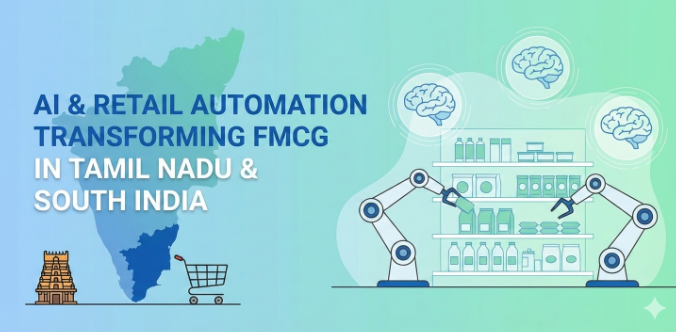
A Retail-First Perspective on the Next Phase of FMCG Growth
Tamil Nadu and South India have long been home to some of India’s most respected FMCG and food brands. The region plays a critical role in staples, spices, dairy, edible oils, and personal care — categories that move at high velocity and depend heavily on retail execution.
Staples and masala leaders such as Aachi, Sakthi Masala, and MTR, dairy and fresh product enterprises like Hatsun, edible oil and ghee brands such as GRB, and personal care players including CavinKare all operate in environments where scale is already achieved, but operational intelligence is now the differentiator.
This marks a clear shift:
growth is no longer constrained by demand, but by how effectively retail operations are managed.
Why AI Matters More Now Than Ever for FMCG Brands
AI is increasingly influencing FMCG strategy from demand forecasting to supply chain optimisation and consumer analytics. However, for South Indian FMCG enterprises, the most immediate and tangible impact of AI is at the retail layer.
Retail systems that unify billing, inventory, and analytics provide the clean, structured data required for AI to function meaningfully. Without this foundation, AI initiatives struggle to move beyond dashboards.
For high-SKU environments — common among masala, staples, and packaged food brands — automation at retail becomes the starting point for any intelligent transformation.
The Retail Execution Challenge in South India’s FMCG Ecosystem
Despite strong manufacturing capabilities, many FMCG brands continue to face challenges once products reach retail.
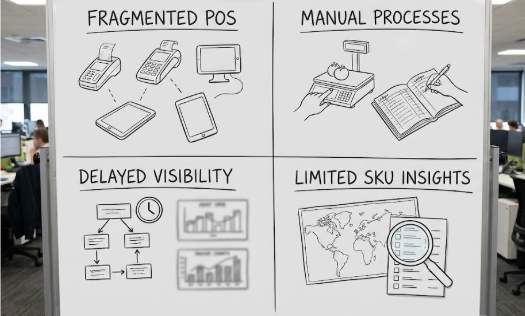
Across categories, common gaps include:
- Fragmented POS systems across stores and distributors
- Manual billing and weighing at high-volume counters
- Delayed visibility into secondary and tertiary sales
- Limited SKU-level insights across geographies
For spice and staples brands like Aachi, Sakthi Masala, and MTR, even small inefficiencies at retail multiply rapidly due to volume.
For dairy-focused enterprises such as Hatsun, freshness, accuracy, and turnaround time are critical.
For personal care brands like CavinKare, retail visibility directly impacts promotion effectiveness and shelf performance.
These realities make retail automation not just beneficial, but necessary.
Why Retail Automation Is the Missing Link
Retail automation bridges the gap between enterprise planning and on-ground execution.
When retail workflows are unified:
- Billing data becomes available in near real time
- Inventory movement is tracked accurately
- Checkout speed improves in high-footfall stores
- Store-level data feeds enterprise analytics reliably
This is particularly important for edible oil and ghee brands like GRB, where pricing accuracy, weight-based billing, and fast throughput influence both margins and consumer trust.
Enterprise-ready retail platforms enable brands to scale without introducing operational complexity.
Key Areas Where AI & Automation Are Driving Impact
1. Intelligent Billing and Checkout
High-volume grocery and supermarket environments benefit from fast, reliable billing systems that minimise manual intervention. This is especially relevant for staples, spices, and daily-use categories.2. Inventory and Shelf-Level Visibility
Automated inventory systems improve stock availability across stores. A critical requirement for brands with wide SKU portfolios and regional demand variations.3. Fresh Category & Weighing Automation
For dairy and fresh categories, smart weighing integrated with billing removes dependency on staff expertise, improving accuracy and speed at the counter.4. Data-Driven Analytics for Decision-Making
Unified retail analytics help FMCG brands understand:- SKU performance by region
- Store-level sales trends
- Promotion effectiveness across formats
Track & Trace: A Growing Priority Across FMCG Categories
Track & trace is becoming increasingly relevant across:
- Food and spice manufacturing
- Dairy and perishable goods
- Edible oils and packaged foods
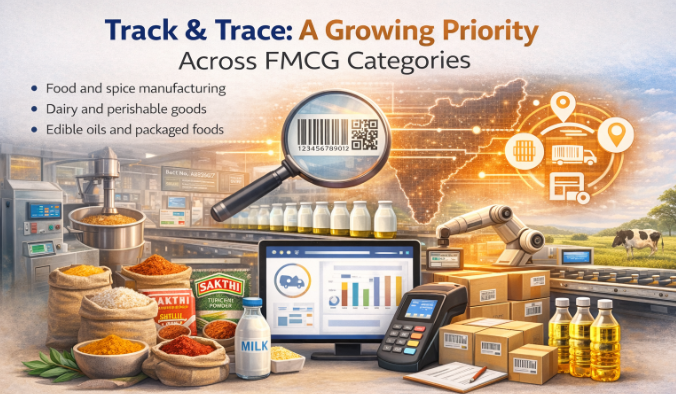
For FMCG enterprises operating at South Indian scale, automation enables batch-level traceability without adding manual overhead. When retail data is integrated with enterprise systems, traceability becomes a source of insight rather than a compliance burden.
Uniprotech’s Perspective: Retail-Ready Platforms for FMCG Scale
At Uniprotech, we believe AI delivers value only when supported by retail-first automation and unified enterprise platforms.
Our experience across large retail and enterprise environments consistently reinforces three principles:
- Unified systems outperform disconnected tools
- Automation reduces friction without disrupting existing workflows
- Flexible deployment – cloud, on-prem, or hybrid – is essential for enterprise adoption
This approach allows FMCG brands and retail partners to modernise incrementally while remaining future-ready.
What This Means for Tamil Nadu & South Indian FMCG Brands
As competition intensifies, the next phase of FMCG growth will depend on:
- Faster retail execution
- Higher data accuracy across the value chain
- Stronger collaboration between brands and retailers
- Scalable systems that support expansion without complexity
For regional FMCG leaders, retail automation is becoming the foundation for sustainable growth.
Final Thought: From Scale to Intelligence
Tamil Nadu and South India have already built FMCG businesses of remarkable scale. The next phase of leadership will be defined by how intelligently that scale is managed.
AI-enabled retail automation enables FMCG enterprises to move from fragmented execution to connected intelligence transforming retail data into a strategic asset.
About Uniprotech
Uniprotech builds enterprise-grade Retail POS, ERP, and automation platforms designed for high-scale FMCG and retail ecosystems, supporting modern trade, distributor-led retail, and multi-store operations with flexible cloud and hybrid deployment models.

 Book your demo
 Talk to our POS experts
- 📧 Email: salesenquiry@uniprotech.co.in
Run your store with confidence. Let technology handle the complexity.
Frequently Asked Question
Retail automation in FMCG refers to the use of integrated POS, ERP, analytics, and AI systems to streamline billing, inventory management, retail execution, and data visibility across stores and distribution channels.
FMCG brands in Tamil Nadu and South India operate at high scale with diverse SKUs and retail formats. Retail automation enables faster checkout, accurate inventory tracking, real-time sales visibility, and better coordination between brands and retailers.
AI enhances FMCG retail by analyzing sales patterns, forecasting demand, identifying inventory gaps, and improving decision-making. Its impact is strongest when powered by clean, real-time data from unified retail POS and ERP systems.
Integrated POS and ERP systems act as the backbone of FMCG automation by connecting billing, inventory, pricing, analytics, and multi-store operations into a single platform, enabling enterprise-wide visibility and control.
Retail automation enables batch-level visibility by connecting retail sales data with enterprise systems. This helps FMCG brands improve compliance, manage recalls efficiently, and gain better transparency across the value chain.
While large FMCG enterprises benefit significantly, retail automation is also valuable for growing regional brands. Scalable platforms allow businesses to start small and expand automation capabilities as operations grow.