
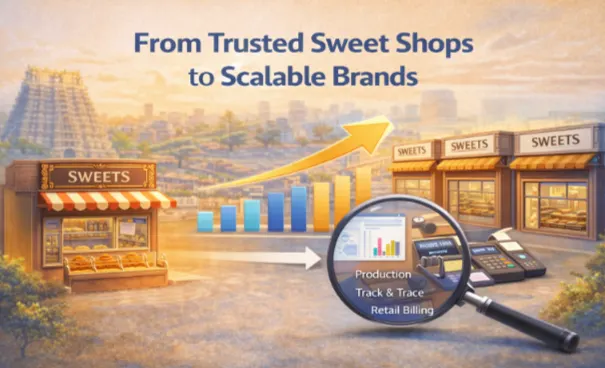
Tamil Nadu’s Sweets Brands Are a Benchmark for Quality and Trust
Tamil Nadu is home to some of India’s most respected sweets brands—businesses that have earned customer loyalty through decades of consistency, taste, and craftsmanship.
Brands such as A2B (Adyar Ananda Bhavan), Sri Krishna Sweets, Shree Mithai, Kakada Ramprasad, BG Naidu, and several other regional leaders are widely admired for:
- Maintaining high quality at scale
- Preserving traditional recipes
- Delivering a reliable customer experience across outlets
These brands represent best-in-class execution in the sweets category, and their success has set benchmarks for the entire industry.
As these businesses continue to grow across cities, regions, and formats the operational needs naturally evolve alongside that growth.
Growth Changes the Nature of Operations
In the early years, sweets businesses often operate with:
- Close founder or family involvement
- Deep production expertise
- Strong intuition about customer demand
This hands-on model has been a key reason behind the success of many leading sweets brands.
As brands expand into:
- Multiple outlets
- Central kitchens
- High-footfall locations
- Festival-driven peak demand
the challenge is no longer about making great sweets it’s about replicating excellence consistently at scale.
This transition is a sign of success, not a shortcoming.
Tamil Nadu is home to some of India’s most respected sweets brands—businesses that have earned customer loyalty through decades of consistency, taste, and craftsmanship.
Brands such as A2B (Adyar Ananda Bhavan), Sri Krishna Sweets, Shree Mithai, Kakada Ramprasad, BG Naidu, and several other regional leaders are widely admired for:
- Maintaining high quality at scale
- Preserving traditional recipes
- Delivering a reliable customer experience across outlets
These brands represent best-in-class execution in the sweets category, and their success has set benchmarks for the entire industry.
As these businesses continue to grow across cities, regions, and formats the operational needs naturally evolve alongside that growth.
Why Structured Systems Become Important at Scale
For multi-outlet sweets brands, operational complexity increases naturally with growth:
- Production volumes rise
- Product movement spans multiple locations
- Sales happen across counters, cities, and time windows
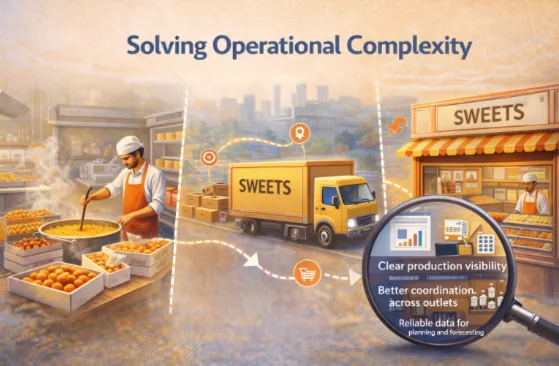
At this stage, structured systems help leadership gain visibility, without interfering with day-to-day craftsmanship.
Automation supports:
- Clear production visibility
- Better coordination across outlets
- Reliable data for planning and forecasting
It complements experience—it doesn’t replace it.
Track & Trace as a Quality-Enabling Capability
For sweets brands that handle fresh, perishable products daily, traceability is a strength, not just a compliance requirement.
Automation can help by:
- Organizing batch and production information
- Improving visibility into ingredient usage
- Supporting shelf-life monitoring
- Enabling faster responses when needed
For established brands known for quality and trust, these capabilities reinforce brand reputation rather than change operations.
Retail Billing: Enhancing the Customer Experience
Leading sweets brands are also known for:
- High footfall
- Fast-moving counters
- Strong festive demand
In such environments, modern POS systems help by:
- Speeding up checkout during peak hours
- Ensuring accurate weight-based billing
- Providing real-time sales visibility across outlets
These systems enhance customer experience and support smoother store operations especially during high-demand periods.
Why End-to-End Visibility Matters for Growing Brands
As sweets brands expand, leadership benefits from having a connected view across:
- Production
- Distribution
- Retail sales
End-to-end visibility helps management:
- Plan confidently
- Allocate resources better
- Support outlet teams effectively
This is about managing growth with clarity, not correcting existing processes.
Automation Supports Tradition It Doesn’t Alter It
It’s important to state this clearly:
Automation does not change recipes.
Automation does not interfere with craftsmanship.
Automation does not replace experience.
Instead, it:
- Preserves consistency
- Reduces operational friction
- Gives leadership better insight
For iconic sweets brands, automation acts as an enabler of tradition at scale.
Uniprotech’s Perspective: Supporting Growth with Structure
At Uniprotech, we deeply respect the legacy and craftsmanship behind India’s leading sweets brands.
Our role is not to change how sweets are made, but to support growing brands with systems that:
- Improve visibility
- Strengthen coordination
- Prepare operations for future scale
Unified platforms connecting production, traceability, and retail operations help brands grow with confidence while preserving what made them successful in the first place.
Final Thought: Excellence Scales Best with Structure
Tamil Nadu’s leading sweets brands have already achieved something remarkable—trust at scale.
As these businesses continue to expand, structured systems and automation simply help leadership manage growth more predictably and confidently.
Automation is not a response to a problem.
It is a natural companion to success.
About Uniprotech
Uniprotech builds enterprise-grade Retail POS, ERP, and automation platforms for food, sweets, FMCG, and multi-store retail businesses, helping growing brands scale smoothly while preserving their identity.

 Book your demo
 Talk to our POS experts
- 📧 Email: salesenquiry@uniprotech.co.in
Run your store with confidence. Let technology handle the complexity.
Frequently Asked Question
As sweets brands expand across outlets and cities, automation helps manage increasing operational complexity by providing better visibility, coordination, and control without affecting traditional production methods.
No. Automation supports operations like billing, traceability, and reporting. It does not change recipes, craftsmanship, or production techniques that define traditional sweets brands.
Automation connects production, distribution, and retail sales across locations, helping leadership monitor performance, plan inventory, and maintain consistency at scale.
Yes. For fresh and perishable products, traceability improves batch tracking, shelf-life monitoring, and ingredient visibility, strengthening quality control and brand trust.
Modern POS systems enable faster checkout, accurate weight-based billing, and real-time sales tracking, especially during peak hours and festive seasons.
Automation becomes valuable when brands expand to multiple outlets, central kitchens, or high-volume operations. It supports growth proactively rather than fixing problems later.