
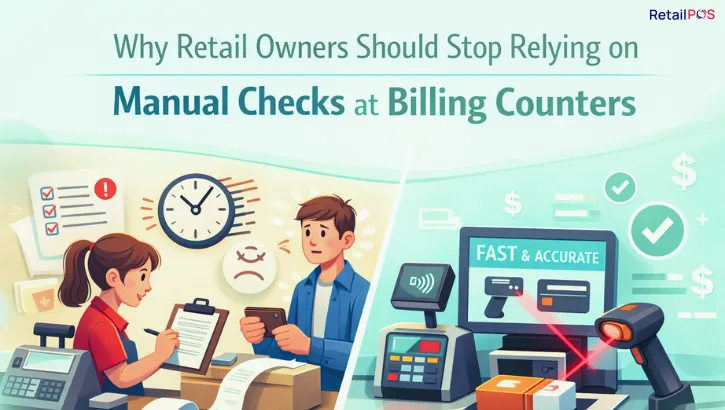
For many retail owners, manual checks at billing counters feel like the safest way to stay in control. Watching bills during peak hours, randomly reviewing receipts, or checking end of day reports gives a sense of involvement and assurance. In small stores, this approach may work temporarily. But as retail operations grow faster, busier, and more complex, manual supervision quietly turns into a weakness.
What once felt like protection slowly becomes a bottleneck. And in modern retail, bottlenecks cost time, money, and peace of mind.
The Illusion of Control in Manual Billing Checks
Manual checking creates visibility only when the owner is physically present. Staff are careful when watched, bills look clean, and numbers appear fine. But retail does not pause when attention shifts. The moment the owner moves to another counter, another task, or another store, blind spots emerge.
Retail today operates in real time. Customers expect fast checkout. Counters face constant pressure during rush hours. Decisions are made in seconds. Manual oversight, by nature, is selective and delayed. It depends on where you are, what you notice, and how much time you have. That is not control. That is dependency.
The Illusion of Control in Manual Billing Checks
Manual checking creates visibility only when the owner is physically present. Staff are careful when watched, bills look clean, and numbers appear fine. But retail does not pause when attention shifts. The moment the owner moves to another counter, another task, or another store, blind spots emerge.
Retail today operates in real time. Customers expect fast checkout. Counters face constant pressure during rush hours. Decisions are made in seconds. Manual oversight, by nature, is selective and delayed. It depends on where you are, what you notice, and how much time you have. That is not control. That is dependency.
Why Manual Checks Stop Working as Retail Grows
Manual Supervision Does Not Scale
One counter can be monitored. Two counters divide attention. Multiple stores make supervision impossible. Growth multiplies transactions, staff, exceptions, and complexity. Manual checks do not scale with volume. They break under it.
Many retail owners experience this during expansion. Sales increase, but stress increases faster. More revenue does not always mean more control.
Errors Hide Inside Normal Activity
Not every issue looks suspicious. Small pricing mistakes, repeated bill cancellations, excessive discounts, or incorrect item entries often appear harmless in daily reports. Individually, they look normal. Over time, they silently erode margins.
Manual checks catch obvious problems. They rarely reveal patterns.
Human Oversight Is Inconsistent
Manual supervision depends on focus, energy, and availability. During peak hours, attention shifts to customer flow. During slow periods, checks become relaxed. Over weeks and months, consistency disappears.
Systems do not get tired. People do.
Trust Alone Is Not a Control Strategy
Retail businesses run on trust, and trust is essential. But trust without structure creates pressure. Owners feel anxious when they are not present. Staff feel watched rather than supported.
A healthy retail operation does not rely on suspicion or constant monitoring. It relies on clarity. Clear rules, clear visibility, and clear accountability built directly into the billing process.
From Supervision to Visibility
Modern retail control is not about watching people. It is about seeing processes.
When billing systems are designed with built in visibility, every action is recorded automatically. Who billed, what was changed, when discounts were applied, and when cancellations happened. All of this happens silently in the background without slowing billing speed.
This changes the owner role completely. Instead of policing, owners start managing through insight.
Instead of asking, did something go wrong today, owners begin asking better questions. Why do cancellations spike during certain shifts. Why are discounts higher at specific counters. Why do some counters perform differently even with similar footfall.
These questions lead to improvement, not confrontation.
Accountability Without Slowing the Counter
A common fear among retailers is that tighter control will slow billing. In practice, the opposite happens.
When permissions and workflows are clearly defined, cashiers work faster because they know exactly what they can and cannot do. Managers step in only when required. Billing becomes smoother, not stricter.
Accountability does not mean adding friction. It means removing ambiguity.
Manual Checks vs System Driven Control
Manual checking is owner dependent, reactive, inconsistent, stressful, and difficult to scale.
System driven control is process driven, proactive, consistent, invisible, and built to scale with growth.
Retail owners do not lose control because they stop checking. They lose control because checking is no longer enough.
The Hidden Benefit. A More Professional Retail Culture
When billing rules live inside the system, staff feel protected rather than monitored. Everyone operates within the same structure. Disputes reduce. Conversations shift from opinion to facts.
This creates a professional retail environment where trust is backed by data, performance is measurable, and growth feels manageable.
Final Thought. Control Should Reduce Stress, Not Add to It
Retail owners should not have to stand behind billing counters to feel confident. As operations grow, control must move from human effort to system design.
The most successful retailers are not watching every bill. They have built systems that quietly watch for them.
That is what real control looks like.
If your retail business is growing and manual checks are starting to feel exhausting, it may be time to rethink how control works at the billing counter. The right system does not replace people. It supports them quietly, consistently, and at scale.

 Book your demo
 Talk to our POS experts
- 📧 Email: salesenquiry@uniprotech.co.in
Run your store with confidence. Let technology handle the complexity.
Frequently Asked Question
Manual billing checks rely on human presence and attention, which makes them inconsistent and difficult to scale as stores grow and transaction volumes increase.
Yes. Modern billing systems enforce rules in the background, ensuring accountability while keeping checkout fast and uninterrupted.
They provide real time visibility, clear accountability, and actionable insights without requiring constant supervision at billing counters.
No. Manual supervision does not scale across multiple counters or stores and often creates blind spots as operations grow.
No. They reduce confusion and disputes by creating clear rules, which improves trust and professionalism in retail teams.
Retailers should shift to system driven control when footfall increases, counters multiply, or owners can no longer be physically present at all billing points.