
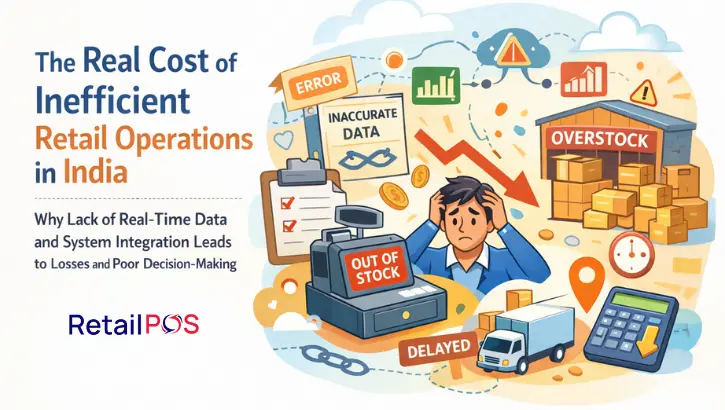
India’s retail sector is growing rapidly, but many retail businesses continue to operate with outdated systems, manual processes, and disconnected software. While these inefficiencies may seem manageable on the surface, they silently drain profits, slow growth, and lead to poor business decisions.
In this article, we break down the real cost of inefficient retail operations in India and explain why real-time data and integrated POS systems are no longer optional for modern retailers.
1. The Hidden Financial Losses Retailers Don’t Track
Most retail losses don’t come from theft or rent they come from inefficient operations.
Common examples include:
- Overstocking slow-moving products
- Running out of fast-moving items
- Incorrect purchase planning
- Manual billing errors
- Inventory mismatches
Without real-time inventory visibility, retailers often buy based on assumptions rather than data. Over time, this leads to dead stock, blocked cash flow, and unnecessary discounts just to clear inventory.
The result: monthly losses that silently add up to lakhs of rupees annually.
2. No Real-Time Inventory = Poor Business Decisions
Many Indian retailers still rely on:
- End-of-day reports
- Excel sheets
- Manual stock checks
This means decisions are made using outdated data.
Without real-time inventory updates:
- Store managers don’t know actual stock levels
- Owners can’t track performance across locations
- Purchase decisions are delayed or incorrect
Real-time data enables retailers to:
- Identify fast-moving products instantly
- Prevent stock-outs
- Optimize purchasing cycles
Without it, decision-making becomes reactive instead of strategic.
3. Disconnected Systems Create Operational Chaos
A common issue in retail operations is using multiple disconnected tools:
- One system for billing
- Another for inventory
- Manual GST calculations
- Separate reporting tools
This lack of system integration causes:
- Duplicate data entry
- Higher chances of human error
- Inconsistent reports
- Time wasted reconciling numbers
Retailers spend more time managing systems instead of growing the business.
4. GST Compliance Errors and Reporting Risks
GST compliance is non-negotiable for Indian retailers, yet inefficient systems make it harder.
Problems include:
- Incorrect tax calculations
- Missing invoices
- Mismatched sales reports
- Delayed filings
Manual or semi-automated processes increase compliance risk and can result in penalties, audits, and loss of credibility.
An integrated POS system ensures:
- Accurate GST billing
- Automated tax calculations
- Ready-to-use compliance reports
5. Scaling Becomes Nearly Impossible
Growth exposes inefficiency.
Retailers planning to:
- Open new stores
- Expand product categories
- Manage warehouses
- Operate franchises
…quickly realize their existing setup doesn’t scale.
Without centralized control:
- Inventory data is fragmented
- Sales reports are inconsistent
- Store-wise performance can’t be tracked
This lack of visibility makes expansion risky and expensive.
6. The Opportunity Cost of Not Using an Integrated POS System
Inefficient retail operations don’t just cause losses—they prevent growth.
Retailers miss out on:
- Demand forecasting
- Purchase optimization
- Supplier negotiation leverage
- Data-driven promotions
- Performance benchmarking
Modern POS software with integrated billing, inventory, and reporting transforms retail operations from reactive management to proactive growth.
7. How Integrated POS Software Solves These Challenges
A modern retail POS system helps businesses by:
- Providing real-time inventory tracking
- Centralizing billing, stock, and reporting
- Offering GST-compliant invoicing
- Delivering actionable business insights
- Supporting multi-store management
Instead of guessing, retailers operate with clarity, accuracy, and control.
Conclusion: Inefficiency Is Costlier Than Technology
The real cost of inefficient retail operations isn’t just financial. It’s lost time, missed opportunities, poor decisions, and stalled growth.
For Indian retailers looking to stay competitive, adopting an integrated, data-driven retail management system is no longer a luxury, it’s a necessity.
Retail success today depends on visibility, control, and real-time insights.

 Book your demo
 Talk to our POS experts
- 📧 Email: salesenquiry@uniprotech.co.in
Run your store with confidence. Let technology handle the complexity.
Frequently Asked Question
Inefficiency in retail operations is mainly caused by manual billing, lack of real-time inventory tracking, disconnected systems, and poor data visibility across stores.
Without real-time inventory data, retailers face stock-outs, overstocking, dead inventory, and incorrect purchase planning, leading to revenue loss and poor decisions.
Integrated POS software connects billing, inventory, GST, and reporting in one system, helping retailers reduce errors, improve efficiency, and make data-driven decisions.
Hidden costs include inventory shrinkage, billing errors, GST compliance risks, excess manpower, time loss, and missed sales opportunities.
Yes, modern POS systems support multi-store management, centralized reporting, and real-time data access, making retail expansion more controlled and scalable.
The best retail management software for Indian businesses offers real-time inventory tracking, GST-compliant billing, detailed reports, and multi-store support tailored to local needs.