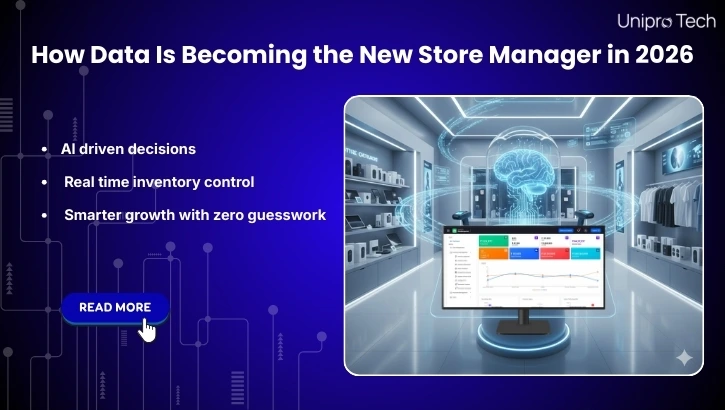
In the past, the success of a retail store depended heavily on a human store manager. Decisions were based on experience, instinct, and manual observation. But in 2026, retail is undergoing a silent transformation. Data is rapidly taking over the role of the store manager.
Every sale, every customer interaction, every stock movement, and every price change now creates valuable data. When this data is analysed using intelligent systems, it begins to make faster, more accurate, and more profitable decisions than any human ever could.
Data is no longer just a record of what happened. It is becoming the brain that decides what should happen next.
1. What Does a Traditional Store Manager Do
A store manager is responsible for overseeing daily operations and making key business decisions such as:
- Managing inventory
- Tracking dail sales
- Deciding purchase quantities
- Planning promotions and discounts
- Handling staff shift planning
- Reducing losses and wastage
- Understanding customer behaviour
- Increasing profit margins
However, a human can only observe and process a limited amount of information at one time. As business scales, this becomes a serious limitation.
2. Why Traditional Management Is No Longer Enough
Modern retail is fast, complex, and data heavy. A single store now handles thousands of products and hundreds of transactions daily. Multi location businesses handle even more.
Traditional management becomes ineffective due to:
- Human errors in judgement
- Limited ability to analyse large data
- Delayed decision making
- Inability to detect patterns in time
- Dependence on manual reports
- Lack of real time insights
As a result, many businesses suffer from overstocking, stockouts, wrong pricing, and low profit margins.
3. How Data Is Replacing Human Decision Making
In 2026, smart systems powered by data and AI can:
- Predict how much stock is needed
- Alert when items reach minimum or maximum levels
- Analyse sales trends and seasonal demand
- Detect slow moving or dead stock
- Automatically suggest reordering quantities
- Recommend the best time for discounts
- Compare competitor pricing
Track customer buying behaviour
Instead of reacting to problems after they happen, data driven systems prevent problems before they even begin.
This is the true role of a modern store manager.
4. Role of AI and Analytics in Retail Management
AI and advanced analytics turn raw data into intelligent action. These systems work continuously in the background and provide:
- Real time dashboards
- Automated reports.
- Smart inventory pre.dictions
- AI based demand fo.recasting
- Intelligent purchase o/rder generation
- Automatic invoice scanning and updates
- Price optimisation suggestions
- Profit and loss insights
- Customer behaviour analysis
These capabilities allow business owners to make faster and more confident decisions without depending only on staff judgment.
5. Real World Examples of Data Driven Management
In a supermarket using data driven POS systems:
The system detects that cooking oil sales increase every weekend
- It automatically warns when stock will finish in two days
- It triggers a purchase order for the supplier
- It recommends a weekend discount to increase sales
- It tracks margin and adjusts pricing automatically
In a multi store retail chain:
The system compares performance of all outlets
- It identifies the top selling products per location
- It highlights poor performing items
- It redistributes stock between branches
- It adjusts order planning region wise
A human manager cannot perform all these actions in real time for multiple locations. Data can.
6. Human Store Manager vs Data Driven System
| Function | Human Store Manager | Data Driven System |
|---|---|---|
| Decision speed | Slow | Instant |
| Data processing | Limited | Unlimited |
| Accuracy | Based on experience | Based on real data |
| Forecasting | Guesswork | AI predictions |
| Reporting | Manual | Automatic |
| Multi store control | Difficult | Easy |
| Error chances | High | Very low |
| Scalability | Limited | Unlimited |
7. Benefits of Having Data as Your Store Manager
- Lower losses and wastage
- Better stock availability
- Higher billing speed
- Smarter purchase planning
- Better profit margins
- Reduced dependency on manpower
- Improved customer satisfaction
- Freedom to focus on business growth instead of daily problems
Data never sleeps. It monitors your business 24/7 with zero fatigue.
8. Future of Retail Management in 2026 and Beyond
In the coming years, retail stores will rely more on data than people for decision making. Human roles will shift from manual execution to strategy and experience.
- Successful stores will not be run by instinct. They will be run by data.
- Those who adopt this early will dominate their market. Those who ignore it will fall behind.
- The future store manager is not a person.
It is data.
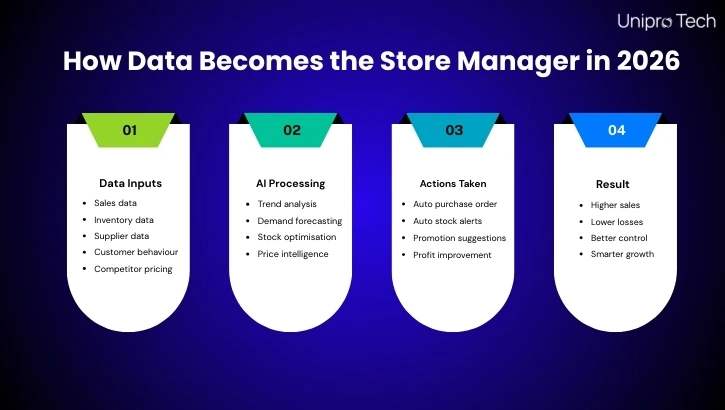
9.How Data Becomes the Store Manager in 2026
Book a Free Demo
Modernize your retail operations with faster billing, smarter inventory control, and seamless GST compliance.
Unipro Tech Solutions
 Book your demo
 Talk to our POS experts
- 📧 Email: salesenquiry@uniprotech.co.in
Run your store with confidence. Let technology handle the complexity.
Frequently Asked Question
Yes, because data is objective, real time and based on actual performance, not assumptions.
Yes, even small stores can benefit from smart POS and inventory data.
No, it supports staff by giving them better direction and control.
Sales trends, inventory movement, customer behaviour and profitability data.
No, modern systems present data in simple dashboards and reports.
In the long run it saves much more than it costs by reducing losses and increasing profit.