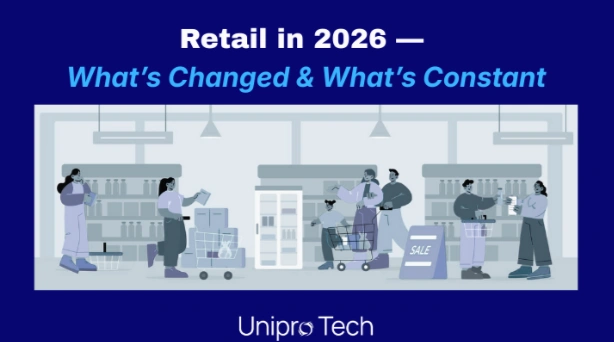
Indian retail in 2026 looks very different on the surface.
It also looks exactly the same underneath.
New tools, new payment methods, and new dashboards have entered stores. Yet the daily pressures inside a supermarket, grocery store, or FMCG outlet remain familiar to anyone who has run retail operations for more than a few years.
To understand why POS systems still struggle and why retailers continue to switch platforms it’s important to separate what has genuinely changed from what has not.
Retail in 2026 – At a Glance
What’s Changed | What’s Stayed the Same |
POS adoption is universal | Retail remains low-margin |
GST is system-driven | Peak hours still break systems |
Inventory is digitised | Staff turnover remains high |
Multi-outlet growth starts early | Offline failures still happen |
Daily reporting is expected | Stores still work around systems |
What Has Changed in Indian Retail
1. Digital Adoption Is No Longer Optional
In 2026, almost every organised retailer uses a digital system:- POS billing is standard
- GST compliance is system-driven
- Inventory is digitally tracked, even in smaller stores
- Reports are expected daily, not monthly
2. Retail Is Data-Aware (Even If It’s Not Data-Driven)
Most retailers today can access:
- Sales reports
- SKU-level movement
- Category performance
- Store-wise comparisons
But access to data doesn’t guarantee better decisions.
In practice:
- Store managers still rely on experience
- Operations teams export data into Excel
- IT teams act as intermediaries between systems and people
Retail has become data-aware, but not consistently data-operational.
3. Multi-Outlet Retail Is No Longer Rare
What once felt like a major leap — one store to three — is now common.
By 2026:
- Even neighbourhood formats plan for multiple outlets
- Replication and franchising are normal growth paths
- Central visibility is expected early
POS expectations have shifted from:
“Does billing work?”
to
“Does this still work when I add five more stores?”
4. Payments and Compliance Have Stabilised
Payments and GST are no longer the hardest problems.
- UPI is stable and widely adopted
- Card payments are routine
- GST rules are well understood by most systems
The friction today is not compliance itself
it’s how compliance interacts with returns, margins, promotions, and transfers.
What Has Not Changed (And Probably Never Will)
1. Retail Is Still a High-Volume, Low-Margin Business
This is the constant most POS systems underestimate. Even in 2026:- Grocery margins remain thin
- FMCG profitability depends on rotation, not markups
- Small inefficiencies compound quickly
- 3 seconds per bill
- 1 extra step per return
- 1 manual reconciliation per day
2. Peak Hours Still Decide Whether a System Is “Good”
No demo environment reflects reality.
The real test happens:
- Between 6 pm and 9 pm
- On weekends
- During festivals
- When staff is short
If a system works only when things are calm, it fails when things matter.
3. Offline Reality Still Exists
Despite better connectivity:
- Internet drops
- Routers fail
- Power fluctuates
- Local network issues occur
Retailers don’t stop billing when systems fail.
They work around failures.
Systems that assume perfect connectivity create risk.
Offline-first thinking creates resilience.
4. Store Operations Still Run on People
No matter how advanced systems become:
- Cashiers make judgment calls
- Store managers override processes
- Operations teams adjust workflows on the fly
- IT teams firefight instead of optimise
Retail systems succeed not by enforcing perfection,
but by absorbing human behaviour without breaking.
Digital Transformation vs. Offline Realities
On paper, digital transformation promises:
- Centralised control
- Real-time visibility
- Automated processes
- Reduced manual work
On the shop floor, reality looks like:
- Varying staff skill levels
- Rush hours that don’t wait
- Daily exceptions
- Decisions made under pressure
The gap between these two worlds is where most POS failures occur.
What Continuous Retail Exposure Teaches You
Retail systems that last are shaped by operations, not roadmaps.
As retail formats matured, new pressures appeared:
- weighing and loose-item billing became routine
- SKU counts expanded rapidly in FMCG categories
- expiry shifted from compliance to operational risk
- reconciliation moved from monthly to daily
These pressures surfaced first on the shop floor.
Working with complex retail models including businesses like Paarrever and JKH Fruit Ventures highlighted this further. Their challenges weren’t about size alone, but about how inventory actually behaved.
Field Notes from Complex FMCG Operations
What breaks standard POS assumptions:
- Fresh inventory isn’t static
- Pricing shifts with freshness and movement
- Wastage is expected, not exceptional
- Speed at the counter matters more than structure
What had to change operationally:
- Billing views simplified
- Expiry and wastage flowed into stock movement
- Store teams acted quickly without corrupting central data
- Controls stayed intact without slowing counters
These weren’t special customisations.
They were stress points moments where systems either adapted or failed.
Progress in retail systems is measured less by what gets added, and more by what stops breaking under pressure.
The Mistake Many Retailers Make
How POS Is Evaluated vs How It’s Lived With
| During Evaluation | During Daily Operations |
| Feature lists | Peak-hour billing |
| Dashboards | Stock shortages |
| Demo data | Network outages |
| Marketing claims | Staff turnover |
Why POS Challenges Are Operational, Not Technical
By 2026, most POS software is technically capable.
Differences appear in:
- Workflow design
- Assumptions about staff behaviour
- Exception handling
- Performance under load
Two retailers can use similar systems and have very different outcomes.
One struggles daily.
The other runs predictably.
The difference isn’t technology
it’s alignment with retail reality.
What This Means for Retailers Evaluating POS Systems
Retailers who succeed ask different questions:
- What happens during peak hours?
- How does the system behave when something goes wrong?
- How many workarounds exist today?
- Can the system scale without adding operational friction?
These answers don’t come from brochures.
They come from:
- Real usage
- Real operations
Real pressure
Over the years, systems like RetailPOS ERP by UniproTech Solutions have evolved largely because of this shift not because retailers demanded more features, but because everyday operations exposed gaps that only appeared once stores started running at volume.As billing, inventory, and compliance became baseline expectations, the real differentiator quietly moved to how systems behaved under pressure, and whether they could adjust as store formats, assortments, and operating patterns changed.
Book a Free Demo
Modernize your retail operations with faster billing, smarter inventory control, and seamless GST compliance.
 Book your demo
 Talk to our POS experts
- 📧 Email: salesenquiry@uniprotech.co.in
Run your store with confidence. Let technology handle the complexity.