Retail Is Changing Faster Than Ever
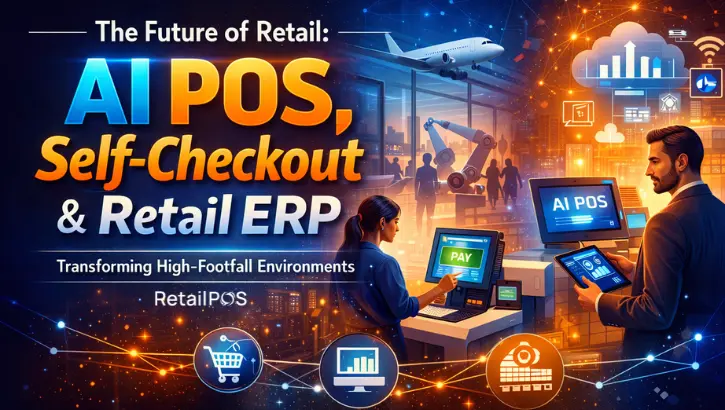
Retail is undergoing a fundamental transformation. From airports and large infrastructure projects to hypermarkets and retail chains, businesses are rethinking how customers shop, pay, and interact at the point of sale.
The shift is clear:
- Self-checkout kiosks are becoming the new front end
- AI-powered POS systems are adding intelligence
- Retail ERP platforms are emerging as the backbone
Together, these technologies are redefining speed, scale, and efficiency in modern retail.
Why High-Footfall Locations Need Smarter Retail Systems
Airports, malls, metro stations, and large infrastructure developments face unique challenges:
- Extremely high customer volumes
- Sharp peak hours and traffic spikes
- Pressure to reduce queues and waiting time
- Dependence on real-time inventory accuracy
- Need for centralized control across multiple outlets
Traditional billing counters and standalone POS systems are no longer enough. This is where AI POS and self-checkout, powered by a robust Retail ERP, make a critical difference.
Self-Checkout Kiosks: Speed at the Front End
Self-checkout kiosks are rapidly becoming standard in modern retail environments because they:
- Reduce billing queues
- Improve customer convenience
- Enable contactless and faster transactions
- Lower dependency on manual billing staff
However, kiosks alone are only half the solution.
Without a strong backend, self-checkout systems can create:
- Inventory mismatches
- Pricing inconsistencies
- Reporting gaps
- Operational blind spots
This is why self-checkout must be tightly integrated with AI-enabled POS and Retail ERP systems.
AI-Powered POS: Intelligence at the Point of Sale
AI-powered POS systems bring decision-making and intelligence into everyday retail operations.
Key benefits of AI POS include:
- Real-time sales pattern analysis
- Peak-hour demand prediction
- Smarter billing workflows
- Reduced billing errors
- Actionable insights for store managers
Instead of reacting to problems, retailers can anticipate demand, optimize stock, and improve checkout efficiency. Especially in high-traffic environments like airports and large retail hubs.
Retail ERP: The Backbone of Modern Retail Operations
While self-checkout and AI POS handle the front end, Retail ERP is the system that keeps everything connected and controlled.
A modern Retail ERP enables:
- Centralized inventory management across locations
- Real-time sales and billing synchronization
- Unified pricing and promotions
- Multi-store and multi-format scalability
- Data-driven reporting and analytics
In large infrastructure projects and enterprise retail setups, Retail ERP ensures consistency, visibility, and operational control at scale.
Why Airports and Mega Infrastructure Projects Are Adopting This Model
Large infrastructure developments demand retail systems that are:
- Scalable
- Reliable
- Data-driven
- Easy to manage centrally
By combining:
- Self-checkout kiosks for speed
- AI POS for intelligence
- Retail ERP for centralized control
Retailers can handle massive footfall without compromising customer experience or operational accuracy.
This integrated model is quickly becoming the default architecture for future-ready retail.
Beyond Checkout: Omnichannel Retail Made Possible
Modern customers don’t shop in just one way. Retail ERP platforms enable true omnichannel operations by connecting:
- In-store POS
- Self-checkout kiosks
- Inventory and supply chain
- Sales reporting and analytics
This allows retailers to:
- Maintain accurate stock levels
- Reduce shrinkage and stock-outs
- Make data-backed decisions
Scale operations without complexity
The Competitive Advantage of AI-Driven Retail ERP
Retailers using AI-enabled Retail ERP gain:
- Faster checkout experiences
- Lower operational costs
- Better inventory planning
- Higher customer satisfaction
- Improved profitability
In competitive, high-traffic environments, these advantages are no longer optional. they are essential.
Conclusion: The Future of Retail Is Intelligent, Automated, and Scalable
The future of retail is not just about adding new hardware or upgrading POS systems. It’s about building a connected, intelligent retail ecosystem.
- Self-checkout improves speed.
- AI POS adds intelligence.
- Retail ERP delivers control and scalability.
Together, they form the foundation of modern retail, ready for airports, large infrastructure projects, and enterprise-scale operations.
Ready to modernize your retail operations?
Discover how Retail POS helps enterprises deploy AI-powered POS, self-checkout kiosks, and Retail ERP to scale faster, reduce queues, and gain real-time operational control.
Unipro Tech Solutions
 Book your demo
 Talk to our POS experts
- 📧 Email: salesenquiry@uniprotech.co.in
Run your store with confidence. Let technology handle the complexity.
Frequently Asked Question
An AI POS system uses intelligent analytics to process sales data in real time, predict demand, and reduce billing errors. When integrated with a Retail ERP, it synchronizes inventory, pricing, and reports across all locations for complete operational control.
Self-checkout kiosks reduce queues, speed up transactions, and lower dependency on staff. When connected to a Retail ERP, they update inventory and sales data instantly, ensuring accuracy even during peak hours.
Airports and mega infrastructure projects handle high customer volumes and peak-time traffic. AI POS combined with Retail ERP enables faster checkout, real-time inventory visibility, centralized control, and data-driven decision-making across multiple outlets.
Traditional POS systems focus only on billing. AI-powered POS systems analyze sales patterns, predict demand, optimize inventory, and provide actionable insights—especially when backed by a centralized Retail ERP platform.
Yes. Self-checkout kiosks handle customer transactions, but Retail ERP manages inventory, pricing, reporting, and multi-store operations. Without Retail ERP, kiosks operate in isolation and can create data and control gaps.
AI-powered Retail ERP automates inventory planning, provides real-time analytics, reduces operational costs, and supports multi-location growth. This allows retailers to scale efficiently while maintaining speed, accuracy, and customer satisfaction.