
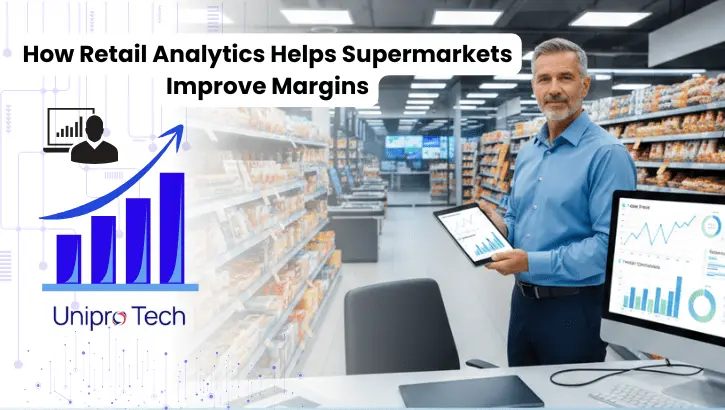
Supermarket margins are under constant pressure. Rising procurement costs, inventory wastage, price competition, and operational inefficiencies make profitability harder to maintain year after year. Many supermarkets focus only on increasing sales, but the real opportunity lies in improving margins.
This is where retail analytics software plays a critical role.
Retail analytics helps supermarkets move from guesswork to data-driven decisions. By analyzing sales, inventory, pricing, and customer behavior in real time, supermarkets can identify profit leaks and take corrective action quickly.
In this article, we’ll explore how retail analytics helps supermarkets improve margins, reduce losses, and operate more efficiently.
What Is Retail Analytics for Supermarkets?
Retail analytics is the process of collecting and analyzing data from POS systems, inventory systems, and customer transactions to generate actionable insights.
For supermarkets, retail analytics software provides visibility into:
- Sales performance
- Inventory movement
- Profit margins
- Customer buying patterns
- Store-wise performance
Instead of relying on delayed reports or manual spreadsheets, supermarket owners get real-time dashboards that show exactly what is happening across stores.
Why Margin Improvement Is a Bigger Challenge Than Sales Growth
Increasing sales does not always increase profit. Many supermarkets experience:
- High wastage due to expiry
- Dead stock occupying shelf space
- Wrong procurement quantities
- Heavy discounting without ROI tracking
- Lack of visibility into low-margin products
1. Identifying Low-Margin and Loss-Making Products
One of the biggest benefits of retail analytics software is product-level margin analysis.
Supermarkets often sell thousands of SKUs, but not all of them contribute equally to profit. Retail analytics helps by:
- Tracking profit margin per product
- Identifying products with high sales but low margins
- Highlighting items that sell at a loss after discounts
With these insights, supermarkets can:
- Adjust pricing
- Renegotiate supplier rates
- Replace low-margin products with better alternatives
2. Reducing Inventory Wastage and Expiry Losses
Inventory wastage is one of the biggest margin killers in supermarkets, especially for groceries, fresh produce, and FMCG items.
Retail analytics helps supermarkets reduce wastage by:
- Identifying slow-moving and dead stock
- Tracking expiry-wise inventory aging
- Alerting teams about overstock risks
- Recommending optimal reorder quantities
By acting early, supermarkets can:
- Run targeted promotions
- Transfer stock between stores
- Reduce expiry-related write-offs
3. Improving Procurement Decisions with Data
Wrong procurement decisions directly impact margins. Ordering too much increases wastage, while ordering too little causes stock-outs and lost sales.
Retail analytics enables:
- Demand forecasting based on sales history
- Store-wise consumption analysis
- Vendor performance comparison
- Optimal reorder level calculation
With data-driven procurement, supermarkets buy the right quantity at the right time, improving cash flow and margins.
4. Store-Wise Performance Comparison for Multi-Store Supermarkets
For supermarket chains, margin leakage often happens because store performance varies widely.
Retail analytics provides:
- Store-wise sales and margin comparison
- Category performance by location
- Staff and counter productivity insights
This helps management:
- Identify underperforming stores
- Replicate best practices from top-performing outlets
- Control pricing and discounting centrally
5. Optimizing Pricing and Discount Strategies
Discounts can boost sales but hurt margins if not tracked properly.
Retail analytics helps supermarkets:
- Measure discount impact on margins
- Identify which offers actually increase profit
- Avoid unnecessary price overrides
- Optimize promotions by category and store
Instead of blanket discounts, supermarkets can run targeted, data-backed promotions that protect margins.
6. Understanding Customer Buying Patterns
Not all customers shop the same way. Retail analytics reveals:
- Frequently bought-together products
- High-value customer segments
- Preferred payment modes
- Repeat purchase cycles
By understanding customer behavior, supermarkets can:
- Increase basket size
- Promote high-margin items
- Improve loyalty program ROI
7. Real-Time Decision Making Instead of End-of-Month Surprises
Traditional reports arrive too late. By the time issues are identified, losses have already occurred.
Retail analytics software offers:
- Real-time dashboards
- Instant alerts for anomalies
- Live sales and inventory tracking
This allows supermarket owners and managers to take action immediately, protecting margins daily, not monthly.
Why Supermarkets Choose Retail Analytics Software
Supermarkets that adopt retail analytics gain:
- Better margin control
- Reduced wastage
- Smarter procurement
- Improved pricing decisions
- Higher operational efficiency
Retail analytics is no longer optional for supermarkets that want to stay competitive and profitable.
How RetailPOS Analytics Helps Supermarkets Improve Margins
RetailPOS Analytics is built specifically for supermarkets and multi-store retail chains.
It provides:
- Centralized dashboards
- Real-time POS analytics
- Inventory and margin intelligence
- Store-wise performance tracking
- Actionable insights for decision makers
With RetailPOS Analytics, supermarkets gain complete visibility across sales, stock, and profitability from a single platform.
Ready to Improve Your Supermarket Margins?
If you want to:
- Reduce inventory losses
- Improve product margins
- Control multi-store operations
- Make data-driven decisions
Then retail analytics is the next step.
Book a free demo of RetailPOS Analytics and see how real-time insights can transform your supermarket profitability.
Chennai Retailers
Looking for the best retail billing software in Chennai?
Unipro Tech Solutions

 Book your demo
 Talk to our POS experts
- 📧 Email: salesenquiry@uniprotech.co.in
Run your store with confidence. Let technology handle the complexity.