
The complete enterprise guide for supermarket chains, apparel chains, electronics retailers, and multi-outlet businesses in Bengaluru
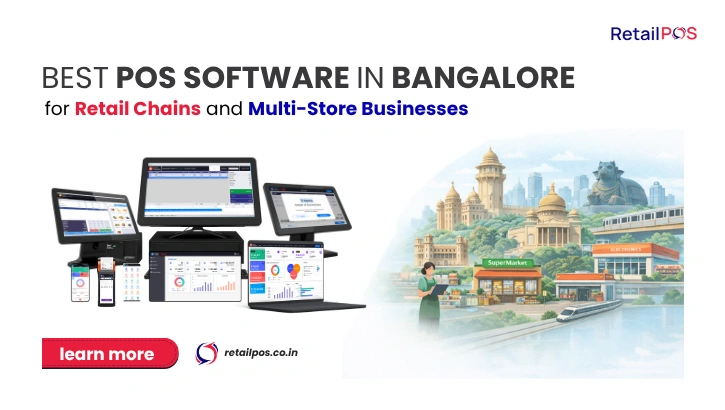
1. Bangalore: India’s Most Demanding Retail Market
Bangalore, officially Bengaluru, has earned its reputation as India’s most commercially sophisticated city. The city is home to over 14 million residents, a per capita income more than four times the national average, and a technology-employed workforce that approaches every purchasing decision with the same analytical rigour they apply to their professional work. These are not casual shoppers. They are informed, quality-conscious consumers who have shopped internationally, compare products online before walking into a store, and expect a retail experience that matches their expectations.
The city’s retail infrastructure reflects this sophistication. Bangalore holds the second-largest mall inventory in India, with over 18 million square feet of organised retail space across more than 40 malls. High-street corridors in Indiranagar, Koramangala, Jayanagar, Whitefield, and Rajajinagar attract both domestic and international brands. Traditional markets in Commercial Street, Chickpet, and Malleswaram continue to evolve with modern formats alongside their legacy operations.
18 Mn+ Sq ft of organised retail space across 40+ malls in Bengaluru | 4x Bangalore per capita income vs national average | 37 Mn Sq ft projected retail space by 2035 (from current 18 million) |
What makes Bangalore particularly demanding for retail operators is not just the volume of business but the complexity of managing it. A supermarket chain serving the Indiranagar tech corridor operates very differently from the same brand’s outlet in Rajajinagar. Customer demographics, peak hours, basket size, product preferences, and promotional sensitivity vary significantly across the city’s micro-markets. A fashion chain with outlets in Phoenix Marketcity, Forum Mall, and a standalone store in Jayanagar needs consistent pricing and inventory management across all three formats simultaneously.
This is why retail chains and multi-store businesses in Bangalore require more than a billing application. They need a purpose-built retail POS and ERP system that can manage multi-outlet operations with the precision, speed, and intelligence that Bangalore retail demands.
Who this guide is for: This guide is written for owners and technology decision-makers at supermarket chains, apparel and fashion chains, electronics retail chains, hypermarkets, pharma chains, lifestyle retail groups, and multi-format retail businesses operating across Bangalore and planning to expand further across Karnataka and South India. |
2. What Separates a Retail POS from a Retail Chain ERP
One of the most important distinctions in retail technology is the difference between a point of sale system and a retail chain ERP. Understanding this difference is critical before you evaluate any software for your multi-outlet business in Bangalore.
2.1 A Retail POS System
A retail POS system is designed to manage the transaction at the billing counter. It processes sales, generates invoices, handles payments, and in most cases provides basic inventory tracking. A single-outlet retail business with one or two billing counters, a manageable SKU count, and straightforward operations can run effectively on a well-designed POS system.
The limitation of a standalone POS system becomes apparent the moment you operate more than one outlet. Each outlet runs its own POS independently. Data does not flow between branches automatically. Head office visibility requires manually collecting reports from each location. Inter-branch stock transfers require separate tracking. Pricing changes must be updated outlet by outlet. Customer loyalty earned in one branch may not be recognised in another.
2.2 A Retail Chain ERP
A retail chain ERP, by contrast, is a centralized platform that manages the entire retail operation across all outlets from a single system. Every branch connects to the same database. Every transaction, whether a sale in Koramangala or a purchase in Whitefield, updates the same inventory in real time. The head office sees all branches simultaneously. Pricing, promotions, and product masters are managed once and deployed across all outlets instantly.
For a retail business managing three or more outlets in Bangalore, or planning to expand to that scale, the choice between a POS system and a retail chain ERP is not a preference decision. It is a business continuity decision. Operating multiple outlets without a centralised ERP creates data fragmentation, operational inconsistency, and margin leakage that compounds with every new outlet you open.
Capability | Standalone POS | Retail Chain ERP |
Billing and invoicing | Yes | Yes, across all outlets |
Inventory management | Single outlet only | Centralised, real-time, all outlets |
Inter-branch stock transfer | Manual, no tracking | System-driven, fully tracked |
Centralised pricing management | Not available | Set once, push to all branches |
Head office dashboard | Not available | Live view of all outlets |
Multi-outlet loyalty program | Not available | Unified across all branches |
Consolidated GST reporting | Manual compilation | Auto-generated, all outlets |
Scalability for new outlets | Requires new setup | Add outlets in days |
Purchase management | Basic or none | Centralised, vendor-wise |
Analytics and business intelligence | Basic sales reports | Branch-wise, SKU-wise, chain-wide |
3. Ten Critical Features Your Retail Chain POS Must Have in Bangalore
Bangalore retail chains evaluating POS and ERP software must go beyond basic feature checklists. Here are the ten capabilities that genuinely differentiate enterprise-grade retail software from basic billing applications, specifically in the context of Bangalore’s retail environment.
3.1 Centralised Real-Time Inventory Across All Outlets
Every sale at every outlet must instantly update a single, centralised inventory count. A shirt sold at your Indiranagar outlet at 6 PM must reflect in your system at the same moment as a sale at your Whitefield branch. This real-time synchronisation is the foundation of every other multi-outlet capability.
Without centralised real-time inventory, you cannot accurately answer the most basic question your customers will ask: is this available at your other store? With it, your staff can check stock at any branch instantly and offer customers the option to purchase from another outlet or arrange an inter-branch transfer.
3.2 Inter-Branch Stock Transfer With Full Tracking
Stock imbalances across branches are a constant challenge for Bangalore retail chains. Your Jayanagar outlet may be overstocked on a particular line while your Whitefield branch is turning away customers for the same product. An enterprise retail ERP enables inter-branch stock transfers initiated and tracked entirely within the system.
The transfer request is raised by the receiving branch. The dispatch branch confirms and ships. The goods receipt is confirmed at the receiving end. Every stage is tracked with date, quantity, and responsible staff member. Stock levels at both branches update automatically. There is no manual reconciliation, no Excel tracking, and no discrepancy between what was sent and what was received.
3.3 Centralised Pricing and Promotion Management
Inconsistent pricing across your retail chain damages customer trust more than almost any other operational failure. A customer who purchased a product at your Koramangala outlet at Rs 1,299 and finds the same product priced at Rs 1,499 at your Indiranagar outlet will not return to either.
Enterprise retail software allows pricing and promotional offers to be configured once at head office and pushed to all outlets, or to selected outlets for region-specific promotions, instantly. When you run a Ugadi sale or a back-to-school promotion, every branch reflects the correct prices simultaneously without any manual update at individual counters.
3.4 Fast Multi-Counter Billing With Offline Capability
A Bangalore supermarket chain running 8 billing counters during a Saturday evening rush needs every counter running at maximum speed simultaneously. Any slowdown at the billing counter translates directly to queue build-up, customer frustration, and reduced revenue per hour.
Enterprise retail POS must operate at full speed in offline mode. Internet connectivity in specific areas of Bangalore, including older commercial corridors, can be inconsistent. A POS system that requires constant connectivity to process a sale is a business risk. All billing, inventory updates, and transaction recording must operate locally with automatic synchronisation when connectivity resumes.
3.5 Variant-Level Inventory Management
For apparel and fashion chains, footwear retailers, and lifestyle businesses, variant management is the single most important inventory feature. A single product style in five colours and five sizes generates 25 unique SKUs. A medium-size fashion chain carrying 500 styles operates with potentially 12,500 or more individual stock-keeping units.
Enterprise retail software must manage variants through a product-attribute-variant hierarchy where one product record generates all combinations automatically. The size-colour matrix view must show stock across all variant combinations at a glance, enabling staff to answer customer queries instantly without walking to the storeroom.
3.6 GST Compliance Across All Outlets
For a multi-outlet retail chain in Bangalore, GST compliance means managing correct tax treatment across hundreds or thousands of transactions per day at multiple locations, consolidating this data into accurate GSTR-1 and GSTR-3B returns each month, and maintaining audit-ready records for every outlet. Manual GST compilation across multiple outlets is time-consuming, error-prone, and a significant compliance risk.
Enterprise retail software must apply correct GST rates automatically based on product category and HSN code, generate e-invoices and e-way bills for qualifying transactions, produce GSTR returns directly from transaction data with no manual compilation, and handle GST correctly on returns, exchanges, inter-branch transfers, and promotional transactions.
3.7 Unified Customer Loyalty Across All Branches
Bangalore retail customers expect their loyalty to be recognised wherever they shop within your chain. A customer who has accumulated points across 10 visits to your Jayanagar outlet should be able to redeem those points at your new Whitefield outlet without any complication.
Unified loyalty management also gives you powerful customer data. You can see which customers shop across multiple branches, which ones are concentrated in specific locations, and which ones have not visited in 30 days and need a re-engagement offer. This level of customer intelligence is only possible when all loyalty data flows into one centralised system.
3.8 Chain-Wide Analytics and Business Intelligence
Running a retail chain without business intelligence is equivalent to navigating Bangalore’s traffic without Google Maps. You will eventually reach your destination, but you will take wrong turns, waste time, and miss opportunities that a real-time data view would have prevented.
Enterprise retail analytics should provide branch-wise sales and margin comparison, outlet-wise performance ranking, category-level profitability across the chain, slow-moving and dead stock identification per outlet, peak hour analysis by branch, and customer purchase frequency and basket size trends. These reports should be accessible in real time from any device, allowing the chain owner to make data-driven decisions from anywhere in Bangalore.
3.9 Centralised Purchase Management and Vendor Control
Multi-outlet retail chains in Bangalore purchase from dozens of vendors across multiple product categories. Managing purchase orders, goods receipt notes, and vendor reconciliation across outlets without a centralised system results in duplicate purchasing, missed bulk discounts, inconsistent vendor terms, and undetected short-supply from vendors.
Centralised purchase management allows the head office to manage all vendor relationships, set approved vendor lists per category, create purchase orders that distribute goods across outlets according to demand, and track GRN completion at each receiving outlet. Vendor performance reports show on-time delivery rates, quality rejection rates, and price compliance across all suppliers.
3.10 Scalability Without Disruption
The right retail ERP for a Bangalore chain is not just the software that manages your current three outlets. It is the software that will manage your 15th outlet without requiring you to change systems, retrain your entire team, or rebuild your product and customer database from scratch.
Adding a new outlet to a scalable retail ERP should take days, not months. The new outlet inherits the same product catalogue, pricing, vendor list, and customer loyalty programme from day one. Your operations team sets up the hardware, configures the outlet’s specific settings, and goes live. The chain’s centralised view immediately includes the new branch’s sales, stock, and performance data.
4. Industry-Specific POS Requirements for Bangalore Retail Chains
Bangalore’s organised retail sector spans multiple categories, each with distinct operational requirements. Here is a detailed look at what the most prominent retail chain categories in Bangalore need from their POS and ERP systems.
4.1 Supermarket and Hypermarket Chains in Bangalore
Supermarket chains operating across Bangalore neighbourhoods like BTM Layout, HSR Layout, Banashankari, Hebbal, and Electronic City face a combination of high transaction volume, complex promotional mechanics, and strict perishable management requirements.
Key operational requirements for Bangalore supermarket chains:
- Weighing scale integration: Items sold by weight including fresh produce, pulses, dry fruits, and nuts must be billed directly from the weighing scale reading. Manual weight entry at a busy counter creates errors and slows throughput.
- Batch and expiry management: Every packaged food, dairy, and personal care product must be tracked by batch and expiry date. Near-expiry alerts must trigger early enough for the operations team to run promotions, donate, or return stock before it becomes a write-off.
- Promotion engine: Supermarket promotions are complex. Buy two get one free, percentage off on minimum purchase, category-specific discounts, and weekend-only offers must all be configured and applied automatically at billing without manual operator intervention.
- Multi-counter synchronisation: A supermarket with 10 billing counters must have all counters sharing the same live inventory. A product sold at counter 3 must be deducted from inventory visible to counters 1 through 10 instantly.
- Fast checkout with barcode scanning: Bangalore supermarket customers have limited patience for slow billing. Item loading speed from barcode scan to line item entry must be under one second per item at all times.
4.2 Apparel and Fashion Chains in Bangalore
Bangalore’s fashion retail landscape ranges from ethnic wear chains in Chickpet and Jayanagar to contemporary fashion chains across Phoenix Marketcity, Forum Mall, and Orion Mall. The city’s large IT population drives strong demand for both workwear and casual fashion across price points.
Key operational requirements for Bangalore apparel chains:
- Size-colour matrix inventory: Every style must be managed across all size and colour combinations with a visual matrix view. Staff must be able to check stock for any combination instantly across all outlets.
- Slow-moving SKU analysis: Fashion retail’s biggest margin risk is unsold stock at season end. The ERP must identify which size-colour combinations are moving slowly at each outlet, enabling timely inter-branch transfers or markdowns before full clearance pricing becomes necessary.
- Season-wise inventory separation: Current collection stock must be tracked separately from carry-forward stock. This allows correct margin calculation per collection and accurate assessment of how much of each season’s buying has been liquidated.
- Alteration and customisation tracking: Many Bangalore apparel chains offer alteration services. The ERP must track alteration orders linked to the original sale, with delivery dates and staff accountability.
- GST at the Rs 1,000 threshold: The automatic application of 5% GST for garments priced up to Rs 1,000 and 12% for garments above Rs 1,000 must be handled by the system without any manual selection at the billing counter.
4.3 Electronics and Appliances Chains in Bangalore
Bangalore’s electronics retail market is among India’s most competitive. SP Road in the city centre, Vijay Sales and Reliance Digital outlets across major malls, and specialised mobile phone chains across the city serve a highly informed customer base that research extensively before purchase and expect seamless post-sale support.
Key operational requirements for Bangalore electronics chains:
- Serial number tracking: Every unit of every electronic product must be tracked by serial number from purchase to sale. The serial number must be printed on the invoice and linked to the customer record for warranty and service tracking.
- IMEI tracking for mobile and computing devices: IMEI numbers must be recorded at goods receipt and linked to the sale invoice. This is critical for regulatory compliance and for managing device-level service requests.
- Warranty management: Warranty start date, duration, and expiry must be automatically calculated from the invoice date for every product sold. Service centres should be able to look up warranty status from the customer’s purchase history instantly.
- Brand-wise scheme tracking: Electronics manufacturers run complex sales schemes including cashback, exchange bonus, and EMI subvention for specific models during specific periods. The ERP must track scheme eligibility and application at the transaction level.
- High-value inventory security: Electronics retail carries significant inventory value per SKU. Role-based access control must limit who can authorise discounts, returns, and inter-branch transfers for high-value items.
4.4 Pharma and Health Retail Chains in Bangalore
Pharma retail chains across Bangalore, from neighbourhood pharmacy chains to hospital-linked pharmacy networks, operate under strict regulatory requirements that make batch tracking and expiry management non-negotiable rather than optional.
- FEFO-enforced dispensing: First Expiry First Out must be enforced at billing. The system must automatically select the batch with the earliest expiry date when dispensing any product, without allowing counter staff to override this without supervisor authentication.
- Schedule H and H1 drug tracking: Controlled substances require prescription recording at the time of sale. The system must prompt for prescription details for all Schedule H and H1 drugs and maintain a searchable record of these transactions for regulatory inspection.
- Near-expiry alerts: Proactive alerts for stock approaching expiry within a configurable window of 30, 60, or 90 days allow pharmacy managers to initiate timely returns to distributors and avoid write-offs.
- Distributor-wise batch reconciliation: When a drug recall is issued, the pharmacy must be able to identify all stock from the recalled batch instantly, including which patients received it. This requires distributor-wise batch records linked to every dispensing transaction.
4.5 Lifestyle, Home Goods, and Speciality Retail Chains
Bangalore’s growing affluent population has created strong demand for lifestyle retail, home goods, furniture, wellness products, and speciality retail formats. Chains like furniture showrooms, home decor outlets, and wellness product retailers serve customers with higher basket sizes and longer purchase consideration cycles.
- Order booking with advance payment: Furniture and home goods chains frequently take orders for items that will be manufactured or imported, requiring advance payment collection linked to the specific order and customer account.
- Delivery and installation tracking: After-sale delivery and installation of furniture and appliances must be tracked from dispatch to completion with customer acknowledgement, linked to the original invoice.
High-margin category analytics: Lifestyle retail margins vary significantly by category. The ERP must identify which product categories generate the best margins and which are underperforming relative to the floor space and inventory capital they consume.
5. The Multi-Outlet Management Challenge: Why Most POS Systems Fail Bangalore Chains
The most common technology failure among growing Bangalore retail chains is not choosing a bad POS system. It is choosing a good single-outlet POS system and attempting to scale it across multiple outlets through manual coordination, spreadsheets, and phone calls.
Here are the specific operational breakdowns that happen when a retail chain in Bangalore outgrows its POS infrastructure:
5.1 The Stock Reconciliation Crisis
Without centralised inventory, each outlet maintains its own stock records. Discrepancies arise from unrecorded inter-branch transfers, incorrectly processed returns, billing errors that are corrected locally without chain-wide visibility, and theft or shrinkage that is only discovered at physical audit.
By the time a chain reaches five outlets, the monthly stock reconciliation exercise can take a full week of the operations manager’s time. The data that emerges is historical rather than actionable. By the time you discover a problem, the damage has already occurred.
5.2 The Pricing Inconsistency Problem
When pricing changes must be made at each outlet separately, the risk of inconsistency rises sharply. A supplier price increase that triggers a retail price adjustment must reach all 8 outlets simultaneously. If two outlets are updated and six are missed, the chain sells the same product at different prices across the city. Customers who discover this, and Bangalore’s tech-savvy customers will discover it, lose trust in the chain’s integrity.
5.3 The Invisible Inventory Problem
When stock is distributed across multiple outlets and each outlet manages its own records independently, the chain owner does not actually know where their inventory is. A Rs 50 lakh inventory investment may be distributed with Rs 15 lakh sitting in slow-moving sizes at one outlet while another outlet is losing sales due to stockouts in the same category.
This invisible inventory problem is solved entirely by centralized real-time inventory management. The chain owner sees every unit at every outlet simultaneously and can make transfer decisions based on actual current stock positions.
The threshold: Most retail chain owners in Bangalore report that the manual coordination approach works until approximately three outlets. By the time a chain reaches five outlets, the operational overhead of managing without a centralized ERP begins to consume disproportionate management time and creates financial leakage that significantly erodes chain-wide margin. |
6. GST Compliance and Accounting for Multi-Store Retailers in Bangalore
GST compliance for a retail chain in Bangalore is meaningfully more complex than for a single-outlet business. Every outlet is a separate place of business that generates its own transaction data. This data must be accurately consolidated into a single GST return that reflects the chain’s complete activity for each return period.
6.1 Multi-Outlet GST Return Consolidation
A retail chain with six outlets in Bangalore generates GST data from thousands of daily transactions across all six locations. Manually consolidating this data into a GSTR-1 and GSTR-3B each month requires extracting data from each outlet’s system, converting it into a standard format, checking for errors, and compiling the consolidated return. For most retail chains doing this manually, the process takes two to four days every month.
An enterprise retail ERP generates the consolidated GST return automatically from all outlets’ transaction data with a single report. Every transaction carries its correct HSN code, GST rate, and tax amount from the point of billing. The consolidated return is accurate, ready for filing, and generated in minutes rather than days.
6.2 E-Invoicing for Retail Chains
Retail businesses in Bangalore above the applicable turnover threshold are required to generate e-invoices for B2B transactions. An enterprise retail ERP generates e-invoices automatically for every qualifying transaction, with the IRN number and QR code embedded in the invoice at the point of billing. No separate e-invoicing tool or manual upload process is required.
6.3 GST on Inter-Branch Transfers
Inter-branch stock transfers within the same GSTIN, which is most common for same-state Bangalore chains, do not attract GST but must be supported by a delivery challan. Transfers to outlets registered under different GSTINs attract GST and require a tax invoice. An enterprise retail ERP handles both scenarios correctly based on the GST registration configuration of each outlet.
6.4 Input Tax Credit Management
Retail chains have significant ITC claims on their purchases. Reconciling ITC claims against GSTR-2B data is a monthly compliance requirement. An enterprise retail ERP tracks all purchase invoices with their GST details, matches them against GSTR-2B data automatically, and highlights discrepancies that need resolution before the return filing deadline.
7. How to Evaluate and Select a Retail ERP in Bangalore
With multiple retail POS and ERP vendors serving the Bangalore market, the evaluation process requires a structured approach. Here is a practical framework for making the right selection for your retail chain.
7.1 Define Your Scale and Growth Trajectory
The most important input to your software evaluation is not where your chain is today but where it will be in three years. If you currently operate four outlets and plan to reach 12 within three years, evaluate software at the 12-outlet scale, not the 4-outlet scale. The cost of migrating your retail operation to a different ERP when you have 8 outlets is far higher than selecting the right system at 4 outlets.
7.2 Evaluate Industry Specificity
A retail ERP designed for supermarket chains operates fundamentally differently from one designed for fashion chains or electronics chains. Ask every vendor you evaluate whether their system has specific modules for your retail category. Generic retail software that requires extensive customisation to handle your category’s specific requirements, whether that is FEFO for pharma, variant matrices for apparel, or serial number tracking for electronics, is a hidden cost and implementation risk.
7.3 Assess the Implementation and Support Model
The quality of implementation and post-go-live support is arguably more important than the features of the software itself. The best software implemented poorly is worse than a good implementation of a competent system. Ask every vendor for references from retail chains of similar size and category that have been live on the system for at least 12 months. Ask those references specifically about the implementation process, the go-live experience, and the quality of ongoing support.
7.4 Evaluate the Total Cost of Ownership
The quoted software price is never the complete cost. A thorough total cost of ownership evaluation for a retail chain ERP includes:
- Implementation fees: One-time cost for setup, data migration, and initial configuration
- Training costs: Time and cost to train all outlet staff and management
- Hardware costs: POS terminals, barcode scanners, receipt printers, and weighing scales if applicable
- Annual maintenance and support: Ongoing fee for software updates, bug fixes, and support access
- Per-outlet or per-user pricing: Many ERP vendors charge per outlet or per concurrent user, which affects total cost significantly as you scale
- Customisation costs: Any category-specific modifications required beyond the standard product
7.5 Run a Proof of Concept
Before committing to any retail ERP for your Bangalore chain, request a detailed demonstration using your actual product data, your actual promotional scenarios, and your actual reporting requirements. Generic demonstrations using vendor-prepared sample data rarely reveal how the system will perform with the complexity of your real operations. A vendor confident in their product will accommodate a detailed proof of concept.
Evaluation Criteria | What to Ask the Vendor | Red Flag |
Multi-outlet capability | Show me a live chain-wide dashboard with my outlet structure | No demo with real multi-outlet data |
Category specificity | Show me variant management or batch tracking in action | Requires significant customisation |
GST compliance | Generate a GSTR-1 from sample transaction data right now | Cannot demo live report generation |
Offline billing | Disconnect the internet. Can the system still bill? | Any hesitation or workaround required |
Scalability | How long does adding a new outlet take? | Answer is more than 2 weeks |
Support model | What is your response time guarantee for billing system failures? | No SLA or vague answer |
References | Give me 3 contacts at retail chains similar to mine | Cannot provide live customer references |
Implementation timeline | Show me your implementation project plan | No structured plan available |
8. How RetailPOS Serves Retail Chains and Multi-Store Businesses in Bangalore
RetailPOS by Unipro Tech Solutions, headquartered in Chennai with retail chain customers across South India including Bangalore and Karnataka, is an enterprise retail POS and ERP built specifically for the operational requirements of Indian multi-outlet retail businesses. Here is how RetailPOS addresses the enterprise retail requirements of Bangalore chains.
8.1 RetailPOS Enterprise: The Centralised Chain Management Platform
RetailPOS Enterprise is the core platform for multi-outlet retail chain management. It provides a single, centralised database that connects every outlet in your Bangalore chain. Every transaction, regardless of which outlet processes it, flows into the same system in real time.
- Live multi-outlet inventory: Every sale, purchase, return, and transfer updates a single inventory count visible to all outlets and head office simultaneously
- Centralised product master: Products, variants, barcodes, and prices are managed once at head office and available at every outlet instantly
- Chain-wide pricing and promotion control: Festival offers, category discounts, and seasonal promotions are configured once and pushed to all or selected outlets with a single action
- Inter-branch transfer management: Transfer requests, dispatch confirmation, and goods receipt are all managed within the system with full audit trail
- Centralised purchase management: Purchase orders, GRNs, and vendor reconciliation are managed at head office with stock distributed to outlets based on demand and allocation rules
8.2 Cockpit: Real-Time Multi-Outlet Intelligence Dashboard
The Cockpit dashboard is RetailPOS’s centralised business intelligence tool for retail chain operators. It aggregates data from every outlet and presents a real-time view of chain-wide performance accessible from any device.
- Branch-wise sales comparison: See all your Bangalore outlets ranked by sales, margin, and growth rate in one view
- Live inventory alerts: Stockout risks and overstock situations flagged in real time across all outlets
- Staff performance monitoring: Sales per staff member, transaction count, and average bill value across all branches
- Consolidated P and L: Chain-wide profitability calculation updated in real time from all outlet transactions
- Mobile access: Full Cockpit functionality accessible from the chain owner’s phone while travelling between outlets or attending a supplier meeting
8.3 TapZap: Mobile POS for Flexible Retail Formats
TapZap is RetailPOS’s tablet-based mobile POS solution, designed for retail formats that require billing flexibility beyond a fixed counter. Fashion outlets with multiple trial room zones, pop-up retail activations in Bangalore malls, and compact speciality stores benefit from TapZap’s ability to bring the billing counter to the customer rather than the other way around.
8.4 WeighSense AI: Intelligent Weighing Scale Integration
For supermarket and grocery chains in Bangalore, WeighSense AI provides intelligent integration between weighing scales and the POS billing counter. Products sold by weight are billed directly from the scale reading with automatic product identification and price calculation, eliminating manual weight entry errors during high-volume billing periods.
8.5 Analytics: Chain-Wide Business Intelligence
RetailPOS Analytics provides deep business intelligence for retail chain management decisions. Category-level margin analysis, outlet-wise performance benchmarking, seasonal trend comparison, vendor performance tracking, and customer purchase pattern analysis are all available within the analytics module. For Bangalore retail chains planning expansion or category rationalisation, this data is the foundation for every major business decision.
8.6 Retail Industry Verticals Served
RetailPOS serves the following retail chain categories in Bangalore and across India:
Retail Category | Key RetailPOS Modules | Bangalore Locations Served |
Supermarkets and hypermarkets | Enterprise ERP, WeighSense AI, Cockpit | BTM, HSR, Whitefield, Hebbal, Electronic City |
Apparel and fashion chains | Variant management, slow-mover analytics | Indiranagar, Koramangala, Jayanagar, Malls |
Electronics and appliances | Serial number, IMEI, warranty tracking | SP Road, Marathahalli, Whitefield |
Pharma and health retail | FEFO, batch tracking, Schedule H | All residential corridors |
Lifestyle and home goods | Order booking, delivery tracking | Whitefield, Sarjapur, Hebbal |
Multi-format retail groups | Full ERP suite with Cockpit | Pan-Bangalore chain operations |
9. Conclusion: Choose the System Built for Where Your Chain Is Going
Bangalore’s organised retail market is one of the most competitive in India. The chains that are gaining market share in this city are not necessarily the ones with the most outlets or the largest marketing budgets. They are the ones that operate with precision, that respond to stock imbalances before customers experience them, that apply the right promotion to the right outlet on the right day, and that make buying decisions based on what their data shows rather than what their gut suggests.
All of this is powered by enterprise retail technology. A centralized retail chain ERP is not a technology investment. It is a competitive infrastructure investment that determines how accurately and how quickly your chain can respond to the demands of Bangalore’s sophisticated retail market.
The right time to invest in enterprise retail software is before the operational complexity of managing multiple outlets overwhelms your current systems. Every month of delay compounds the cost: in manual effort, in data discrepancies, in inventory leakage, and in the margin erosion that comes from making decisions without accurate real-time information.
Your retail chain’s growth in Bangalore deserves the infrastructure to support it. The question is not whether you need an enterprise retail ERP. The question is which one is built for the specific operational requirements of your retail category and your growth ambitions.
Book a Free Demo for Your Bangalore Retail Chain

 Book your demo
 Talk to our POS experts
- 📧 Email: salesenquiry@uniprotech.co.in
Run your store with confidence. Let technology handle the complexity.
Or WhatsApp our team directly – we respond within minutes.
Or call us at 95662 44611
10. Frequently Asked Question
The operational signals that indicate readiness for an ERP are more relevant than a specific outlet count. If you are spending more than 4 hours per week manually reconciling stock across outlets, if pricing inconsistencies between your outlets have caused customer complaints, or if your buying decisions rely on data that is more than 24 hours old, you have already reached the point where an ERP will deliver immediate operational and financial return. For most Bangalore supermarket operators, three outlets is typically the threshold.
Yes. RetailPOS supports cloud, on-premise, and hybrid deployment models. Bangalore retail chains with connectivity concerns in specific outlet locations benefit from the hybrid approach where each outlet operates fully offline with automatic cloud synchronisation, giving head office real-time visibility while individual outlets remain operationally independent of internet connectivity.
RetailPOS automatically applies the correct GST rate based on the product's selling price at the time of billing. When a garment priced at Rs 990 is sold, 5% GST is applied. When the same garment is exchanged for a Rs 1,050 variant, 12% GST applies. This switch happens automatically without any manual selection by the billing operator.
Yes. RetailPOS supports multi-format retail operations under a single system. Supermarket outlets and apparel outlets can be managed from the same head office dashboard with category-specific configurations per outlet format. GST reporting consolidates across all formats and all outlets.
Yes. RetailPOS is designed for retail chains operating across multiple cities and states. New outlets in Mysuru, Mangaluru, or any other location are added to the same centralised system. GST compliance handles inter-state versus intra-state stock transfers correctly based on the GST registration details of each outlet. The Cockpit dashboard provides city-wise and outlet-wise performance comparison across the entire chain from one view.
Implementation timeline for a five-outlet retail chain in Bangalore typically runs four to six weeks from contract to full go-live. This includes data migration from the existing system, product master setup, GST configuration, staff training at all outlets, hardware setup if required, and a parallel run period where both old and new systems operate simultaneously to validate data accuracy before full cutover.
About RetailPOS
RetailPOS is an enterprise retail POS and ERP solution by Unipro Tech Solutions Pvt Ltd, headquartered in Chennai, Tamil Nadu, with retail chain customers across India including Bangalore, Karnataka, and South India. With over 20 years of domain expertise and 10,000 plus businesses served, RetailPOS provides purpose-built technology for supermarket chains, apparel and fashion chains, electronics retailers, pharma chains, and multi-format retail businesses.
Products include: RetailPOS Enterprise (multi-outlet ERP), Cockpit (chain-wide analytics dashboard), TapZap (mobile tablet POS), WeighSense AI (intelligent weighing scale integration), Analytics (business intelligence), UniMini (single-outlet configuration), UniBolt, FlitPos, and consumer loyalty integration.
Phone: 044-421 421 40 / 95662 44611
Email: salesenquiry@uniprotech.co.in