
1. Introduction
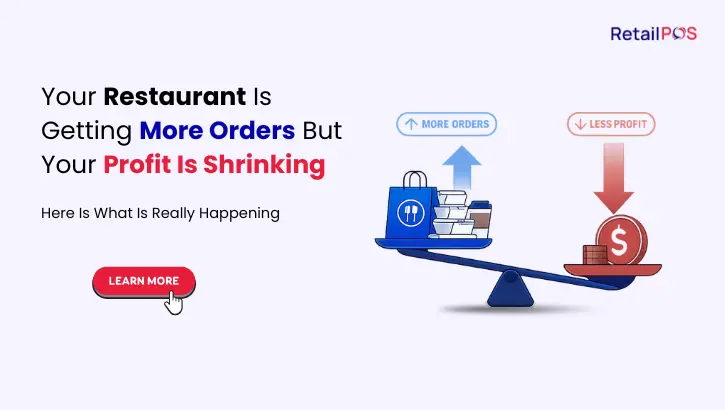
You opened your restaurant with a clear picture in your mind. More customers means more revenue. More revenue means more profit. It is simple math and it made complete sense when you started.
Then something strange happened. Orders went up. The kitchen got busier. Your delivery app notifications never stopped. Your dining room is filled up every weekend. Your Zomato and Swiggy ratings climbed. On paper, everything looked like success.
But at the end of every month, after paying suppliers, staff, rent, platform commissions, and utilities, the amount left over felt smaller than it should be. Sometimes it felt smaller than it did when you were doing half the orders you are doing now.
If this sounds familiar, you are experiencing one of the most common and least talked about problems in the Indian restaurant industry in 2026. More orders. Less profit. And nobody in your operation can explain exactly where the money is going.
This guide breaks down exactly why this happens, where the money is actually going, and what restaurant owners across India are doing to fix it without reducing orders or compromising on food quality.
2. The Restaurant Paradox That Nobody Talks About Openly
The restaurant industry in India is going through a period of extraordinary surface-level growth. Food delivery platforms have expanded the customer base for every restaurant that lists them. QR code menus and digital ordering have made in-dining faster and more convenient. Cloud kitchens have lowered the barrier to entry. New residential areas in cities like Pune, Hyderabad, Bengaluru, and Chennai are generating demand for organised food businesses that did not exist five years ago.
Yet restaurant profitability in India is under more pressure than it has been in a decade. The reason is that revenue growth and profit growth have decoupled. A restaurant doing twice the orders of three years ago is not necessarily making twice the profit. In many cases it is making less profit in absolute terms while working significantly harder.
This decoupling happens because most restaurants in India are scaling their revenue without scaling their operational controls. The kitchen gets busier. The ordering process gets faster. But the systems tracking food cost, wastage, staff productivity, and actual margin per dish remain exactly as informal as they were when the restaurant was doing half the volume.
The result is that every inefficiency in the operation, every percentage point of food cost variance, every hour of untracked staff overtime, every portion that is slightly larger than the recipe card specifies, every dish that sells well but at a margin that does not justify the kitchen time it consumes, scales proportionally with order volume. More orders do not fix these problems. More orders make them more expensive.
3. Reason One: Your Food Cost Is Bleeding Quietly Every Single Day
Food cost is the single largest controllable expense in any restaurant operation. For most Indian restaurants, food cost should sit between 28% and 35% of revenue depending on the cuisine type, price point, and service format. When food cost drifts above this range, it erodes profit faster than almost any other factor.
The problem is that most restaurant owners in India do not know their actual food cost percentage in real time. They know their supplier bills. They know their monthly purchase total. But they do not know what percentage of revenue that purchase total represents after accounting for wastage, portion variance, pilferage, and incorrect recipe execution.
Here is how food cost bleeds in a typical Indian restaurant without anyone noticing:
Portion Inconsistency
Your recipe card says 150 grams of paneer per serving of your best-selling dish. In practice, during a busy Friday evening service, the chef is plating 170 grams because there is no time to weigh every portion and the eye estimate runs a little heavy. On 80 covers that evening, the excess paneer cost adds up. Multiplied across 25 service days a month, this single portion inconsistency across a single ingredient in a single dish becomes a meaningful monthly cost.
Supplier Price Drift
Your supplier has been delivering tomatoes at a certain price per kilogram for months. At some point the price increases by a few rupees. The delivery comes in, the kitchen accepts it, and the higher price gets paid. Nobody in the restaurant has updated the standard recipe cost to reflect the new ingredient price. The menu price stays the same. The margin on every dish containing tomatoes quietly reduces without triggering any alert in your operation.
Purchase Without Recipe Linkage
Most Indian restaurants purchase ingredients based on kitchen estimates or chef intuition rather than recipe-linked purchase planning. The result is ingredients purchased in quantities that do not match actual menu requirements, leading to spoilage of excess perishables and emergency purchases of shortfall items at retail prices rather than supplier rates.
The Fix
A restaurant management system that links your recipe master to your purchase module tracks food cost as a percentage of revenue in real time. Every dish sold reduces the expected ingredient consumption. Every purchase updates the ingredient cost. The system flags when actual food cost percentage deviates from the standard, giving you a daily view of where the bleeding is happening rather than a monthly surprise when you total the supplier bills.
4. Reason Two: Your Staff Cost Is Growing Faster Than Your Revenue
Staff cost is the second largest expense in a restaurant and the one that grows most invisibly in Indian restaurant operations. The reason is not that owners are paying their staff too much. The reason is that staff productivity, attendance, and overtime are almost never tracked with the same rigour as food cost in a typical Indian restaurant.
Consider a restaurant in Indiranagar, Bengaluru with a team of 18 staff across kitchen, service, and management. On a slow Tuesday, 18 staff are present and doing 40 covers. On a busy Saturday, 18 staff are present and doing 120 covers. The staff cost as an absolute number is identical on both days. As a percentage of revenue, it is three times higher on Tuesday than on Saturday.
This variability in staff cost to revenue ratio is normal in restaurants. What makes it a problem is when it is never measured, never managed, and never used to adjust scheduling. Restaurants that schedule staff based on history and habit rather than forecast demand consistently overstaff on slow days and understaff on busy ones, paying the cost both in direct labour expense and in service quality degradation during peak hours.
Overtime is the other invisible component. Kitchen staff in Indian restaurants regularly work beyond their contracted hours during busy periods. Without a system tracking shift times and flagging overtime, these additional labour costs accumulate monthly without any visibility to the owner until the salary processing happens and the numbers are higher than expected.
The Fix
Staff scheduling linked to your sales forecast and POS data allows you to right-size your team for each day’s expected demand. A system that tracks clock-in and clock-out times by staff members gives you a daily labour cost percentage alongside your revenue figure. These two numbers together tell you whether your staff cost is in control or drifting, every single day rather than every single month.
5. Reason Three: Your Wastage Numbers Are Invisible to You
Ask the owner of almost any restaurant in India what their monthly wastage cost is and you will get one of two answers. Either a number that feels like a guess, or an honest admission that they do not really know.
Wastage in a restaurant operation happens in multiple places. Raw ingredient wastage from over-purchasing perishables that do not get used before they spoil. Preparation wastage from over-prepping mis en place that does not get used in service. Plate wastage from dishes that get prepared and then cancelled or returned. Kitchen errors that produce food that cannot be served and gets discarded. End-of-service wastage from prepped items that cannot be held overnight.
Each of these wastage types is real money. The paneer that was prepped for a weekday service that turned out to be slow and sits in the walk-in for three days before being discarded. The bread rolls are baked fresh every morning where 30% are binned at close because the cover count was lower than expected. The cooking oil changed on a fixed schedule regardless of actual usage because nobody is tracking it against covers served.
For a restaurant doing 200 covers a day with an average revenue per cover of Rs 500, a wastage rate of even 3% represents Rs 3,000 per day. That is Rs 90,000 per month going into the bin. For most restaurants in India, the actual wastage rate is higher than 3% and is never measured at all.
The Fix
A kitchen management system that tracks ingredient consumption against theoretical usage based on actual orders served allows you to identify wastage at the ingredient level. When actual consumption of an ingredient consistently exceeds theoretical consumption, the system flags it. The cause could be portion variance, recipe deviation, wastage, or pilferage. Whatever the cause, you now know it is happening and where, rather than absorbing the cost invisibly every month.
6. Reason Four: Delivery Platforms Are Taking More Than You Realise
This is the most discussed profitability challenge in the Indian restaurant industry and also the most frequently miscalculated. Most restaurant owners know that Zomato and Swiggy charge a commission. Fewer have calculated what their effective margin on a delivery order actually is after all platform-related costs are accounted for.
The commission rate is the visible cost. But the full cost of a delivery platform order includes the commission percentage on order value, the packaging cost for delivery-appropriate containers, the food cost variance because delivery dishes sometimes require more robust preparation that uses more ingredients, the customer acquisition cost embedded in platform advertising if you are running paid promotions, and the operational overhead of managing a separate order channel that feeds into the kitchen alongside dine-in orders.
Here is a simplified example of how a delivery order’s true margin compares to a dine-in order for a restaurant in Koramangala, Bengaluru:
Cost Component | Dine-In Order Rs 500 | Delivery Order Rs 500 |
Food cost at 32% | Rs 160 | Rs 160 |
Platform commission at 25% | Nil | Rs 125 |
Packaging cost | Nil | Rs 25 |
Staff cost allocation | Rs 80 | Rs 60 |
Rent and utilities allocation | Rs 70 | Rs 50 |
Total cost | Rs 310 | Rs 420 |
Gross contribution | Rs 190 | Rs 80 |
Effective margin | 38% | 16% |
A restaurant doing 60% of its orders through delivery platforms and 40% through dine-in, without adjusting its menu pricing or operational model for the delivery channel, is systematically generating lower margins on the majority of its orders. As delivery volume grows, overall margin compresses even as overall revenue grows.
The Fix
Separate P&L tracking for your dine-in and delivery channels is the starting point. When you can see the margin contribution of each channel independently, you can make informed decisions about delivery menu pricing, which dishes to promote on delivery platforms versus in-dining, and what level of platform advertising spend is justified given the actual margin the channel generates.
7. Reason Five: Your Kitchen Is Inefficient at Peak Hours
Kitchen inefficiency during peak service is one of the most direct causes of the more orders less profit problem in Indian restaurants and one of the hardest to see from the owner’s perspective because it looks like a capacity problem rather than a systems problem.
Here is what peak hour kitchen inefficiency actually looks like in a restaurant in Anna Nagar, Chennai on a busy Saturday evening:
Orders come in from three channels simultaneously. Table 4 has been ordered through the QR code. Table 7 has given their order verbally to the server who has written it on a pad and is walking to the counter. A delivery order has come in on the tablet from Swiggy. The kitchen has no unified view of all three orders. The chef is managing verbally communicated orders alongside printed KOTs alongside a separate device for delivery orders.
In this environment, orders get made out of sequence. A table that ordered after another table gets their food first because their dish was faster to prepare. The table that has been waiting longer gets frustrated and complains. The kitchen prepares a dish and then realises the table it was meant for has cancelled the item. Preparation time per order increases because the kitchen team is managing communication chaos alongside actual cooking.
The cost of this inefficiency is not just in customer satisfaction. It is in food cost because rushed preparation leads to more errors and more discards. It is in energy cost because equipment runs longer during chaotic service. It is in staff overtime because inefficient service extends the kitchen’s working hours beyond the reservation period.
The Fix
A Kitchen Display System that consolidates all orders from all channels into one prioritised queue, visible to every kitchen station simultaneously, eliminates the communication chaos that drives peak hour inefficiency. Orders are sequenced by time received, station-specific items are routed to the correct preparation point, and the kitchen operates on data rather than verbal instruction during its busiest periods.
8. Reason Six: Your Menu Has Too Many Items That Do Not Make Money
Menu engineering is one of the most powerful profitability levers available to Indian restaurant owners and one of the least used. Most restaurant menus in India have grown organically over time, with dishes added because customers requested them, because a new chef joined and brought their specialties, or because a competitor added something similar and the owner wanted to match it.
The result is menus that are significantly longer than they need to be, carrying items that occupy kitchen prep time, require ingredient purchases, and appear in the customer’s decision process while generating margins that do not justify their presence.
Here is a menu engineering framework that classifies every dish in your menu into one of four categories:
Category | High Popularity | Low Popularity |
High Margin | Stars: Promote heavily, protect quality | Puzzles: Improve visibility and marketing |
Low Margin | Plowhorses: Reprice or reformulate | Dogs: Remove or significantly reformulate |
Most Indian restaurant menus, when analysed honestly against sales data and actual dish-level margins, contain a significant number of Dogs and Plowhorses. The Dogs are dishes that neither sell well nor make money. They occupy menu space, require ingredients to be purchased and held, and consume kitchen prep time that could be spent on Stars.
The Plowhorses are more dangerous because they are often popular dishes that create a false sense of contribution. A biryani that sells 80 portions a day looks like a success. But if the food cost on that biryani is 48% because of the ingredient cost and portion size, it is generating less margin per cover than a starter that sells 30 portions a day at a 65% gross margin.
The Fix
A restaurant POS system that tracks dish-level sales volume and links to your recipe cost data produces a real menu engineering analysis automatically. You can see exactly which dishes are Stars, which are Dogs, and which Plowhorses need repricing. This analysis, done monthly, gives you the data to make menu decisions based on profitability rather than assumption.
9. Reason Seven: You Are Not Tracking Table Turnover or Average Order Value
Two metrics that directly determine restaurant profitability are consistently undertracked in Indian restaurant operations: table turnover rate and average order value per cover.
Table turnover rate is the number of times a table is occupied and cleared during a service period. For a restaurant in Jubilee Hills, Hyderabad with 40 covers and an average dining time of 75 minutes operating a 4-hour dinner service, the theoretical maximum turnover is approximately 3.2 covers per table. If actual turnover is averaging 1.8 covers per table, 44% of potential revenue capacity is being left on the table every service.
The causes of low turnover are multiple. Slow order taking because staff are not prompted by a system when a table has been seated for more than a set time. Long gaps between courses because the kitchen has no visibility into table status. Delayed billing because the server is busy with another table and the customer has to wait to ask for the check. Each of these delays reduces turnover and directly reduces revenue without any corresponding reduction in fixed costs.
Average order value is the other undertracked metric. A table of 4 that orders 2 starters, 4 mains, and no beverages generates less revenue than a table of 4 that orders 2 starters, 4 mains, 4 beverages, and a dessert. The difference is not just in revenue. Beverages and desserts typically carry significantly higher margins than mains. A table that orders beverages and desserts is often more profitable than one that spends more on food alone.
The Fix
A POS system with table management that tracks time since seating, time since last order, and average order value per cover gives your floor team the prompts they need to improve both metrics systematically. When a table has been seated for 15 minutes without an order, the system alerts the server. When a table finishes their mains, the system reminds the server to offer desserts and beverages before bringing the check.
10 . How Technology Fixes the Restaurant More Orders Less Profit Problem
The common thread running through every reason listed above is visibility. Every profitability leak described in this guide exists primarily because the restaurant owner does not have real-time, accurate data showing it is happening.
Food cost bleeds because there is no system linking recipe cost to purchase price to actual usage in real time. Staff cost grows because scheduling is not connected to demand forecasting. Wastage accumulates because there is no tracking of actual versus theoretical ingredient consumption. Delivery margins compress because there is no channel-wise P&L. Kitchen inefficiency continues because there is no unified order management across channels. Menu profitability is unknown because dish-level margin data is not connected to sales data.
A purpose-built restaurant management system fixes all of these visibility gaps simultaneously. Here is what the technology does across each problem area:
Problem Area | What the System Tracks | What It Enables |
Food cost variance | Actual vs theoretical ingredient consumption per dish | Daily food cost percentage visibility and variance alerts |
Staff cost management | Clock-in and clock-out times linked to cover count | Labour cost as percentage of revenue tracked daily |
Wastage tracking | Ingredient usage against order-based theoretical consumption | Wastage identification at ingredient and dish level |
Delivery channel margin | Channel-wise revenue, commission, and cost tracking | Independent P&L for dine-in and delivery channels |
Kitchen efficiency | Unified KDS with order time tracking across all channels | Preparation time per dish and peak hour performance data |
Menu engineering | Dish-level sales volume linked to recipe cost data | Automatic Star, Plowhorse, Puzzle, and Dog classification |
Table turnover | Time-since-seating and time-since-order tracking | Server alerts and turnover rate reporting by service period |
Average order value | Per-cover revenue tracking with category breakdown | Upsell prompts and beverage and dessert attachment rate data |
GST compliance | Automatic HSN mapping and return data preparation | GSTR-1 and GSTR-3B ready without manual data compilation |
Multi-outlet control | Centralised dashboard for all restaurant locations | Real-time visibility across every outlet from one screen |
11. What RetailPOS Delivers for Indian Restaurants
RetailPOS is built for the Indian restaurant and food service environment, covering quick service restaurants, full-service dining, bakeries, cloud kitchens, and multi-outlet food chains across India. The platform addresses every profitability leak described in this guide through integrated technology that connects your billing, kitchen, inventory, and management reporting into one unified system.
For restaurant owners dealing with the more orders less profit problem, RetailPOS delivers:
- Fast touchscreen billing with multi-channel order integration covering dine-in, delivery, and takeaway from one system
- Kitchen Display System that consolidates all orders from all channels into one prioritised kitchen queue
- Recipe master linked to purchase management for real-time food cost percentage tracking
- Ingredient-level consumption tracking with actual versus theoretical usage variance alerts
- Staff management with shift tracking and labour cost as a percentage of revenue reporting
- Table management with time-since-seating alerts and turnover rate reporting by service period
- Dish-level sales and margin data for menu engineering analysis updated in real time
- Channel-wise revenue reporting separating dine-in and delivery contribution independently
- GST-compliant invoicing with automatic HSN mapping and return data preparation
- Multi-outlet dashboard for restaurant chains to monitor all locations from one centralised view
For restaurant chains with multiple locations, RetailPOS extends all of these capabilities across every outlet simultaneously, with centralised menu management, consolidated reporting, and unified customer loyalty that works across every location in the chain.
You can explore how RetailPOS handles restaurant management for your specific format by visiting our restaurant POS software page or reading our guide on how retail ERP software supports multi-outlet food businesses.
12.Conclusion
More orders with less profit is not a market problem. It is an operational visibility problem. Every restaurant in India experiencing this pattern has the same underlying issue: the operation is scaling faster than the systems tracking it.
The money is not disappearing. It is leaking through food cost variance, staff scheduling gaps, invisible wastage, delivery platform margin compression, kitchen inefficiency, unprofitable menu items, and undertacked table and order metrics. Each of these leaks is fixable. But none of them can be fixed until they are visible.
The restaurant owners in India who are growing both revenue and profit in 2026 are not doing something fundamentally different in their kitchens or dining rooms. They are using systems that show them exactly what is happening in their operation every day, so they can make decisions based on data rather than instinct and fix problems before they compound into monthly losses.
If your restaurant is getting more orders but your profit is shrinking, the first step is not to cut costs or raise prices. The first step is to install the visibility that shows you where the money is actually going.
Book a free demo with the RetailPOS team and see exactly how the platform handles your specific restaurant format, your channel mix, and your operational complexity in a live demonstration built around your actual business.

 Book your demo
 Talk to our POS experts
- 📧 Email: salesenquiry@uniprotech.co.in
Run your store with confidence. Let technology handle the complexity.
Or WhatsApp our team directly – we respond within minutes.
Or call us at 95662 44611
13. Frequently Asked Question
The most common reasons are food cost variance from portion inconsistency and supplier price drift, staff cost growing faster than revenue due to unoptimised scheduling, invisible wastage at the ingredient and preparation level, delivery platform commissions compressing margins on your highest-volume channel, kitchen inefficiency during peak hours, and menu items that sell well but generate low margins. The root cause in almost every case is a lack of real-time visibility into where each rupee of revenue is going. A restaurant management system that tracks food cost, labour cost, wastage, and dish-level margin simultaneously gives you the data to identify and fix each of these leaks.
For most Indian restaurant formats, a food cost between 28% and 35% of revenue is considered healthy. Quick service restaurants and cloud kitchens targeting higher volume at lower price points should aim for the lower end of this range. Full-service restaurants with premium ingredients and table service can sustain the higher end. When food cost consistently exceeds 38%, it is almost always a signal of portion variance, ingredient pilferage, supplier price drift, or recipe deviation that requires immediate investigation rather than a menu price increase.
The effective margin on a delivery platform order is typically 40% to 60% lower than the equivalent dine-in order when all costs are accounted for. A dish that generates a 35% margin in-dining may generate only 12% to 18% margin on a delivery platform after commission, packaging, and channel-specific operational costs are subtracted. Restaurants that have not separated their dine-in and delivery P&L are almost certainly overestimating their actual profitability because they are averaging high-margin dine-in revenue with low-margin delivery revenue into one blended number.
Menu engineering is the practice of classifying every dish in your menu by its popularity and its margin contribution, then making strategic decisions about each category. High popularity, high margin dishes called Stars should be prominently featured and their quality protected. High popularity, low margin dishes called Plowhorses should be repriced or reformulated to improve margin. Low popularity, high margin dishes called Puzzles need better visibility and marketing. Low popularity, low margin dishes called Dogs should be removed or significantly changed. Most Indian restaurant menus, when analysed honestly, carry 20% to 30% of their items in the Dog category, consuming kitchen prep time and ingredient purchasing budget without contributing meaningfully to profitability.
A Kitchen Display System consolidates all orders from all channels including dine-in, delivery, and takeaway into one prioritised queue visible to every kitchen station simultaneously. This eliminates the verbal communication overhead that causes preparation errors, order sequencing mistakes, and extended ticket times during peak service. Faster and more accurate kitchen execution reduces food waste from errors, reduces staff overtime from extended service periods, and improves table turnover by shortening the time between order placement and food delivery. For restaurants doing significant delivery volume alongside dine-in service, a KDS is the single most impactful kitchen technology investment available.
Yes. RetailPOS links your recipe master to your purchase module and your billing system so that every dish sold reduces the theoretical ingredient consumption in real time. The platform tracks actual ingredient usage against theoretical usage based on orders served and flags variances that indicate wastage, portion deviation, or pilferage. Food cost percentage is updated after every service rather than calculated once a month when the supplier bills arrive. This real-time food cost visibility is the foundation of the operational control that allows restaurant owners to fix profitability problems as they emerge rather than discovering them weeks after the money has already been lost.