
Powered by Unipro Tech
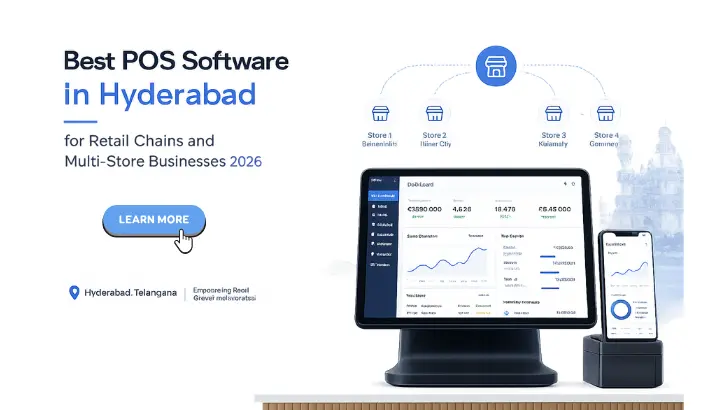
Best POS Software in Hyderabad for Retail Chains and Multi-Store Businesses 2026
1. Introduction
Hyderabad is one of India’s most commercially dynamic cities and its retail sector reflects that energy in full. From the established luxury corridors of Banjara Hills and Jubilee Hills to the high-density residential markets of Kukatpally and LB Nagar, from the technology-driven consumer base in Madhapur to the traditional commercial heartlands of Ameerpet, Himayatnagar, and Secunderabad, retail chains across Hyderabad are scaling faster than most operational systems can handle.
A supermarket chain that started in Kukatpally three years ago now operates seven outlets across the city. A pharmacy chain that began in Banjara Hills has expanded to Madhapur, Ameerpet, and LB Nagar. A textile retail group with its flagship on Himayatnagar’s commercial strip has opened outlets in Jubilee Hills and Secunderabad. And every one of these businesses is asking the same fundamental question: how do we manage this growth without losing operational control?
The answer begins and ends with the enterprise POS software running at the core of the operation.
This guide is written specifically for retail chain owners and multi-store business operators in Hyderabad who are evaluating enterprise POS software in 2026. It is not a guide for single-outlet retailers. It is a guide for businesses that are already managing multiple locations or are planning to within the next 12 to 24 months and need a platform that is built for that complexity from the ground up.
2. Why Hyderabad Retail
Chains Need Enterprise POS Software in 2026
Hyderabad’s retail market has characteristics that create specific requirements for multi-store management technology. Understanding these characteristics is the foundation for making the right software decision for your chain.
Hyderabad is one of the fastest-growing urban economies in India. The city’s IT sector has created a large, high-income, digitally sophisticated consumer population concentrated in corridors like Madhapur, Kondapur, Gachibowli, and Hitec City. This population has high average transaction values, strong brand loyalty expectations, and a preference for seamless digital experiences including digital payments, app-based loyalty, and consistent pricing across every outlet they visit.
At the same time, Hyderabad’s traditional retail markets in Ameerpet, Secunderabad, LB Nagar, and Himayatnagar serve a different but equally important consumer segment: high-volume, price-sensitive shoppers who value convenience, product availability, and personalised service from retailers they have trusted for years.
A retail chain operating across both these consumer environments faces a complex management challenge. The pricing strategy, product mix, and customer engagement approach that works in Madhapur is different from what works in LB Nagar. But the operational infrastructure, the inventory management, the compliance framework, and the financial reporting must be unified across all outlets simultaneously.
This is precisely what single-store POS software cannot deliver and what enterprise multi-store retail management software is built to handle.
Hyderabad also sits at the centre of Telangana’s GST compliance environment. Retail chains with outlets across the city and the surrounding districts manage significant compliance complexity, particularly those with B2B billing alongside B2C, multiple GSTINs for different business entities, and the e-invoicing mandate that applies above the notified turnover threshold.
3. The Hyderabad Retail Landscape: Area by Area
Understanding the retail characteristics of each major area in Hyderabad allows retail chain owners to configure their operations and their technology appropriately for each location.
Banjara Hills
Banjara Hills is Hyderabad’s most established premium retail destination. The area’s consumer base has high disposable income, strong brand awareness, and high expectations for service quality and product consistency. Retail chains in Banjara Hills deal with high average transaction values, significant weekend footfall variance, and customers who actively compare their experience at this outlet against the chain’s other locations. CRM, loyalty programme quality, and pricing consistency across the chain are particularly important for retailers operating here.
Jubilee Hills
Jubilee Hills sits alongside Banjara Hills as one of Hyderabad’s premium retail corridors and shares many of the same consumer characteristics. The area has a strong concentration of organised retail formats including supermarkets, specialty stores, and branded apparel outlets. Retailers in Jubilee Hills deal with a consumer base that is digitally active, expects loyalty programmes to function seamlessly, and will notice immediately if the pricing or product availability at this outlet differs from another outlet in the chain they visited recently.
Kukatpally
Kukatpally is one of Hyderabad’s highest-density residential and commercial areas and one of the most important markets for retail chains targeting middle-income consumers at high transaction volumes. The KPHB Colony residential cluster generates consistent daily footfall for grocery, pharmacy, and convenience retail. Retail chains in Kukatpally deal with significant peak hours during morning and evening office commute periods and a consumer base that strongly prefers UPI payment and expects fast billing counter speeds.
Himayatnagar
Himayatnagar is a traditional commercial hub in central Hyderabad with a dense mix of retail formats from textiles and electronics to pharmacies and supermarkets. The area has a mix of long-established retailers with deep customer loyalty and newer chains expanding into the market. Retailers here deal with high competition for customer attention and a consumer base that spans both the surrounding residential areas and visitors from other parts of the city drawn to the commercial density.
Ameerpet
Ameerpet is one of Hyderabad’s most commercially active intersections, serving both residential consumers and the large working population in the area. The retail environment is highly competitive with significant price sensitivity. Retail chains in Ameerpet need fast billing, accurate inventory, and strong promotional management to compete effectively. The area also has significant B2B retail activity with small businesses purchasing in bulk from organised retailers.
Secunderabad
Secunderabad functions as a twin city to Hyderabad and has its own distinct retail ecosystem centred around MG Road, Paradise Circle, and the surrounding residential and commercial areas. The consumer base here has deep-rooted preferences for established retailers and strong word-of-mouth influence. Retail chains that have built a presence in Secunderabad typically find it one of their highest-loyalty customer bases if they maintain consistent quality and pricing.
Madhapur
Madhapur and the broader Hitec City corridor represent Hyderabad’s technology-driven retail market. The large IT workforce in this area creates strong demand for organised retail, particularly convenience formats, supermarkets, and food businesses catering to working professionals. The consumer base here is highly digitally engaged, expects app-based loyalty interaction, and has the highest UPI and digital payment adoption rate in the city.
LB Nagar
LB Nagar serves as the primary commercial hub for south-east Hyderabad and a gateway to the significant residential population in Vanasthalipuram, Saroornagar, and surrounding areas. Retail chains expanding southward from central Hyderabad typically use LB Nagar as their anchor location for this corridor. The market is price-sensitive with high volume potential and strong demand for grocery, pharmacy, and convenience retail.
4. What Multi-Store Retail Chain Owners in Hyderabad Are Struggling With
Before evaluating any enterprise POS software, it is important to map the specific problems that Hyderabad retail chain owners are dealing with right now. These problems are consistent across retail categories and outlet counts.
Inventory Blindness Across Outlets
A supermarket chain with outlets in Kukatpally, Madhapur, and LB Nagar cannot see real-time stock positions across all three locations without manual stock counts or phone calls to store managers. When a product runs out at the Madhapur outlet, nobody at head office knows until a customer complaint triggers a call. Meanwhile, the same product may be sitting in excess at the LB Nagar outlet with no visibility to the team that could arrange a transfer.
Pricing Inconsistency Across the Chain
A Bonalu season promotion needs to go live at all outlets simultaneously with the correct prices. When pricing is managed at the local outlet level rather than centrally, inconsistencies appear. A customer who visited the Banjara Hills outlet on Saturday and then visits the Secunderabad outlet on Sunday notices immediately if the promotional price differs. This inconsistency damages trust in the chain brand far more than most retailers realise.
GST Compliance Consuming Weeks Every Month
Retail chains with outlets across Hyderabad and surrounding areas spend significant accounts team time preparing GST returns manually because their billing data and accounting data are in separate systems. For chains with both B2C and B2B billing, the GSTR-1 preparation is particularly complex and time-consuming. Errors made in monthly filings compound into annual return discrepancies that require amendment filings and create audit risk.
No Real-Time Management Visibility
By the time manually compiled reports from each outlet reach the head office, the information is one to two days old. A fast-moving stockout situation at the Kukatpally outlet that could have been addressed with a same-day inter-outlet transfer becomes a lost sales event because the head office did not know about it until the next morning’s report. Decisions made on delayed data are always behind the operational reality.
Disconnected Customer Loyalty
A customer who shops regularly at the Jubilee Hills outlet and has accumulated significant loyalty points expects to use them at the Ameerpet outlet when they are in that area. When the loyalty system is outlet-specific, this expectation fails at the most important moment in the customer relationship, when they are standing at the counter ready to redeem. The result is a loyalty programme that actively disappoints customers rather than retaining them.
Staff Accountability Gaps
Without cashier-level transaction tracking and role-based access controls across the chain, managing staff accountability at outlets the owner cannot visit daily is a persistent challenge. Cash discrepancies, unauthorised discounts, and inventory handling lapses go undetected until they have accumulated into meaningful financial losses.
5. What Enterprise POS Software for Hyderabad Retail Chains Must Do
Given the specific characteristics of Hyderabad’s retail market and the operational challenges multi-store chain owners face, here is what enterprise POS software for Hyderabad retail chains must deliver as non-negotiable baseline capability:
Centralised Multi-Outlet Management
Every outlet in the chain must be connected to a single backend platform. Inventory, pricing, compliance, customer data, and reporting must flow through one central system that gives head office complete real-time visibility across all locations simultaneously.
Real-Time Inventory Across All Hyderabad Outlets
Stock positions at every outlet must update in real time after every transaction. The head office must be able to see how much of any product is available at every outlet at any moment and act on that information immediately, whether that means approving a transfer, raising a purchase order, or flagging a discrepancy.
Centralised Pricing and Promotion Management
Pricing must be set and controlled from head office and pushed to all outlets simultaneously. Festival promotions for Bonalu, Dussehra, and Sankranti must go live at every outlet at the correct time without depending on local store managers to update their systems correctly.
Enterprise-Grade GST Compliance
Full GST automation from HSN mapping to GSTR-1 preparation to e-invoicing must be built into the billing workflow, not bolted on as a separate process. For chains with multiple GSTINs, the system must handle separate compliance records per registration with a consolidated overview for the head office.
Chain-Wide Customer Loyalty
Loyalty must work across the entire chain. Points earned at Madhapur must be redeemable at Kukatpally. Customer profiles must be accessible at any outlet. Campaign communications must be manageable from one central CRM for the entire customer base.
Scalable Architecture
The platform must handle the chain as it is today and as it will be in three years without requiring a system change at each growth milestone. Adding a new outlet should be a configuration task, not a technology project.
6. Key Features Comparison Table for Hyderabad Retail Chains
Feature | Why It Matters for Hyderabad Chains | Enterprise Requirement Level |
Real-time multi-outlet inventory | Managing stock across Kukatpally, Madhapur, LB Nagar simultaneously | Non-negotiable |
Centralised pricing and promotions | Bonalu, Dussehra, Sankranti promotion consistency at all outlets | Non-negotiable |
GST-compliant invoicing with HSN mapping | Telangana retail compliance with automatic rate application | Non-negotiable |
E-invoicing with direct IRP integration | B2B billing at and above the e-invoicing threshold | Non-negotiable |
GSTR-1 and GSTR-3B automated preparation | Eliminating monthly manual accounts team effort | Non-negotiable |
Multi-GSTIN support | Chains with separate registrations across entities or states | Non-negotiable for chains |
Inter-outlet stock transfer management | Moving excess from LB Nagar to Madhapur with document trail | Non-negotiable |
Chain-wide customer loyalty and CRM | Points earned at Banjara Hills redeemable at Ameerpet | Non-negotiable |
Role-based access control | Outlet managers see their data, HQ team sees everything | Non-negotiable |
Automated purchase order generation | Reorder triggered by real-time sales velocity per outlet | High priority |
Mobile owner dashboard | Real-time chain visibility for owners travelling or off-site | High priority |
Staff shift and attendance tracking | Cashier-level accountability across all outlets | High priority |
Expiry and batch number tracking | Pharmacy and FMCG chains in Hyderabad | Non-negotiable for pharma |
Offline billing capability | Billing continuity during connectivity interruptions | Non-negotiable |
Kitchen Display System | QSR and food chains in Madhapur and Kukatpally | Non-negotiable for F&B |
7. POS Software by Retail Category in Hyderabad
Supermarket and Grocery Chains
Supermarket chains across Hyderabad manage thousands of SKUs spanning multiple GST rate categories within a single transaction. The enterprise POS system must handle barcode-based fast billing, automatic HSN-level tax rate application across all slabs from nil-rated to 18%, weighing scale integration for loose products, and purchase management linked to real-time sales velocity data for automated reorder management. Chains managing outlets across Kukatpally, LB Nagar, and Madhapur need centralised stock visibility and inter-outlet transfer capability as absolute baseline requirements.
Pharmacy Chains
Pharmacy chains in Hyderabad face the most compliance-intensive retail environment in the city. Batch number and expiry date tracking is mandatory at every outlet. Scheduled drug restrictions must be enforced automatically at the billing counter. GST rates across pharmaceutical products span multiple slabs and must be applied with complete accuracy. For chains with outlets from Banjara Hills to LB Nagar, centralised near-expiry stock alerts and inter-outlet transfer management protect margin and ensure compliance simultaneously.
Textile and Apparel Chains
Textile retailers in Hyderabad manage complex variant inventory across sizes, colours, and styles. A single style may generate 30 or more individual SKUs when size and colour combinations are accounted for, each of which must be tracked separately across every outlet in the chain. The enterprise POS system must support a size and colour variant matrix with fast navigation for counter staff and centralised pricing management for seasonal promotions across all locations simultaneously.
Electronics and Mobile Retail Chains
Electronics chains need individual serial number tracking from purchase receipt through to sale and post-sale warranty management. High-value inventory controls, cashier-level transaction authorisation for above-threshold sales, and inter-outlet transfer tracking for demonstration units are requirements that generic retail POS systems rarely address adequately. For chains with outlets in Himayatnagar, Ameerpet, and Secunderabad, serial number visibility across the chain is a non-negotiable operational requirement.
Quick Service Restaurant Chains
QSR chains in Madhapur and Kukatpally deal with high transaction volumes during peak hours, multiple simultaneous order channels including counter, delivery platforms, and app orders, and kitchen management requirements that go beyond standard retail billing. The enterprise POS must include Kitchen Display System integration, delivery platform order consolidation into a single kitchen queue, and recipe-linked inventory tracking for food cost management.
8. How Hyderabad Retail Chains Manage All Outlets From One Dashboard
For a retail chain owner managing outlets across Hyderabad, the centralised dashboard is the operational foundation that makes scaling possible without proportionally scaling the management team.
Consider a supermarket chain owner with outlets in Banjara Hills, Kukatpally, Ameerpet, Madhapur, and LB Nagar. Every morning at 8:30 AM, before visiting any outlet, this owner opens one screen and sees the following without making a single phone call:
Yesterday’s outlet-wise revenue compared to the same day the previous week, showing which outlet outperformed and which underperformed against expectations. Products that dropped below reorder level overnight at any of the five outlets, with system-generated purchase orders already prepared for approval. Cash reconciliation variances at any outlet above the set threshold, with the specific cashier and transaction flagged for investigation. Delivery orders pending fulfilment at any outlet and the average fulfilment time per location.
By 9 AM, the owner has approved four purchase orders, initiated one stock transfer from LB Nagar to Madhapur for a fast-moving product, and sent a message to the Ameerpet store manager about a cash variance the system detected overnight.
This level of operational visibility and control across five outlets, available from a single mobile screen, transforms what a retail chain owner can manage without being physically present at every location. The key outcomes this centralised management delivers for Hyderabad retail chains include:
- Daily operational decisions made on real-time data rather than next-day manual reports
- Festival promotions for Bonalu, Dussehra, and Sankranti pushed to all outlets simultaneously from one screen
- Stock transfers between outlets managed digitally with a complete document trail and no phone calls
- GST return data prepared automatically from all outlets combined without manual data collection
- Customer loyalty points usable across the entire chain with balance updated after every transaction at every outlet
- Purchase decisions based on outlet-specific real-time sales velocity rather than weekly stock count estimates
9. GST Compliance for Telangana Retail Chains
GST compliance for retail chains in Hyderabad and Telangana has specific dimensions that make it important to choose enterprise POS software with deep, reliably updated compliance capabilities.
Every retail transaction must carry the correct HSN code and corresponding GST rate. For supermarket chains managing thousands of products across multiple tax slabs in a single transaction, manual rate assignment is operationally impossible. The system must maintain a complete HSN master with automatic rate mapping at the product level, applied without any operator decision at the billing counter.
For B2B transactions above the e-invoicing threshold, the invoice must be registered on the Invoice Registration Portal before it reaches the buyer. The IRN and digitally signed QR code must appear on the invoice as it is printed. This must happen automatically within the billing workflow without any separate portal login by the counter operator.
For Hyderabad retail chains that have expanded beyond Telangana into Andhra Pradesh, Karnataka, or Maharashtra, each state registration requires separate compliance records. The enterprise POS system must generate outlet-wise or GSTIN-wise return data automatically from the billing transactions at each location while providing a consolidated compliance overview for the head office.
GST Compliance Requirement | Single GSTIN Hyderabad Chain | Multi-State Chain with Multiple GSTINs |
HSN code mapping | Unified product master with automatic rate application | Same unified master applied across all GSTINs |
E-invoicing with IRN | Required at all outlets above threshold | Required at every outlet under each GSTIN |
GSTR-1 preparation | All outlet data aggregated into one return | Separate return data generated per GSTIN automatically |
GSTR-3B preparation | Single monthly summary return | Separate monthly summary per GSTIN |
ITC reconciliation | Chain-wide supplier purchase matching | Entity-wise supplier purchase matching |
Credit note management | Chain-wide with outlet attribution | GSTIN-wise with outlet attribution |
Annual return support | Consolidated full year data from all outlets | Full year data per GSTIN with consolidated overview |
10. How to Evaluate Enterprise POS Software for Your Hyderabad Retail Chain
With multiple POS software options available in the Hyderabad market, here is a practical evaluation framework for retail chain owners making this decision:
Step 1: Define Your Chain’s Current and 24-Month Future State
Document your current outlet count, your planned outlets in the next two years, your GSTIN structure, and your key operational challenges. The software you choose must serve your business as it will be in two years, not just as it is today. A system that fits three outlets but requires migration at ten is not an enterprise solution.
Step 2: Demand a Live Demo With Your Specific Scenarios
Ask every vendor to demonstrate their system using your product categories, your outlet structure, and your specific GST configuration. How the platform handles a centralised Bonalu promotion price push to all outlets, a real-time stock transfer from Secunderabad to Banjara Hills, and an automatic GSTR-1 preparation across all outlets is more revealing than any feature brochure.
Step 3: Test the System Under Stress Conditions
Ask what happens when the internet goes down at one outlet during peak hours. Ask what happens when two outlets simultaneously process a return against the same customer’s loyalty account. Ask what happens when a cashier at the LB Nagar outlet attempts to apply a discount above their authorised level. Systems that handle these scenarios correctly in the demo will handle them correctly in your operation.
Step 4: Verify the Compliance Update Process
GST rates, e-invoicing thresholds, and compliance requirements change periodically. Ask the vendor how quickly their system is updated when a compliance change is announced by the government and how that update is delivered to your live system. A vendor who cannot answer this clearly is a compliance risk for your business.
Step 5: Ask for References From Hyderabad Retail Chains
Ask the vendor for references from retail chains in Hyderabad or Telangana who have been using the system for at least 12 months with a similar outlet count and retail category. Speaking to a supermarket chain owner in Kukatpally who has used the platform through a full Dussehra and Sankranti season is more valuable than any sales presentation.
11. What RetailPOS Delivers for Hyderabad Multi-Store Retail Chains
RetailPOS has been serving Indian retail chains for over 20 years and is trusted by multi-outlet businesses across supermarkets, apparel, pharmacy, electronics, and food categories throughout India including retail chains across Telangana. The platform is purpose-built for the Indian retail chain environment with enterprise-grade multi-store management, deep GST compliance, and the operational depth that Hyderabad retail chains specifically require.
For multi-store retail chain owners in Hyderabad, RetailPOS delivers:
- Fast touchscreen billing on tablet, mobile, and desktop hardware with barcode scanning and weighing scale integration at every outlet
- Real-time inventory visibility across all outlets with inter-outlet stock transfer management and digital approval workflow
- Centralised pricing and promotion management with instant push to all outlets for Bonalu, Dussehra, Sankranti, and daily promotions
- Complete GST compliance including HSN master with automatic rate mapping, e-invoicing with direct IRP integration, and GSTR-1 and GSTR-3B automated preparation across all outlets
- Multi-GSTIN support for chains operating across Telangana and other states with separate compliance records per registration
- Automated purchase order generation based on real-time outlet-level sales velocity and configurable reorder thresholds
- Chain-wide customer loyalty and CRM with points usable at any outlet and campaign management from one central platform
- Role-based access control with outlet-level permissions for store managers and full chain visibility for head office teams
- Mobile owner dashboard for complete chain performance monitoring from anywhere in real time
- Expiry date and batch number tracking for pharmacy and FMCG chains with centralised near-expiry alerts
- Size and colour variant management for textile and apparel chains with inter-outlet transfer capability
- Kitchen Display System integration for QSR and food chains in Madhapur, Kukatpally, and beyond
- Staff management with shift tracking and cashier-level transaction accountability across all outlets
- Offline billing at every outlet with automatic sync when connectivity is restored
For Hyderabad retail chains planning expansion to Vijayawada, Visakhapatnam, Bengaluru, or beyond Telangana, RetailPOS scales with the same platform architecture, adding outlets and GSTINs as configuration without requiring any system change at each growth milestone.
Explore how RetailPOS works for your specific retail chain by visiting our multi-store retail management page or reading our detailed guide on how retail ERP software supports Indian retail chains in 2026.
12. Conclusion
Hyderabad’s retail market is one of the most commercially dynamic in India and its multi-store retail chains are operating in an environment that demands enterprise-grade operational infrastructure, not single-store software stretched beyond its design limits.
The retail chain owners who are scaling profitably from Banjara Hills and Jubilee Hills to Kukatpally, Madhapur, LB Nagar, Ameerpet, Himayatnagar, and Secunderabad are doing it through centralised management systems that give them real-time visibility, operational control, and compliance accuracy across every outlet simultaneously.
The best POS software in Hyderabad for retail chains in 2026 is not the most affordable entry-level option or the most feature-heavy global platform. It is the enterprise solution purpose-built for the Indian retail chain environment, handling Telangana’s compliance requirements reliably, scaling with your expansion without system replacement, and giving your management team the real-time data they need to make fast, accurate decisions across every outlet in your chain.
If you manage a retail chain in Hyderabad and are evaluating enterprise POS software, the RetailPOS team is ready to show you exactly how the platform handles your outlet structure, your product categories, and your compliance requirements in a live demonstration built around your actual business.
Book a free demo with the RetailPOS team today and see the enterprise difference.
Frequently Asked Question
The best enterprise POS software for retail chains in Hyderabad in 2026 is one that delivers real-time multi-outlet inventory management, centralised pricing and promotion control, full GST compliance including e-invoicing and automated return preparation, chain-wide customer loyalty, and scalable architecture that grows with the chain without system replacement. RetailPOS meets all of these enterprise requirements and has over 20 years of experience serving multi-store retail chains across India including businesses throughout Telangana.
Enterprise POS software connects all outlets to a single backend platform, giving head office real-time visibility into inventory, sales, compliance, and staff performance across every location simultaneously. A retail chain managing outlets in Banjara Hills, Kukatpally, Madhapur, Ameerpet, and LB Nagar can see consolidated performance data, push centralised pricing updates, manage inter-outlet stock transfers digitally, and prepare GST returns automatically from one platform without manual data collection from each store.
Hyderabad retail chains need HSN code mapping with automatic rate application across all GST slabs, e-invoicing with direct IRP integration for B2B transactions above the threshold, automated GSTR-1 and GSTR-3B preparation from all outlet billing data, multi-GSTIN support for chains operating across Telangana and other states, ITC reconciliation against GSTR-2B, and reliable compliance updates when GST rules change. For chains with both B2B and B2C billing, the system must handle both invoice types with the correct compliance treatment automatically.
Yes. RetailPOS supports all the specific requirements of pharmacy chains in Hyderabad including batch number and expiry date tracking at every outlet, centralised near-expiry stock alerts with inter-outlet transfer management, scheduled drug restriction enforcement at the billing counter, multi-slab GST application across pharmaceutical product categories, and multi-GSTIN compliance for chains that have expanded beyond Telangana. The platform manages all of these requirements from one centralised system across every outlet in the chain.
RetailPOS is designed to scale from a two-outlet chain to a 200-outlet national retail operation on the same platform architecture. Adding a new outlet in Hyderabad or in any other city is a configuration task within the existing system, not a technology project requiring new software. The platform's architecture was designed for chain management from the ground up, which means it handles the operational complexity of a large chain without the performance degradation or feature limitations that single-store software experiences when stretched across multiple locations.
For a retail chain with five to ten outlets in Hyderabad, a typical implementation runs six to ten weeks from contract signing to full chain go-live. This includes data preparation and product master standardisation, outlet-level system configuration and hardware setup, staff training at each location, a parallel run period to validate billing and inventory accuracy, and phased go-live outlet by outlet. RetailPOS implementations for Hyderabad chains include dedicated support throughout the process with experience in the specific compliance and operational requirements of Telangana retail businesses.

 Book your demo
 Talk to our POS experts
- 📧 Email: salesenquiry@uniprotech.co.in
Run your store with confidence. Let technology handle the complexity.
Or WhatsApp our team directly – we respond within minutes.
Or call us at 95662 44611