
Powered by Unipro Tech
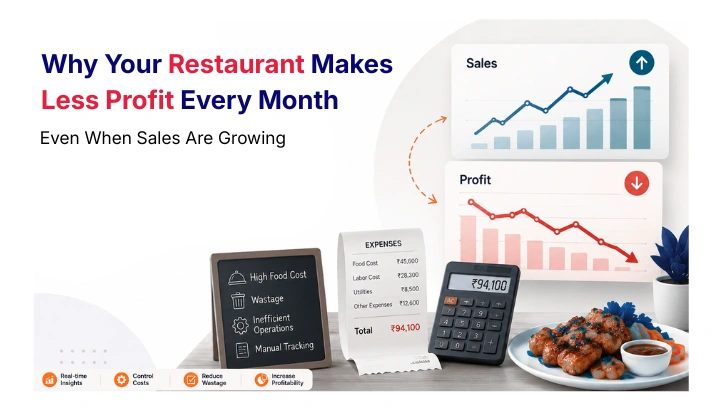
Why Your Restaurant Makes Less Profit Every Month Even When Sales Are Growing
1. The Most Confusing Problem in Indian Restaurants Today
You opened your restaurant because you love food, hospitality, and the energy of a busy dining room. You have built something real. Customers are coming. Tables are full on weekends. Your Zomato dashboard shows orders ticking up month on month. By every visible measure, your business is growing.
So why does your bank account not agree?
This is the most common and most demoralising experience in Indian restaurant ownership today. Sales are climbing. The kitchen is busier than ever. Staff are running full pace. And yet at the end of every month, when you sit down with your accounts, the profit number is smaller than it was three months ago. Sometimes it has disappeared entirely. Sometimes, on paper, you are in loss.
You are not alone and you are not imagining it.
The restaurant industry in India runs on some of the thinnest margins of any business category. Food costs typically consume 28 to 40% of revenue. Labour takes another 25 to 31%. Rent in prime locations like Indiranagar in Bangalore, Banjara Hills in Hyderabad, or MG Road in Kochi can consume 15 to 25% of total revenue on its own. Add GST, packaging, utilities, aggregator commissions, and marketing, and the window for actual profit is narrow to begin with.
What makes this worse is that most Indian restaurant owners are managing all of these cost pressures without the real-time visibility to know which one is draining their margin the most. They discover problems in the monthly accounts, weeks after the damage has already been done.
This guide identifies the seven specific reasons your restaurant profit is declining even as sales grow, shows you exactly what each one costs in rupees, and explains how the right restaurant management system permanently fixes every single one.
2: Why Growing Sales Can Actually Hide Declining Profits
Before getting into the specific causes, it is important to understand why growing sales can actually mask declining profitability, and why this makes the problem so dangerous.
When sales go up, everything in the restaurant feels positive. The team is motivated. Suppliers are easier to manage because you are ordering more. The owner feels validated. This positive energy creates a dangerous blind spot: nobody looks hard at whether the growing revenue is actually generating more money at the bottom line.
Here is what is actually happening in many Indian restaurants when sales grow:
What the Owner Sees | What Is Actually Happening |
More covers every evening | Kitchen producing more food with the same waste rate, so wastage is growing in absolute terms |
More Zomato and Swiggy orders | Delivery commissions of 18 to 25% consuming an increasing share of total revenue |
Higher monthly revenue total | Food costs creeping up because portion sizes are inconsistent across shifts |
Kitchen running at full capacity | Labour cost growing as overtime accumulates without visibility |
Full tables every weekend | Fixed costs like rent absorbing a smaller percentage of revenue, masking how operational costs are growing |
The result is a business that looks healthy from the outside and from the revenue line, but is quietly bleeding margin from half a dozen operational leaks simultaneously. By the time the owner sees the problem in the monthly accounts, weeks of profitable trading have already been given away.
3: The Seven Silent Profit Killers in Your Restaurant
These are the seven specific operational problems that drain profit from Indian restaurants, often invisibly, month after month.
3.1 Food Cost Variance From Inconsistent Portioning
Your recipe says 180g of chicken per portion of butter chicken. Your chef plates 220g because that is what feels right when you are moving fast in a busy kitchen. The customer pays the same price either way. But your food cost for that dish just increased by 22% compared to what your menu pricing assumed.
This problem multiplies across every dish, every shift, every service period.
The rupee impact:
- A restaurant doing 100 portions of butter chicken per day
- At Rs 350 per kg for chicken, 40g over-portioning per dish costs Rs 14 per dish
- 100 dishes per day times Rs 14 equals Rs 1,400 per day in unpriced food cost
- Monthly impact: Rs 42,000
- Annual impact: Rs 5.04 lakh from one portioning habit on one dish
Now multiply this across 15 to 20 dishes on your menu where portioning is inconsistent, and the annual food cost variance from this single problem alone can easily exceed Rs 25 to 40 lakh for a mid-size restaurant.
3.2 Ingredient Wastage That Nobody Is Measuring
Ask any Indian restaurant owner what their monthly wastage cost is. Most will give a rough guess or admit they genuinely do not know. Both answers reveal the same problem: wastage is not being tracked.
Wastage in a restaurant happens at three distinct stages:
- Raw ingredient wastage: Perishables over-ordered and not used before spoiling. Leafy vegetables bought Monday that go into the bin by Wednesday because the weekend did not use them up.
- Preparation wastage: Mise en place prepped in excess of what the service actually needs. Rice cooked for 60 portions when the service only used 40. Curry base prepared for 50 portions discarded at end of service.
- Plate wastage: Dishes prepared for orders that were subsequently cancelled. Kitchen errors produce food that cannot be served.
The rupee impact of invisible wastage:
A restaurant generating Rs 10 lakh in monthly revenue with a 5% wastage rate is losing Rs 50,000 every month to waste. A 10% wastage rate means Rs 1 lakh per month lost to food that was bought, prepared, and thrown away. These numbers are not hypothetical. They represent the realistic range for Indian restaurants operating without real-time ingredient tracking.
3.3 Delivery Platform Commissions Compressing Your Best-Volume Channel
When your restaurant first joined Zomato and Swiggy, the incremental orders felt like pure revenue. The commission model felt manageable. Today, with Zomato and Swiggy charging 18 to 25% commission per order plus payment gateway fees plus packaging costs plus mandatory discounts, the economics of your delivery channel have changed fundamentally.
Consider what actually happens to a Rs 300 delivery order:
Item | Amount |
Customer pays | Rs 300 |
Platform commission at 22% | Rs 66 |
Payment gateway fee at 2% | Rs 6 |
Packaging cost | Rs 15 |
Revenue reaching the kitchen | Rs 213 |
Food cost at 35% of Rs 300 | Rs 105 |
Labour and overhead allocation | Rs 70 |
Actual profit on this order | Rs 38 |
On a Rs 300 order, your restaurant makes Rs 38. That is a 12.7% net margin before rent allocation. If your restaurant is doing 80% of its volume through delivery platforms without knowing this number, you are growing the channel that is generating the least profit while potentially neglecting the dine-in channel that generates significantly more margin per rupee of revenue.
The problem is not that delivery is inherently unprofitable. The problem is operating on delivery platforms without dish-level profitability data that accounts for all the deductions. Without this data, you cannot know which delivery dishes are worth promoting and which ones are destroying your margin.
3.4 Staff Costs Growing Faster Than Revenue
In Indian restaurant kitchens, overtime is a way of life. Chefs stay late. Kitchen assistants work split shifts. The schedule that was designed for a Rs 6 lakh monthly revenue operation is still running when revenue has grown to Rs 10 lakh, with the same team working harder and longer rather than the scheduling being restructured.
The result is that labour costs grow through overtime rather than through transparent headcount decisions. Most restaurant owners in India discover their monthly labour costs are higher than expected only when salary processing happens. By then, weeks of untracked overtime have already been paid.
The industry benchmark for Indian restaurant labour costs is 25 to 31% of revenue. When overtime is untracked and scheduling is based on habit rather than demand forecast, labour costs regularly drift to 35 to 40% without anyone noticing.
The rupee impact:
- Restaurant with Rs 10 lakh monthly revenue
- Ideal labour cost at 28%: Rs 2.8 lakh
- Actual labour cost at 36% due to untracked overtime: Rs 3.6 lakh
- Monthly overspend: Rs 80,000
- Annual overspend: Rs 9.6 lakh
3.5 Menu Items That Sell Well but Generate Almost No Margin
Some of the most popular dishes on an Indian restaurant menu are also the most expensive to produce. A restaurant that is known for its butter chicken, biryani, and a popular prawn dish may find on analysis that the prawn dish, despite being a bestseller, has a food cost of 48% because of the raw material price. It is selling constantly and destroying margin with every plate.
Menu engineering, the practice of analysing each dish by both sales volume and margin contribution, is the most powerful profitability improvement available to any Indian restaurant. But it requires dish-level cost data that only comes from a system tracking ingredient costs against actual sales volume.
Without this data, restaurants keep unprofitable dishes on the menu indefinitely because they sell well and nobody has done the calculation to reveal that selling more of them makes the business less profitable.
3.6 Table Turnover and Peak Hour Revenue Leakage
In high-rent markets like Mumbai’s Lower Parel, Hyderabad’s Banjara Hills, or Bangalore’s Koramangala, fixed costs per square foot are significant. The only way to make a high-rent dine-in restaurant profitable is to turn tables efficiently and maximise revenue per available seat during peak hours.
Most Indian restaurants lose significant peak-hour revenue to slow billing at the end of the meal, inability to take new table orders quickly because staff are occupied clearing previous tables, and no visibility into which tables have been seated for too long relative to typical dining time.
A casual dining restaurant in a high-rent Hyderabad location with 40 covers that turns tables at 1.8x instead of the achievable 2.4x during a 3-hour dinner service is losing approximately 24 covers of revenue per service. At an average spend of Rs 600 per cover, that is Rs 14,400 per evening in unrealised revenue. Monthly: Rs 4.3 lakh. Annually: Rs 52 lakh, from table management inefficiency alone.
3.7 GST and Compliance Costs That Nobody Tracks Precisely
Standalone restaurants in India pay 5% GST without input tax credit on food sales. Air-conditioned restaurants pay 18% GST. The GST itself is a legitimate tax cost that must be built into pricing. The additional cost that most restaurant owners do not account for is the manual compliance effort.
Compiling GST returns monthly by manually pulling data from billing records, reconciling input purchases, and checking for errors takes the finance team of most Indian restaurants two to three days every month. For multi-outlet chains, this multiplies by the number of locations.
The cost of this manual process is not just the time. It is the errors. Manual GST compilation for a busy restaurant generates mistakes that create notices, reconciliation work, and occasionally penalties that a properly configured restaurant management system would have prevented entirely.
4: The Numbers Your Restaurant Must Know Every Single Day
The reason profit continues to decline even as sales grow is almost always the same: the owner does not have daily visibility into the numbers that determine whether the business is actually making money. Here are the five numbers every Indian restaurant must know every day, not every month.
Number | What It Tells You | Healthy Range for India |
Food cost percentage | Whether ingredient costs are within the profitable range | 28% to 35% of revenue |
Prime cost | Food cost plus labour as a percentage of revenue | 55% to 65% of revenue |
Labour cost percentage | Whether staffing is appropriately sized for current volume | 25% to 31% of revenue |
Dish-level margin | Which dishes are actually making money | Varies by format |
Channel-wise profitability | Whether dine-in or delivery is generating more real margin | Delivery typically lower |
Most Indian restaurant owners can tell you their monthly revenue and their monthly food purchase amount. Very few can tell you their current food cost percentage for this week, their prime cost year to date, or which five dishes on their menu are generating the most and least margin.
The businesses that have this visibility make better decisions every week. They adjust menus based on data. They schedule staff based on forecast demand. They identify waste before it becomes a monthly write-off. They know which delivery dishes to promote and which to reprice. They make money more consistently because they understand their business at a level that their competitors cannot.
5: How Technology Solves Each Profit Drain Permanently
Each of the seven profit killers described above has a specific technology solution. Here is how a properly configured restaurant management system eliminates each one.
5.1 Recipe Management and Portion Control
A recipe management module stores exact ingredient quantities per dish in grams or millilitres. Every station has access to the standard recipe. Every chef, regardless of shift or experience level, follows the same portion guide.
- Immediate impact: Food cost variance from over-portioning drops to near zero within the first service week
- System requirement: Recipe data must be linked to the billing system so that every dish sold deducts its exact ingredient quantities from live stock
- Long-term benefit: Accurate food cost data per dish that updates in real time as ingredient prices change
5.2 Real-Time Wastage Tracking
Kitchen staff can log wastage directly in the system during or after service with a reason code: over-prep, spoilage, plate return, kitchen error. This data feeds into a daily wastage report that the manager reviews at the start of each morning.
- Immediate impact: Wastage becomes visible and measurable rather than invisible
- Operational change enabled: The system can identify which ingredients are wasted most frequently and at which stage, enabling targeted intervention
- Financial impact: Most restaurants see a 20 to 35% reduction in measurable wastage within 60 days of consistent logging
5.3 Delivery Channel Profitability Analysis
A POS system that applies your configured aggregator commission rate, packaging cost, and recipe-level food cost to every delivery order generates a per-channel profitability report. You can see exactly what each Zomato order and each Swiggy order actually contributes to net margin, not just gross revenue.
- Decision enabled: Which dishes to promote on delivery platforms based on actual margin, not sales volume
- Repricing decisions: Which delivery items need a price increase to remain profitable after commission
- Menu rationalisation: Which delivery items to remove because they are loss-making after all deductions
5.4 Demand-Based Staff Scheduling
A POS system that tracks sales by day and by time slot builds a historical demand pattern for your restaurant. This data tells you with reasonable accuracy how many covers to expect on any given evening, enabling staff scheduling that is demand-driven rather than habit-driven.
- Immediate impact: Overstaffing on slow days and understaffing on busy ones both reduce
- Overtime reduction: When scheduling matches forecast demand, unplanned overtime decreases significantly
- Labour cost impact: Most restaurants see labour cost as a percentage of revenue improve by 2 to 4 percentage points within 90 days of demand-based scheduling
5.5 Menu Engineering Reports
When every dish is mapped to its ingredient cost and linked to sales volume data, the system generates a menu engineering report showing every dish in one of four categories:
- Stars: High sales volume and high margin. Feature these prominently and protect their cost structure.
- Workhorses: High sales volume but lower margin. Reduce cost or adjust pricing.
- Puzzles: Low sales volume but high margin. Reposition or bundle with popular items.
- Dogs: Low sales volume and low margin. Remove or radically redesign.
This analysis, updated monthly from actual transaction data, transforms menu decisions from creative guesswork into evidence-based financial management.
6: The Problem vs Solution Breakdown
Profit Problem | Root Cause | Technology Solution | Monthly Financial Impact |
Inconsistent portioning | No standard recipe at station level | Recipe management module | Rs 20,000 to Rs 50,000 saved |
Invisible wastage | No wastage logging or reporting | Daily wastage recording with reason codes | Rs 30,000 to Rs 80,000 recovered |
Delivery margin blindness | No channel-wise profitability reporting | Per-channel margin analysis with commission applied | Rs 15,000 to Rs 40,000 identified |
Labour cost drift | No forecast-based scheduling | Demand-linked scheduling with labour cost tracking | Rs 40,000 to Rs 1 lakh saved |
Unprofitable menu items | No dish-level cost and margin data | Recipe-linked menu engineering reports | Rs 20,000 to Rs 60,000 recovered |
Table turnover leakage | No table timing or peak hour visibility | Table management with turnover alerts | Rs 50,000 to Rs 2 lakh in additional revenue |
Manual GST errors | No automated compliance system | Auto GST filing from transaction data | Rs 10,000 to Rs 30,000 in compliance costs avoided |
Total monthly improvement | Rs 1.85 lakh to Rs 5.6 lakh |
These are conservative estimates for a mid-size Indian restaurant doing Rs 8 to Rs 15 lakh in monthly revenue. Actual improvement depends on current waste levels, menu complexity, delivery volume, and operational maturity.
7: How RetailPOS Dineazy Fixes Your Restaurant Profit Problem
RetailPOS Dineazy is a full-service restaurant POS and management system built specifically for Indian F&B operations. Here is how each module addresses the profit problems identified in this guide.
Recipe management and food cost tracking: Every dish is mapped to exact ingredient quantities. Every sale deducts ingredient stock in real time. Food cost percentage per dish updates automatically as supplier prices change. The owner can see this week’s food cost percentage before the end of this week, not at the end of the month.
Real-time inventory with wastage recording: Kitchen staff log wastage directly in Dineazy during service. Daily wastage reports show total value wasted, by category and by reason. Managers can identify and address specific wastage patterns before they compound monthly.
Channel-wise profitability reporting: Dineazy tracks revenue separately for dine-in, Zomato, Swiggy, takeaway, and telephone orders. Each channel’s contribution is reported after applying configured commission rates, packaging costs, and food costs. The owner knows every week which channel is generating real margin and which is generating volume without profitability.
Menu engineering reports: Monthly reports categorise every dish by sales volume and margin contribution. Stars, workhorses, puzzles, and dogs are identified automatically. Menu decisions are backed by actual transaction data rather than staff opinion or owner instinct.
Labour cost tracking: Staff clock-in and clock-out data generates a daily labour cost percentage alongside daily revenue. Overtime is flagged automatically. The manager can see whether labour cost is within the healthy range every day rather than discovering it has drifted when payroll is processed.
Table management with turnover alerts: Tables are tracked from the moment a party is seated. Time-at-table alerts notify floor staff when a table has been occupied beyond the typical dining duration for that day and service period. This supports proactive table management that protects revenue per available seat during peak hours.
Cockpit dashboard for multi-outlet chains: For restaurant groups with multiple outlets, the Cockpit dashboard shows all seven profitability metrics across every location simultaneously. A chain owner in Chennai can see that the Adyar outlet’s food cost has drifted to 38% this week while Anna Nagar is running at 31%, and investigate the specific cause before the monthly accounts reveal a chain-wide margin problem.
8: What Your Restaurant Should Look Like After 90 Days on the Right System
Here is what changes when an Indian restaurant implements proper management software and uses it consistently for 90 days:
Week 1 to 2:
- Recipe standards established for all dishes. Kitchen staff trained on portions.
- Wastage logging begins. First daily wastage reports reviewed.
- Channel-wise profitability reports generated for the first time. Owner sees actual margin per channel.
Week 3 to 4:
- First low-stock alerts fire before mid-service stockouts. No paneer crisis on Friday evening.
- Labour scheduling adjusted based on the previous two weeks of demand data.
- First slow-mover dishes identified from early sales and margin data.
Month 2:
- Food cost percentage visible and actively managed. Portioning variance reduced.
- Two to three loss-making delivery dishes repriced or replaced.
- Table turnover improved at least marginally through floor staff using timing alerts.
- First GST return generated automatically from transaction data.
Month 3:
- First full menu engineering report completed from 60 days of dish-level data.
- Staff scheduling aligned to demand patterns with measurable overtime reduction.
- Owner has a clear weekly view of prime cost, food cost, and labour cost for the first time.
- Profit improvement visible in month 3 accounts even if revenue has not changed.
Conclusion: Your Sales Are Not the Problem. Your Visibility Is.
The Indian restaurants that are growing their profit alongside their sales in 2026 are not necessarily the ones with the best food, the best location, or the most marketing spend. They are the ones that have built operational visibility into their business so that every profit drain is identified and addressed in real time rather than discovered in the monthly accounts.
Your restaurant is not unprofitable because sales are not growing. It is unprofitable because seven specific operational leaks are consuming the margin that growing sales should be generating. Every one of those leaks has a name, a rupee value, and a technology solution.
The right restaurant management system does not just take orders and generate bills. It tells you what your food cost is today, which dishes are making you money, which delivery orders are loss-making, and whether your kitchen team is producing food to standard or burning margin with every plate.
That visibility is what separates the restaurants that make money from the ones that are always wondering where it went.

 Book your demo
 Talk to our POS experts
- 📧 Email: salesenquiry@uniprotech.co.in
Book a free demo and see how RetailPOS Dineazy gives you complete financial visibility across your restaurant operations..
Or WhatsApp our team directly – we respond within minutes.
Or call us at 95662 44611
Frequently Asked Question
For Indian restaurants, a net profit margin of 6 to 12% is generally considered healthy after all costs including food, labour, rent, utilities, GST, and aggregator commissions. Quick service restaurants can achieve 10 to 15% due to lower labour and preparation costs. Fine dining and casual dining formats typically run at 6 to 9%. Cloud kitchens, when managed well, can achieve 12 to 18% because rent costs are significantly lower.
Food cost percentage is calculated as: total ingredient cost divided by total revenue, multiplied by 100. For a restaurant spending Rs 3.5 lakh on ingredients in a month and generating Rs 10 lakh in revenue, food cost percentage is 35%. RetailPOS Dineazy calculates this automatically from recipe-level deductions on every sale, giving you an accurate and real-time food cost percentage without any manual calculation.
The moment you are unable to answer three questions accurately without spending more than 10 minutes pulling data: what is my food cost this week, which dish has the lowest margin, and what is my labour cost as a percentage of revenue today. If these numbers require manual work to produce, you are operating without the visibility needed to manage profitability actively.
Not necessarily, but delivery is almost always less profitable than it appears without proper channel cost accounting. A dine-in cover generates revenue without a 22% platform commission deduction. A delivery order generates revenue after commission, packaging, and payment gateway fees. However, delivery has lower table space cost and can generate volume that dine-in cannot physically accommodate. The correct approach is to know the actual margin for each channel from your own data, then make informed decisions about how to grow each one.
For a single-outlet restaurant migrating from an existing billing system, the core implementation including menu setup, recipe configuration, and staff training typically takes 5 to 10 working days. Most restaurants are fully operational on the new system within two weeks, with the first profitability reports available from day one of live operation.
About RetailPOS
RetailPOS is an enterprise restaurant and retail POS solution by Unipro Tech Solutions Pvt Ltd, headquartered in Chennai, Tamil Nadu. With over 20 years of experience and 10,000 plus businesses served across India and globally, RetailPOS provides purpose-built technology for restaurant, retail, and distribution businesses. Restaurant products include Dineazy, KDS, Kitchenserve, Kioskserve, QSR+, QR+, and the Cockpit multi-outlet dashboard.
Website: retailpos.co.in | Phone: 044-421 421 40 / 95662 44611 | Email: salesenquiry@uniprotech.co.in