
Powered by Unipro Tech
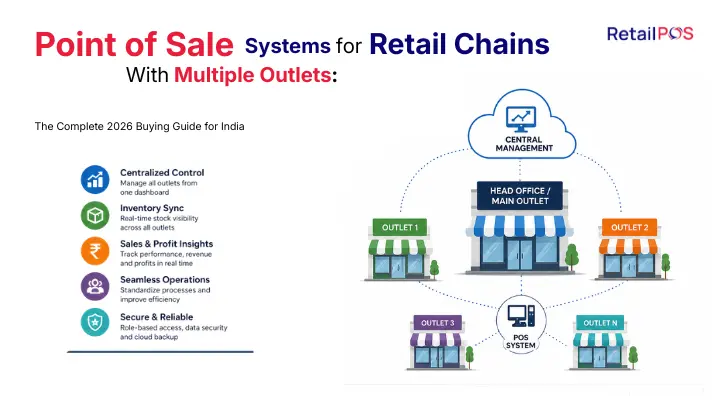
Point of Sale Systems for Retail Chains With Multiple Outlets: The Complete 2026 Buying Guide for India
1. Introduction
Buying a point of sale system for a single retail store is a straightforward decision. You need fast billing, GST-compliant invoicing, basic inventory tracking, and end-of-day reconciliation. Most POS systems available in India today handle these requirements adequately.
Buying a point of sale system for a retail chain with multiple outlets is an entirely different decision. The requirements are not just larger versions of single-store requirements. They are fundamentally different in nature. A multi-outlet retail chain needs a system that manages stock across locations simultaneously, pushes pricing updates to all outlets at once, consolidates GST compliance data from every outlet automatically, tracks customer loyalty across the entire chain, gives management real-time visibility into every location from one dashboard, and scales to handle additional outlets without system replacement at each growth milestone.
Most POS software sold in India is built for single stores. Some of it is adapted for multi-outlet use with varying degrees of success. Very few platforms are genuinely built from the ground up for the operational complexity of a multi-outlet retail chain.
This buying guide exists to help Indian retail chain owners cut through the marketing noise, ask the right questions, evaluate the right features, understand the true cost of ownership, and make the technology decision that serves their chain today and continues to serve it as it grows.
If you manage two outlets today or twenty, this guide gives you the complete framework to choose the right point of sale system for your retail chain in 2026.
2: Why This Buying Guide Is for Retail Chains Not Single Stores
Before entering the evaluation framework, it is important to be clear about who this guide is written for and why the buying decision is different for retail chains.
A single-store retailer buys a POS system to solve counter-level problems. Billing speed, GST invoice accuracy, basic stock tracking, and end-of-day settlement are the primary requirements. These are important problems and a good single-store POS system solves them well.
A retail chain owner buys a point of sale system to solve business-level problems. The counter-level requirements are still there but they are the baseline, not the deciding factor. The deciding factors are the capabilities that exist beyond the counter: centralised inventory management across all outlets, multi-outlet GST compliance automation, consolidated business reporting, chain-wide customer loyalty, centralised pricing and promotion control, inter-outlet stock transfer management, and scalable architecture that grows with the chain.
The financial consequences of choosing the wrong system are also fundamentally different for a retail chain. A single-store retailer who chooses a system that does not quite fit their needs can migrate to a better one with manageable disruption. A retail chain that chooses the wrong system and builds operations around it across five or ten outlets faces a migration that is disruptive, expensive, and operationally risky. Getting the decision right the first time is significantly more important for a multi-outlet chain than for a single store.
This guide is written with that reality in mind. Every framework, every question, and every evaluation criterion in this guide is designed for the retail chain owner making a decision with multi-outlet implications.
3: What a Point of Sale System for Multiple Outlets Actually Means
The phrase point of sale system for retail is used broadly in the Indian market to describe everything from a basic billing application on a tablet to a full enterprise retail management platform with ERP-level capabilities. Understanding what the term actually means in a multi-outlet context is the foundation of a good buying decision.
At its most basic level, a point of sale system handles transactions at the billing counter. It processes sales, generates invoices, accepts payments, and records what was sold. This is the POS layer and every retail chain needs it to work fast, accurately, and reliably at every outlet.
For a multi-outlet retail chain, the POS layer is only the front end of a much larger system requirement. Behind the billing terminal, the system must maintain a centralized inventory database that reflects stock movements at every outlet in real time. It must route transaction data to the correct GST compliance record automatically. It must update the customer loyalty account after every transaction at any outlet. It must feed the management reporting dashboard with current data from all locations simultaneously.
This combination of a fast, reliable billing front end connected to a centralized management backend is what a genuine point of sale system for a multi-outlet retail chain looks like. It is not just a billing tool. It is the operational infrastructure that connects every function of the chain into one coherent system.
The Indian market uses several terms for this category of solution including retail POS software, retail ERP, retail management software, and multi-store POS system. These terms describe overlapping capabilities and the distinctions between them matter less than understanding which specific capabilities your chain requires.
4: The 10 Non-Negotiable Features for Multi-Outlet Retail POS Systems
These are the ten features that every multi-outlet retail chain in India must have in their point of sale system before any other consideration. If a system you are evaluating cannot demonstrate all ten of these capabilities in a live demonstration, it is not ready for your chain.
Feature One: Real-Time Centralised Inventory Across All Outlets
Every stock movement at every outlet must update the central inventory database immediately. Not daily. Not hourly. Immediately. When your Bengaluru outlet sells 10 units of a product, your Chennai head office must see that the Bengaluru stock has reduced by 10 units within seconds. Without real-time inventory, every management decision based on stock data is already outdated the moment it is made.
Feature Two: Centralised Pricing and Promotion Management
Pricing must be controlled from head office and pushed to all outlets simultaneously. A festival promotion must go live at every outlet at the same moment with the correct price applied automatically at the billing counter. No store manager should need to manually update prices at their outlet for a chain-wide promotion to work correctly.
Feature Three: Multi-GSTIN Compliance Management
For retail chains operating across multiple states, each state registration must be managed as a separate compliance entity. The system must automatically route each outlet’s transactions to the correct GSTIN’s compliance record and generate separate return data for each registration without manual intervention from the accounts team.
Feature Four: Automated GST Return Preparation
GSTR-1 and GSTR-3B data must be prepared automatically from billing transaction data across all outlets. The accounts team should review and approve, not build from scratch. If your accounts team is still manually preparing return data from billing exports, your system is not automating GST compliance. It is just generating invoices.
Feature Five: Inter-Outlet Stock Transfer Management
Moving stock between outlets must be a documented, system-tracked process. Every transfer must generate a proper document trail with the sending outlet, receiving outlet, product details, quantities, and GST treatment where applicable. Undocumented stock movements between outlets are one of the most common causes of inventory inaccuracy in Indian retail chains.
Feature Six: Chain-Wide Customer Loyalty
Customer loyalty must function at the chain level, not the outlet level. Points earned at any outlet must be redeemable at any other outlet in the chain. The customer profile must be accessible from any billing terminal. A loyalty programme that is outlet-specific is not a chain loyalty programme. It is multiple disconnected single-store programmes that happen to share a brand name.
Feature Seven: Role-Based Access Control
Store managers must see only their outlet’s data. Area managers must see the outlets under their supervision. Head office teams must see the entire chain. Owners must see everything including data that store managers cannot access. Without role-based access, either your management team has insufficient visibility or your operational staff has access to data they should not see. Both outcomes create risk.
Feature Eight: Offline Billing Capability
Every outlet in your chain must be able to continue billing accurately during internet outages. India’s connectivity infrastructure, even in major cities, is not immune to disruption. A point of sale system that stops functioning without internet is a revenue risk at every outlet every time connectivity is interrupted. Offline capability with automatic synchronisation when connectivity is restored is a non-negotiable requirement for Indian retail chains.
Feature Nine: Consolidated Real-Time Reporting
The owner and management team must be able to see consolidated performance data across all outlets from a single dashboard without any manual data collection or compilation. Revenue by outlet, gross margin by category, inventory position across all locations, staff productivity, and GST compliance status must all be visible from one screen in real time.
Feature Ten: Scalable Architecture for Chain Growth
Adding a new outlet must be a configuration task within the existing system, not a technology project requiring new software, new implementation, or significant additional cost. The system architecture must be designed to handle your chain as it is today and as it will be in three years without replacement at each growth milestone.
5: What Separates a Basic POS From an Enterprise Retail Management System
The Indian retail technology market includes hundreds of POS software options at varying price points and capability levels. Understanding where the line falls between a basic POS system and a genuine enterprise retail management system protects retail chain owners from investing in a system that meets their current needs but fails as the chain grows.
A basic POS system is designed for the billing counter. It handles fast transaction processing, generates GST invoices, tracks basic stock levels, and produces daily sales summaries. It does these things well for a single store or a very small chain where the owner can physically supervise every outlet and manage operational coordination personally.
An enterprise retail management system is designed for the business behind the counter. It handles everything a basic POS handles at the front end while simultaneously managing the entire operational, compliance, and analytical infrastructure of a multi-outlet chain from a centralized backend. The billing terminal is the visible tip of a much larger system.
Here is where the specific differences appear in practice:
Capability Area | Basic POS System | Enterprise Retail Management System |
Inventory management | Reduces stock at billing only | Tracks every movement from purchase to sale to transfer to audit |
GST compliance | Generates compliant invoices | Automates full return preparation and e-invoicing across all outlets |
Multi-outlet management | Separate instances per outlet | Single centralised backend connecting all outlets in real time |
Reporting | Daily sales summary per outlet | Real-time consolidated analytics across all outlets simultaneously |
Customer loyalty | Basic per-outlet programme | Chain-wide unified loyalty with CRM and campaign management |
Purchase management | Not integrated | Linked to real-time sales data for automated reorder management |
Staff management | Basic cashier tracking | Full shift management with labour cost reporting by outlet |
Pricing control | Manual per outlet | Centralised with instant push to all outlets simultaneously |
Scalability | Works for 1 to 3 outlets | Designed for 1 to 200 plus outlets on same architecture |
Business intelligence | Transaction reports | Margin analysis, vendor performance, customer behaviour analytics |
6: The Complete Feature Evaluation Table for Multi-Outlet Retail Chains
Use this table as your evaluation scorecard when assessing any point of sale system for your retail chain. Rate each vendor on every feature before making your final decision.
Feature | What to Verify in the Demo | Why It Matters |
Real-time inventory sync | Ask vendor to show stock update speed after a simulated sale | Outdated stock data leads to stockouts and overbuying |
Centralised pricing push | Ask how long it takes to update price at all outlets simultaneously | Pricing inconsistency damages brand trust and margin |
Multi-GSTIN support | Ask to see separate return data generated for two different state registrations | Essential for any chain operating across multiple states |
GSTR-1 automation | Ask to see a complete GSTR-1 dataset generated from billing data | Manual preparation wastes weeks of accounts team time monthly |
E-invoicing integration | Ask to see an IRN generated at the billing counter in real time | Mandatory for qualifying B2B transactions above threshold |
Inter-outlet transfer | Ask to see a stock transfer document raised and tracked in system | Undocumented transfers create inventory inaccuracy chain-wide |
Chain-wide loyalty | Ask to show a loyalty balance earned at outlet A being used at outlet B | Per-outlet loyalty fails the customer at the most important moment |
Role-based access | Ask to log in as a store manager and confirm what is not visible | Data security and accountability require proper access controls |
Offline billing | Ask vendor to disconnect internet during demo and attempt a sale | Revenue loss during outages is unacceptable for any serious chain |
Consolidated reporting | Ask to see a single report covering all outlets with drill-down | Management decisions require complete current data not manual reports |
Purchase automation | Ask to see an automatic reorder alert triggered by low stock | Manual purchasing decisions always lag behind real demand |
Mobile dashboard | Ask to see the owner dashboard on a mobile device | Real-time visibility must be available anywhere not just at head office |
Scalability demonstration | Ask how adding a new outlet is configured in the system | Migration costs mid-expansion are expensive and disruptive |
Implementation timeline | Ask for a realistic timeline for your specific outlet count | Unrealistic timelines create operational disruption at go-live |
Support after go-live | Ask what the post-implementation support process looks like | Go-live is the beginning not the end of the vendor relationship |
7: How to Assess GST Compliance Depth in Any POS System
GST compliance capability is the area where Indian retail chain owners are most frequently misled by vendor marketing. Every POS software vendor in India will tell you their system is GST-compliant. The word compliant describes a minimum standard, not a capability level. Here is how to assess the actual depth of GST compliance in any system you evaluate.
Level 1: Invoice Compliance
The system generates a GST invoice with the correct tax amounts shown. This is the minimum level and virtually every POS system in India achieves it. It is necessary but nowhere near sufficient for a multi-outlet retail chain with serious compliance requirements.
Level 2: Automated Rate Application
The system applies GST rates automatically from HSN code mapping at the product master level. No billing operator makes a tax rate decision. This eliminates the most common source of GST errors at the transaction level and is a requirement for any chain managing thousands of SKUs across multiple tax slabs.
Level 3: E-Invoicing Integration
The system connects directly to the Invoice Registration Portal and generates an IRN automatically when a qualifying B2B invoice is processed at the billing counter. The IRN and QR code appear on the printed invoice without any separate portal login or manual upload step. This is non-negotiable for retail chains above the e-invoicing threshold.
Level 4: Return Data Automation
The system prepares complete GSTR-1 and GSTR-3B datasets automatically from billing transaction data. The accounts team reviews and approves. They do not build the data from scratch. This is the level that separates genuine GST automation from GST compliance and is the level that determines whether your accounts team spends two days or two hours on monthly return filing.
Level 5: Multi-GSTIN and ITC Management
The system manages separate compliance records for multiple state GSTINs automatically, routes transactions to the correct registration, supports ITC reconciliation against GSTR-2B, and generates state-wise return data alongside consolidated chain-wide compliance reporting. This level is essential for any retail chain operating across multiple states.
Ask every vendor to demonstrate which level their system operates at. A vendor who cannot clearly demonstrate Level 4 and Level 5 in a live system is not ready for a serious multi-state retail chain.
8: Total Cost of Ownership: What Indian Retail Chains Actually Pay
The purchase price or monthly subscription fee of a point of sale system is rarely its true cost for a multi-outlet retail chain. Understanding the total cost of ownership prevents expensive surprises after the contract is signed.
Licence or Subscription Cost
Most Indian retail POS systems are priced either as a one-time licence or a monthly subscription. Per-outlet pricing is common and the cost difference between a three-outlet chain and a ten-outlet chain can be significant. Ask for pricing at your current outlet count and at the outlet count you expect to reach in two years so you understand the cost trajectory of your investment.
Hardware Cost
The billing terminal, barcode scanners, receipt printers, weighing scale integration, and payment terminals at each outlet represent a significant hardware investment that is separate from the software cost. Ask the vendor which hardware is required, which is recommended, and which third-party hardware the software is compatible with so you are not locked into a hardware vendor at premium prices.
Implementation Cost
The cost of setting up the system at every outlet including data migration, product master configuration, HSN code mapping, staff training, and hardware installation is often as large as the first year’s software cost for a multi-outlet chain. Get a detailed implementation quote before signing any contract and confirm whether implementation is included in the subscription price or billed separately.
Integration Cost
If your existing accounting software, e-commerce platform, payment gateway, or loyalty programme needs to be integrated with the new POS system, there is usually an additional integration cost. Ask which integrations are included out of the box and which require custom development with associated fees.
Training Cost
Staff training at every outlet for every role is a real cost in time and sometimes in direct fees depending on the vendor’s support model. For a chain with ten outlets and multiple staff members per outlet, the training investment is significant and should be factored into the total cost calculation.
Ongoing Support Cost
Annual maintenance contracts, support desk access, and software update fees vary significantly between vendors. A system with a low subscription price but a high annual maintenance fee may be more expensive over three years than a system with a higher subscription price that includes all updates and support.
Cost Component | What to Ask | Typical Range for 5-Outlet Chain |
Software licence or subscription | Annual cost at current and future outlet count | Rs 1.5 lakh to Rs 6 lakh per year |
Hardware per outlet | Full hardware list and compatible alternatives | Rs 50,000 to Rs 1.5 lakh per outlet |
Implementation fee | What is included and what is extra | Rs 1 lakh to Rs 3 lakh total |
Integration fees | Which integrations are included or extra | Rs 0 to Rs 1 lakh depending on complexity |
Training fees | Per outlet or included in implementation | Rs 0 to Rs 50,000 depending on vendor |
Annual maintenance | Support and update fees after year one | 15% to 25% of licence cost annually |
9: Implementation: What the Process Really Looks Like for a Multi-Outlet Chain
Implementation is the phase of the buying process that receives the least attention during evaluation and causes the most problems after signing. Understanding what a realistic implementation looks like for a multi-outlet chain protects you from timelines and disruption levels that catch most retail chain owners off guard.
Phase One: Data Preparation
The first and most frequently underestimated phase is cleaning and standardising your existing data before it goes into the new system. Your product master must be standardised with consistent naming, correct HSN codes, accurate GST rates, and agreed units of measurement across all outlets. Your customer data must be deduplicated and formatted correctly. Your supplier master must be complete with GSTIN details for ITC tracking.
For a retail chain with thousands of SKUs and years of accumulated data across multiple outlets, this phase takes two to four weeks and requires significant internal effort. Retailers who skip or rush this phase spend months after go-live correcting data errors that were introduced at the start.
Phase Two: System Configuration
Each outlet must be configured in the system with its correct address, GSTIN, hardware settings, role-based access configuration, and outlet-specific parameters. This phase is technical and should be led by the vendor’s implementation team with your operations team providing the configuration inputs for each location.
Phase Three: Pilot Outlet Go-Live
Before going live at all outlets simultaneously, a two to three outlet pilot go-live with a parallel running period of two to four weeks validates that the system produces accurate billing, inventory, and compliance data that matches your existing system’s output for the same period. Discrepancies found during parallel running are corrected before the full chain goes live.
Phase Four: Phased Full Chain Rollout
Outlets are added to the live system one or two at a time after the pilot is validated. Each outlet going live receives focused support for the first week to address staff questions and configuration adjustments. A phased rollout ensures that a problem at one outlet does not affect the entire chain simultaneously.
Phase Five: Post Go-Live Stabilisation
The first one to two months after full chain go-live is a stabilisation period during which the system is fine-tuned based on real operational experience. Report configurations are adjusted. Reorder levels are calibrated against actual sales patterns. Staff productivity with the new system improves as familiarity grows.
10 : The Right Questions to Ask Every POS Vendor Before Signing
These are the questions that separate vendors who are ready for your retail chain from those who are not. Ask every question. Require a live demonstration of the answer rather than a verbal or written response.
Questions about multi-outlet capability:
- Show me how stock updates at one outlet are visible at head office in real time
- Show me how a centralised price update reaches all outlets simultaneously
- Show me how an inter-outlet stock transfer is raised, approved, and tracked in the system
- Show me how I add a new outlet to the system and how long it takes
Questions about GST compliance depth:
- Show me how HSN codes are mapped and how tax rates are applied automatically
- Show me an e-invoice being generated with IRN at the billing counter without a separate portal login
- Show me a complete GSTR-1 dataset prepared automatically from billing data for multiple outlets
- Show me how your system handles two different state GSTINs simultaneously
Questions about reporting and analytics:
- Show me the consolidated real-time dashboard across all outlets on a single screen
- Show me how I drill down from a consolidated revenue figure to the individual transactions behind it
- Show me the gross margin report by product category across all outlets
- Show me how the same dashboard looks on a mobile device
Questions about implementation and support:
- Give me a realistic week-by-week implementation timeline for my specific outlet count
- Who does the product master setup, HSN configuration, and staff training
- What does the support process look like after go-live including response time commitments
- Can you connect me with three retail chain owners in India who have been using the system for at least one year
11: Common Buying Mistakes Indian Retail Chain Owners Make
Mistake One: Choosing Based on Price Rather Than Total Cost of Ownership
The system with the lowest monthly subscription fee is rarely the most cost-effective choice over three years. A system that requires additional integration work, has high implementation fees, charges for every software update, and requires migration to a different platform when the chain reaches ten outlets costs significantly more than a higher-subscription enterprise system that includes all of these elements from the start.
Mistake Two: Evaluating for Today’s Outlet Count Rather Than Tomorrow’s
A system that works perfectly for three outlets may visibly struggle at seven. Choosing a system based on current requirements without evaluating its performance at your expected two-year outlet count is the most common cause of mid-expansion system migration, which is expensive, disruptive, and avoidable.
Mistake Three: Accepting Demo Conditions That Do Not Reflect Reality
Vendors demonstrate their systems in clean, configured environments with sample data and reliable internet. Insist on seeing offline billing demonstrated by actually disconnecting the internet. Insist on seeing multi-outlet inventory sync demonstrated with simulated transactions at two outlets simultaneously. Insist on seeing the GST return preparation demonstrated with data that resembles your actual transaction volume and type. A system that performs well under real conditions will handle the demo. A system that only performs well in the demo will struggle in real operations.
Mistake Four: Underestimating the Data Preparation Requirement
Almost every retail chain owner underestimates how long it takes to clean and standardise product master data before a new system can be configured correctly. Build at least three weeks into your timeline for data preparation and treat it as the foundation phase of the implementation rather than a minor preliminary task.
Mistake Five: Not Verifying the Post Go-Live Support Model
The vendor’s responsiveness before signing a contract is not necessarily representative of their responsiveness after go-live. Ask specifically what the support process looks like after implementation is complete. What is the response time commitment for billing system issues during peak hours. What is the escalation process for a critical system failure at one of your outlets during a festival promotion. A vendor who cannot answer these questions clearly before signing is telling you something important about what the relationship will look like after signing.
12: What RetailPOS Delivers for Multi-Outlet Retail Chains in India
RetailPOS has been serving Indian retail chains for over 20 years and is purpose-built for the multi-outlet enterprise retail environment. The platform is not a single-store POS system adapted for chains. It is an enterprise retail management system designed from the ground up for the operational complexity of Indian retail chains managing multiple outlets across one or more states.
For multi-outlet retail chain owners across India, RetailPOS delivers every non-negotiable feature identified in this buying guide:
- Real-time centralised inventory management updated after every transaction at every outlet
- Centralised pricing and promotion management with instant push to all outlets simultaneously
- Multi-GSTIN compliance management for chains operating across multiple states
- Automated GSTR-1 and GSTR-3B preparation from all outlet billing data without manual intervention
- E-invoicing with direct IRP integration for automatic IRN generation at every qualifying outlet
- Inter-outlet stock transfer management with digital approval workflow and complete document trail
- Chain-wide customer loyalty with unified point balance usable at any outlet across the chain
- Role-based access control with outlet-level, area-level, and chain-level permission configuration
- Full offline billing capability at every outlet with automatic cloud synchronisation on restoration
- Real-time consolidated reporting dashboard with drill-down to individual transaction level
- Automated purchase order generation based on outlet-level real-time sales velocity data
- Mobile owner dashboard for complete chain visibility from any device at any location
- Scalable architecture that grows from two outlets to two hundred on the same platform
RetailPOS serves retail chains across supermarkets, apparel, pharmacy, electronics, and food and beverage businesses throughout India including major chains across Tamil Nadu, Karnataka, Kerala, Andhra Pradesh, and Telangana. The implementation team has deep experience in Indian retail compliance requirements across all states and the support model is built for the operational reality of high-volume retail chain environments.
Explore how RetailPOS handles your specific chain requirements by visiting our multi-store retail management page or reading our detailed guides on best POS software for retail chains in Hyderabad and how retail ERP software supports Indian retail chains. You can also explore our complete guide on GST return filing automation for retail chains to understand the compliance depth the platform delivers.
13. Conclusion
Choosing the right point of sale system for a multi-outlet retail chain in India is one of the most consequential operational decisions a retail chain owner makes. The wrong choice means a system that works today but fails as the chain grows, requiring a disruptive and expensive migration at the worst possible time. The right choice means operational infrastructure that supports the chain at every stage of its growth without replacement.
The framework in this buying guide gives you the evaluation criteria, the questions, the feature checklist, and the cost transparency to make this decision with confidence. Use every element of it before signing any contract with any vendor.
The non-negotiable features are non-negotiable because retail chains that operate without them pay for their absence every month in inventory inaccuracy, GST errors, manual reporting overhead, and customer loyalty that does not work across outlets. These are not advanced enterprise features. They are the baseline requirements for any retail chain that is serious about operational control and profitable growth.
If you manage a retail chain in India and are evaluating point of sale systems, the RetailPOS team is ready to take you through every element of this buying guide with your specific chain as the context. Not a generic demonstration. A live evaluation of how the platform handles your outlet structure, your product categories, and your compliance requirements.
Book a free demo with the RetailPOS team today and make your 2026 POS decision with complete information.

 Book your demo
 Talk to our POS experts
- 📧 Email: salesenquiry@uniprotech.co.in
Book a free demo and see how RetailPOS Dineazy gives you complete financial visibility across your restaurant operations..
Or WhatsApp our team directly – we respond within minutes.
Or call us at 95662 44611
14. Frequently Asked Questions
The single most important feature is real-time centralised inventory management that updates stock across all outlets simultaneously after every transaction. Inventory inaccuracy is the root cause of the most financially damaging operational problems in Indian retail chains including stockouts, overbuying, shrinkage, and incorrect purchase decisions. Every other management capability in a multi-outlet POS system depends on accurate, current inventory data as its foundation. A system that gets inventory right in real time across all outlets builds the data quality that makes every other feature more valuable.
2. How many outlets does a retail chain need before investing in an enterprise point of sale system?
The honest answer is two outlets. The moment you open a second location, the operational complexity of managing inventory, pricing, compliance, and reporting across disconnected systems begins generating costs and errors that a centralised platform eliminates. Retail chain owners who invest in enterprise-capable software before opening the second outlet avoid the painful and expensive process of migrating systems mid-expansion. If you currently have three or more outlets on disconnected systems, the investment in a unified enterprise platform typically pays back within six to twelve months through shrinkage reduction, GST automation savings, and management time recovered from manual reporting.
A POS system manages transactions at the billing counter. A retail ERP connects every function of the business into one unified platform including billing, inventory, purchasing, accounting, GST compliance, CRM, and reporting. For a multi-outlet retail chain, the distinction matters because POS-level capability handles what happens at the counter while ERP-level capability handles what happens across the entire chain. The best enterprise retail management systems for Indian chains combine a fast, intuitive POS front end with a full ERP backend so counter speed and business depth are delivered from one integrated platform rather than two disconnected systems.
For a retail chain with five to ten outlets, a realistic implementation timeline is six to ten weeks from contract signing to full chain go-live. This includes two to three weeks of data preparation and product master standardisation, one week of system configuration and GSTIN setup, two to three weeks of pilot outlet parallel running, and two to three weeks of phased rollout to remaining outlets with training at each location. Chains that invest time in data cleaning before implementation begins consistently achieve faster and more accurate go-lives than those who attempt migration with unprepared data.
Look for a vendor who provides a defined response time commitment for critical billing system issues, a clear escalation process for outlet-level failures during peak trading periods, regular software updates that include GST compliance changes without additional fees, and proactive communication when compliance requirements change that affect your return filing. Ask the vendor to describe their support process specifically for a scenario where your billing system goes down at one outlet during a festival promotion on a Saturday evening. How they answer that question tells you more about their post go-live support quality than any service level agreement document.
Adding a new state to an existing RetailPOS implementation involves configuring a new GSTIN registration in the system, setting up the new state's outlet or outlets with the correct address and state of supply settings, and configuring the compliance module to generate separate return data for the new registration alongside the existing ones. This is a configuration exercise within the existing system, not a new implementation. The new state's outlets are connected to the same central inventory, pricing, loyalty, and reporting infrastructure from day one. The chain's head office gains visibility into the new state's performance immediately through the same consolidated dashboard they already use for existing outlets.