
Powered by Unipro Tech
Your Restaurant Opens a New Branch and Everything That Worked at the First One Stops Working
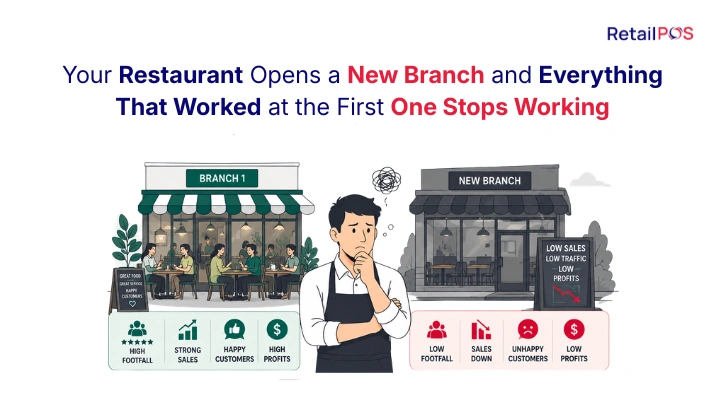
For Indian restaurant owners opening their second or third outlet and anyone planning multi-outlet F&B expansion
1: The Second Branch Is the Most Dangerous Moment in a Restaurant’s Growth
Opening the first restaurant is hard. Everyone who has done it will tell you that. The long hours, the supplier relationships built from scratch, the staff trained one by one, the regulars cultivated through months of consistent service. It is exhausting work and it takes everything you have.
But the first restaurant, once it finds its rhythm, becomes manageable. You are there every day. You know every dish on the menu and what it should cost. You know every staff member by name and what each one can be trusted with. You know when the produce delivery is late because you can see the storeroom yourself. You know the day’s revenue because you closed the counter yourself. Your personal presence is the operating system of the business.
Then you open the second branch.
And everything that worked at the first one stops working.
Not because your food quality has declined. Not because your concept was wrong. Not because the new location is bad. But because the operating system of your first restaurant, which was built entirely on your personal presence, physically cannot run two restaurants at the same time.
The second branch is the single most dangerous and most misunderstood stage in Indian restaurant growth. More restaurant concepts fail here than at any other point. Not because the owner ran out of capital or chose the wrong location. But because they assumed that what worked at one outlet would naturally scale to two.
It does not. And this guide explains exactly why, what it costs when it goes wrong, and how the right restaurant management system prevents every one of these problems.
2: Why Everything Breaks When You Open a Second Location
The restaurant that you built at your first location runs on a set of systems that are mostly invisible because they are mostly you. You are the quality check at the pass before every plate goes out. You are the pricing authority every time a customer questions a bill. You are the inventory system because you walk the storeroom every morning. You are the loyalty programme because you remember your regulars by name. You are the GST process because your accountant calls you every month.
None of these systems exist in documented, transferable form. They exist in your presence, your memory, and your judgement. The moment you open a second branch, your presence is divided and everything built on your personal presence begins to fracture.
Here is what the division of your attention actually looks like in practice:
What You Did at Branch 1 | What Happens at Branch 2 Without You |
Tasted every dish before service | Chef plates what they think is right without a standard to follow |
Corrected billing errors immediately | Errors go unnoticed until a customer complains |
Checked stock every morning | Kitchen runs out of ingredients mid-service |
Recognised regulars and their preferences | New branch staff treat regulars as strangers |
Monitored staff performance daily | Underperformers have no oversight |
Knew this week’s food cost by feel | Food cost at branch 2 drifts upward invisibly |
Handled supplier calls personally | Branch 2 manager over-orders or chooses wrong suppliers |
Reconciled GST monthly with accountant | Two sets of data, double the time, double the error risk |
The second branch does not inherit your operating system. It needs a new one. And that operating system needs to be software-driven, not person-driven. Because you cannot be in two places at once.
3: The Eight Specific Problems That Hit Every Indian Restaurant at the Second Branch
3.1 Inconsistent Food Quality Between Branches
This is the problem that customers notice first and that damages your brand the most. At your original outlet in Indiranagar, the butter chicken has been the same for three years. Every customer who orders it knows what they are getting. When you open the second branch in Koramangala and the same dish is noticeably different, whether blander, more oily, differently spiced, or a smaller portion, customers do not blame the new branch. They blame the brand.
Food quality inconsistency at the second branch happens for two reasons. First, the head chef or experienced kitchen staff at Branch 1 trained the Branch 2 kitchen team but the training was informal, verbal, and based on experience rather than documented standards. Second, without a recipe management system, there is no enforceable standard. Every cook makes every dish according to their interpretation of what they were told during training.
The result is that your second branch slowly develops its own food identity that diverges from your original. Some customers prefer it. Most do not. But more importantly, the brand promise of consistency is broken, and in the highly connected world of Zomato reviews and Instagram posts, inconsistency between branches is discovered and publicised very quickly.
3.2 Pricing Errors That Appear at the New Branch
When your first branch was operating smoothly, pricing was consistent because you were there to enforce it. When you make a price change, it happened in the system and you knew it happened. When a supplier increase required a menu adjustment, you handled it and the counter reflected the change immediately.
At Branch 2, pricing changes travel through a different path. You tell the Branch 2 manager. The manager updates the system, or thinks they have, or updates it partially. Or you send a WhatsApp message that gets missed. The result is that Branch 1 sells the dal makhani at Rs 180 and Branch 2 sells the same dish at Rs 160, not because the pricing strategy is different but because the update never reached the second counter.
Customers who visit both branches notice this immediately. A customer in Hyderabad who eats at your Banjara Hills outlet and then visits your Madhapur outlet will compare prices. If they differ, the question is not which branch is right. The question is whether the restaurant knows what it is doing. Trust is damaged by something that was entirely preventable.
3.3 Zero Visibility Into What the Second Branch Is Actually Doing
At Branch 1, you have always known roughly how the day is going. You can see the dining room. You know when it is busy. You know what dishes are moving. You feel the energy of the service.
At Branch 2, you know nothing until the manager tells you. And what the manager tells you is a filtered, edited version of the truth shaped by what they think you want to hear and what they remember from the day. The actual sales figure, the actual food cost, the actual table turnover, the actual number of orders cancelled, the actual stock position at 8 PM, none of these reach you in real time unless a system is generating them automatically.
The consequence is that you discover problems at Branch 2 weeks after they started. The food cost that was creeping upward for three weeks. The slow Monday service that the manager knew about but did not flag. The ingredient that has been short for four days but no reorder was placed. The GST error that has been appearing in every invoice for two weeks.
By the time you find out, the damage has already accumulated. The right system would have shown you every one of these problems on the day they started.
3.4 Two Separate Loyalty Databases That Do Not Talk to Each Other
Your first branch built genuine customer loyalty over years. Regulars who come every week. Families who celebrate milestones at your restaurant. The IT professional who orders the same thing every Tuesday lunch. These customers feel recognised and valued because your staff know them.
When you open Branch 2, these same customers are complete strangers. The loyalty they built at Branch 1 is invisible at Branch 2. Their points balance is not there. Their order history is not there. The staff treat them exactly like a first-time customer because to the Branch 2 system, they are.
For the customer, this is jarring. They are not a new customer. They are one of your most valuable customers visiting a new location. The experience of being treated as a stranger at a restaurant they have been loyal to for two years is a genuinely negative experience that reduces the likelihood they will visit the new branch again.
Separately, you are now managing two customer databases that overlap significantly but have no connection. A customer who changes their neighbourhood from your first area to your second is effectively lost from your loyalty programme. All the data built about them at Branch 1 is inaccessible at Branch 2.
3.5 Stock Management Across Two Kitchens With No Shared Visibility
At Branch 1, your storeroom is a physical space you know well. You know roughly what is in it. You know when coriander is running low because you have been managing that kitchen for three years.
At Branch 2, the storeroom is in a different building managed by a team you have known for three months. Their stock management practices are whatever they learned from Branch 1 training, not from three years of working directly with you.
The specific problem that emerges is that each branch manages its inventory independently with no visibility into the other’s stock position. Branch 1 may have 4 kg of marinated chicken sitting in the fridge from an overestimated prep that Friday’s service did not need. Branch 2 ran out of marinated chicken at 7:30 PM on the same Friday and made an emergency purchase from a local market at double the supplier price.
Nobody knows about either situation. The manager at Branch 1 does not think to call Branch 2 because they have no reason to believe Branch 2 has a shortage. The Branch 2 manager handles the crisis alone. The emergency purchase inflates the day’s food cost. The Branch 1 chicken is used the next day at the edge of its usable window.
This exact scenario, in variations, plays out every week across restaurant groups that manage their branches as independent silos.
3.6 Staff Management Across Two Teams Without a Performance System
At Branch 1, you managed staff performance through daily observation. You noticed when a server was underperforming. You caught billing errors quickly. You recognised the kitchen team member who consistently produced better quality output and rewarded them accordingly.
At Branch 2, you are present perhaps twice a week. The Branch 2 manager monitors staff according to their own standards and priorities, which may differ significantly from yours. Performance problems at Branch 2 reach you slowly, filtered through the manager’s perspective, and usually only after a customer complaint has already been received.
The result is that your Branch 1 team is managed by you to your standards, while your Branch 2 team is managed by a manager to their interpretation of your standards. Over time, the two teams develop different cultures, different norms, and different levels of performance. Your brand delivers two different experiences depending on which branch the customer walks into.
3.7 GST Compliance Doubles in Complexity
With one restaurant, your monthly GST filing was already demanding. With two restaurants, it becomes a part-time job.
Every month, your accountant now collects transaction data from two branches, reconciles two sets of records, checks for errors in two billing systems, and compiles two datasets into a single return. If the two branches have different GSTIN registrations, the complexity increases further. If the two branches have different seating configurations where one is air-conditioned and the other is not, the applicable GST rates differ and the compilation must account for this correctly.
A restaurant group that had its monthly GST process taking one working day at one branch now finds it taking three working days at two branches. The time does not simply double because two datasets means twice as many reconciliation steps, twice as many potential errors, and twice as much back-and-forth between the manager and the accountant.
3.8 Supplier Management Fragmentation
At one branch, you had clear supplier relationships built over years. You knew which supplier to call for which ingredient. You had negotiated prices. You had credit terms. You had an understanding of which deliveries needed personal supervision.
At two branches, supplier management fragments. Branch 2 develops its own supplier relationships, sometimes duplicating your Branch 1 suppliers, sometimes finding new suppliers who may offer lower quality at similar prices. Bulk purchasing power that you could use to negotiate better rates across both branches is never realised because nobody is aggregating demand. Branch 2 pays retail prices for quantities that, combined with Branch 1, would justify wholesale pricing.
4: The Rupee Cost of Getting the Second Branch Wrong
The problems above are not just operational inconveniences. Each one has a specific and measurable financial cost.
Problem | Financial Impact | Estimated Monthly Cost |
Food quality inconsistency | Lost repeat visits and negative reviews at Branch 2 | Rs 40,000 to Rs 1,20,000 in lost revenue |
Pricing errors | Under-billing at Branch 2 relative to intended prices | Rs 15,000 to Rs 40,000 in under-recovered revenue |
No visibility into Branch 2 | Problems discovered 2 to 3 weeks late, damage accumulates | Rs 30,000 to Rs 80,000 in preventable operational loss |
Separate loyalty databases | Loyal customers not recognised at Branch 2, reduce visit frequency | Rs 20,000 to Rs 60,000 in missed repeat revenue |
Siloed stock management | Emergency purchases at retail prices, over-prep wastage | Rs 25,000 to Rs 70,000 in inventory and purchasing inefficiency |
No staff performance data | Underperformers unidentified, high performers leave | Rs 20,000 to Rs 50,000 in productivity loss |
Doubled GST process | Accountant time, error risk, potential penalties | Rs 15,000 to Rs 30,000 in time cost and compliance exposure |
Fragmented supplier management | Lost bulk pricing, suboptimal supplier terms at Branch 2 | Rs 20,000 to Rs 50,000 in missed purchasing savings |
Total monthly cost of managing two branches as silos | Rs 1.85 lakh to Rs 5 lakh per month |
For a restaurant group doing Rs 20 to Rs 30 lakh combined monthly revenue across two branches, a monthly operational loss of Rs 2 to Rs 3 lakh from these avoidable problems represents a profit drain of 8 to 15% of total revenue. This is the cost of operating without a centralised management system across two branches.
5: The Problem vs Solution Breakdown
Second Branch Problem | Why It Happens | Technology Solution | Result |
Inconsistent food quality | No shared recipe database with gram-level standards | Centralised recipe management module | Both branches follow the same recipe standard on every dish every shift |
Pricing errors | Pricing updated per outlet manually or not at all | Centralised pricing pushed to all branches instantly | Price change at head office reaches both billing counters simultaneously |
No visibility into Branch 2 | No real-time data flow between branches | Live multi-outlet dashboard accessible on any device | Owner sees both branches simultaneously from phone or laptop |
Separate loyalty databases | Each branch runs its own customer records | Unified loyalty database shared across all branches | Customer recognised and rewarded at any branch automatically |
Siloed stock management | No shared inventory between branches | Centralised real-time inventory with inter-branch visibility | Branch 1 stock visible to Branch 2 in real time |
` | Performance tracked by manager observation only | POS-generated staff performance metrics per employee | Sales per hour, error rate, and table turnover data for every staff member |
Doubled GST complexity | Two separate billing systems, manual compilation | Centralised GST generation from both branches in one report | Monthly GST filing from two branches in 30 minutes rather than 3 days |
Fragmented supplier management | Each branch manages suppliers independently | Centralised purchase management with combined demand data | Bulk purchasing across both branches with consolidated supplier terms |
6: How the Right Restaurant Management System Fixes Every Second Branch Problem
The solution to every problem described above is the same at its core: a centralised restaurant management system where both branches share one database, one product master, one recipe library, one pricing structure, one loyalty programme, and one head office dashboard.
This is not a theoretical concept. It is the specific architecture that successful Indian restaurant groups use to manage multiple branches without the owner needing to be physically present at both locations simultaneously.
Here is what each component of the right system does for a two-branch restaurant in India:
Centralised recipe management: Every dish is defined once with exact gram-level ingredient quantities, accessible to both branch kitchens simultaneously. When Branch 2 opens, the kitchen team is trained on the same recipe standards that Branch 1 has used for years. When a recipe changes, it changes for both branches at the same moment. There is no interpretation, no informal training, and no quality drift.
Real-time shared inventory: Both branches draw from the same inventory database. When Branch 1 has excess marinated chicken and Branch 2 is running short, the system shows this to the head office manager in real time. An inter-branch transfer is initiated within the system with full documentation. The emergency retail purchase at double the supplier price never happens.
Centralised pricing and promotions: Menu prices are set once at head office and reflected at both billing counters simultaneously. When a price changes, both branches update instantly. When a weekend promotion is configured, it activates at both branches at the same moment. The pricing inconsistency that damages customer trust is structurally impossible.
Unified customer loyalty: One customer database covers both branches. A customer who earned loyalty points at Branch 1 redeems them at Branch 2 without any friction. Their purchase history is visible at either branch. A customer who becomes a regular at the new branch is recognised and valued from their first visit if they were already a loyal customer at Branch 1.
Live multi-outlet dashboard: The owner can see both branches simultaneously from a single screen on any device. Current sales, stock levels, table occupancy, food cost percentage, and staff performance are all visible in real time without calling a manager or waiting for an end-of-day report. Problems at Branch 2 are visible to the owner on the day they start, not three weeks later.
Staff performance tracking: The POS records individual staff performance metrics at both branches, including sales per hour, average bill value, error rate, and table turnover. The owner can compare performance across both branches objectively and manage personnel decisions with data rather than observation and instinct.
Consolidated GST reporting: Transactions from both branches feed into a single GST report. GSTR-1 and GSTR-3B are generated automatically from combined transaction data. Monthly GST filing goes from a three-day manual process to a 30-minute review and submission.
7: How RetailPOS Dineazy Serves Multi-Outlet Restaurant Businesses Across India
RetailPOS Dineazy is a full-service restaurant POS and management system built specifically for Indian F&B operations, with dedicated multi-outlet capabilities that address every second branch problem described in this guide.
What Dineazy gives a two-branch Indian restaurant group:
- One centralised database connecting both branches simultaneously
- Shared recipe library with gram-level portion standards accessible to both kitchens
- Centralised pricing management where one change updates both billing counters instantly
- Unified customer loyalty database shared across both branches in real time
- Live inter-branch stock visibility with transfer request capability built into the system
- Individual staff performance metrics tracked per employee across both locations
- Consolidated GST reporting from both branches in one automated report
- Delivery platform integration connecting Zomato and Swiggy across both branches to the same inventory
The Cockpit dashboard for Indian restaurant chain owners:
Cockpit is RetailPOS’s centralized multi-outlet intelligence dashboard. For a restaurant owner managing branches in Chennai’s Anna Nagar and Velachery, or in Bangalore’s Koramangala and Whitefield, or in Hyderabad’s Banjara Hills and Madhapur, Cockpit provides a live view of both branches simultaneously on one screen accessible from a mobile phone anywhere in the city.
From Cockpit, the owner can see both branches’ current sales against target, current food cost percentage, table occupancy and turnover rates, staff performance rankings across both teams, inventory alerts for any ingredient approaching a critical level at either branch, and pending inter-branch transfers in real time.
The owner does not need to be at either branch to know what is happening. The operating system is no longer their personal presence. It is the software.
How Dineazy serves restaurant chains in different Indian cities:
A Chennai restaurant group expanding from Anna Nagar to Adyar uses Dineazy to maintain the Tamil cuisine standards, portion sizes, and customer loyalty programme across both locations while managing GST compliance for both outlets from one centralised report.
A Bangalore restaurant group adding a second outlet in Electronic City to serve its Indiranagar customer base uses Dineazy to push the same menu, pricing, and weekend promotions to both billing counters simultaneously while giving the owner real-time visibility into both branch performances from the Cockpit dashboard.
A Hyderabad restaurant chain with outlets in Banjara Hills and Secunderabad uses Dineazy to manage the different demand patterns of its upmarket Banjara Hills location and its more traditional Secunderabad outlet, with different promotional strategies but unified recipe standards, loyalty programmes, and GST reporting.
8: What Your Restaurant Group Should Look Like 90 Days After Implementing the Right System
The transformation from two independently managed branches to a centralised multi-outlet restaurant operation does not take months. Here is the progression over the first 90 days:
Week 1 to 2:
- Centralised recipe library configured for both branches
- Both billing counters connected to the same pricing database
- Unified loyalty programme activated across both branches
- Cockpit dashboard live showing both branches simultaneously
Week 3 to 4:
- First inter-branch stock transfer initiated and completed entirely within the system
- First week of staff performance data visible for both branches on one dashboard
- Branch 2 customer loyalty recognition functioning for Branch 1 regulars
Month 2:
- First month of centralised GST report generated from both branches in one process
- Pricing consistency confirmed across both branches with no manual updates required
- Owner reviewing both branch performance from Cockpit each morning without visiting either location
- First food cost comparison between branches identifying where Branch 2 needs attention
Month 3:
- Recipe standards measurably consistent across both branches from customer feedback
- Staff performance ranking available across both teams with objective metrics
- Food cost gap between branches narrowing as Branch 2 benefits from centralised recipe and purchasing management
- Owner spending less time driving between branches and more time planning the third outlet
Conclusion: The Second Branch Does Not Kill Restaurant Businesses. The Absence of Systems Does.
Every restaurant that has grown beyond two or three branches has solved the same problem: how to operate consistently and profitably without the owner’s personal presence at every location simultaneously. The solution is always the same. Systems that do what the owner used to do manually, automatically and at scale.
The second branch is not the problem. The second branch is the opportunity to prove that your restaurant concept is genuinely scalable. But that proof requires infrastructure. It requires recipe standards that live in a database, not in a chef’s memory. It requires pricing that updates from head office in seconds, not through a WhatsApp message that may or may not be read. It requires a loyalty programme that follows your customers between branches, not one that treats your most loyal regulars as strangers at your newest location. It requires a dashboard that shows you both branches simultaneously, not a phone call to a manager who tells you what they think you want to hear.
The restaurants in India that are building successful multi-outlet chains in 2026 are the ones that made this infrastructure investment at the second branch, not the fourth or the fifth. Every branch opened on a solid centralised foundation scales faster and more profitably than a branch opened on the same personal presence model that could not even survive the move from one to two.
Your second branch can work. Every problem described in this guide is solvable. The solution is not more management hours from you. It is the right system running in the background while you focus on what only you can do: grow the business.
Frequently Asked Questions
Before. Always before. The ideal time to implement a centralized restaurant management system is during the planning phase of the second branch, not after the problems described in this guide have already appeared. Implementing before the second branch opens means the recipe library, pricing, and loyalty programme are already centralised from day one. The second branch opens on the same infrastructure as the first rather than building its own and then requiring a painful migration later.
Yes. Dineazy supports restaurant groups operating across any combination of Indian cities. A group with one branch in Chennai and another in Bangalore connects both to the same centralised database. The Cockpit dashboard shows both city branches simultaneously. GST compliance handles intra-state operations per branch correctly, and inventory, pricing, and loyalty management work across both cities from one head office view.
For a restaurant group with two branches already operating on separate systems, migration to a centralised Dineazy setup typically takes two to three weeks. This includes data migration from both existing systems, recipe library setup, staff training at both branches, and a parallel run period where both old and new systems operate simultaneously to verify data accuracy before full cutover.
Yes. Dineazy supports both unified menus across branches and branch-specific menu variations. You can maintain a core menu shared across both branches while allowing each branch to have location-specific dishes that appear only at that location. Pricing can be set uniformly or with branch-specific adjustments where justified. Recipe standards remain consistent regardless of which dishes appear at which branch.
Yes. Dineazy is designed to handle high concurrent transaction volumes across multiple branches simultaneously. A branch processing 200 covers in an evening operates on the same platform as a branch processing 80 covers, with no performance difference between them. System performance scales with your business without requiring infrastructure changes.
Most restaurants using RetailPOS Dineazy begin seeing measurable results within the first 60 to 90 days of implementation. Within the first 30 days, the customer database begins building as transaction-linked profiles accumulate. Within 60 days, enough visit frequency data exists to identify at-risk customers for re-engagement campaigns. Within 90 days, the first campaign cycle is typically complete and the restaurant can measure redemption rates, recovered customers, and incremental revenue from customers who responded to loyalty communications. Birthday campaigns begin generating results immediately for customers whose birthdays fall within the first months of programme operation. The compounding effect of consistent customer data capture means the system becomes more valuable every month as the database grows and behavioural patterns become clearer.
About RetailPOS
RetailPOS is an enterprise restaurant and retail POS solution by Unipro Tech Solutions Pvt Ltd, headquartered in Chennai, Tamil Nadu. With over 20 years of experience and 10,000 plus businesses served across India and globally, RetailPOS provides purpose-built technology for restaurant, retail, and distribution businesses. Restaurant products include Dineazy, KDS, Kitchenserve, Kioskserve, QSR+, QR+, and the Cockpit multi-outlet dashboard.

 Book your demo
 Talk to our POS experts
- 📧 Email: salesenquiry@uniprotech.co.in
Book a free demo and see how RetailPOS Dineazy gives you complete financial visibility across your restaurant operations..
Or WhatsApp our team directly – we respond within minutes.
Or call us at 95662 44611