
Powered by Unipro Tech
Cloud POS vs On-Premise POS Software: Which Is Right for Your Retail Business in India in 2026
1. Introduction
If you have spoken to more than one POS vendor while evaluating software for your retail business in India, you have almost certainly heard one of them mention whether their system is “cloud-based” or “on-premise.” For many retail owners, this distinction sounds technical and somewhat irrelevant to the actual day-to-day decision of running a business. Billing is billing. Inventory is inventory. Does it really matter where the software runs?
It matters more than most retail owners realise, and the reasons go far beyond technical architecture. The deployment model of your POS software determines whether you can see your business performance from your phone while traveling, whether opening a second outlet requires new servers or just a new login, whether a hardware failure at your shop means losing your sales data permanently or simply switching to a backup device, and whether your software automatically stays updated with the latest GST requirements or requires a technician visit every time compliance rules change.
This guide explains exactly what cloud POS and on-premise POS mean in practical terms for an Indian retail business, addresses the genuine concerns that make some retailers hesitant about cloud systems, and gives you a clear framework for deciding which approach fits your business in 2026.
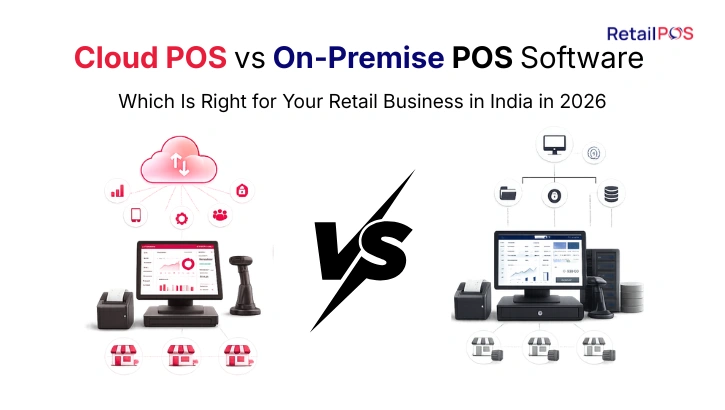
2: What Cloud POS and On-Premise POS Actually Mean
On-Premise POS
On-premise POS software is installed directly on a computer or server physically located at your shop. All your data, including your product catalogue, sales records, customer information, and inventory levels, is stored on that local machine. The software runs whether or not you have an internet connection, because everything it needs is right there in your shop.
To access your business data, you need to be physically at the shop, or you need to set up a remote connection to that specific computer, which most small retail owners never configure. If that computer’s hard drive fails, is stolen, or is damaged, your data is at serious risk unless you have been diligently backing it up to an external device, which in practice many retailers do not do consistently.
Cloud POS
Cloud POS software runs on remote servers maintained by the software provider, accessed through the internet from devices at your shop. Your data is stored on these remote servers, not on the device at your counter. The device at your shop, whether it is a tablet, computer, or dedicated POS terminal, is essentially a window into your business data that lives securely elsewhere.
Because your data lives on remote servers rather than a single local machine, you can access your business performance from any device with an internet connection and the right login, whether that is your phone while traveling, a laptop at home, or a tablet at a different outlet entirely.
Aspect | On-Premise POS | Cloud POS |
Where data lives | Local computer at your shop | Remote servers managed by provider |
Access location | Only from the shop or via complex setup | Any device, any location, with internet |
Internet requirement | Not required for basic operation | Required for real-time sync, optional for offline billing |
Hardware failure risk | Data loss risk if not backed up | Data remains safe on remote servers |
Software updates | Often require manual installation or technician visit | Applied automatically by provider |
Multi-outlet setup | Requires separate installation and manual consolidation | New outlet connects to existing central system |
3: The Real Differences That Matter for Indian Retailers
Beyond the technical definitions, here is what the cloud versus on-premise choice actually means for how you run your retail business day to day.
Visibility When You Are Not at the Shop
With on-premise systems, knowing how your shop performed yesterday typically means being physically present or calling your staff and asking them to check. With cloud systems, you open an app on your phone and see yesterday’s revenue, top-selling products, and any issues that need attention, regardless of where you are.
What Happens When Your Computer Breaks
With on-premise systems, if the computer running your POS software fails, you may lose access to your billing system entirely until it is repaired or replaced, and you may lose historical data if backups were not maintained. With cloud systems, you can switch to any other device, log in, and continue operating because your data was never tied to that specific machine.
Adding a Second Outlet
With on-premise systems, opening a second outlet typically means setting up an entirely separate installation at that location, and then manually finding ways to combine data from both locations for any consolidated view. With cloud systems, the new outlet connects to your existing central account, and consolidated reporting across both locations works automatically from day one.
Keeping Up With GST Changes
GST rates, e-invoicing requirements, and return filing formats change periodically. With on-premise systems, applying these updates often requires a technician visit or manual software installation at every location running the software. With cloud systems, the provider applies updates centrally and they become available to all users automatically.
4: Why On-Premise POS Was the Default Choice in India for Years
Understanding why on-premise systems became the default in Indian retail helps explain why some retailers remain hesitant about cloud systems, and why that hesitation made more sense in the past than it does today.
For many years, reliable internet connectivity in India was genuinely inconsistent, particularly outside major metro areas. A system that depended on a constant internet connection to function at all would have been a serious operational risk. On-premise systems, which functioned entirely independently of internet connectivity, were the safer choice in this environment.
There was also a generation of retail software that was sold as a one-time purchase, installed once, and used for years without ongoing subscription costs. This pricing model aligned naturally with on-premise deployment, where the software lived on hardware the retailer owned outright.
Additionally, concerns about data privacy and control led many business owners to feel more comfortable with their data living on a machine they could physically see and touch, even if that machine was less secure in practice than a properly managed cloud server.
These were legitimate considerations at the time. The question for 2026 is whether they remain accurate today.
5: Why Cloud POS Has Become the Practical Choice in 2026
Several shifts in the Indian retail and technology landscape have changed the calculus significantly.
Internet Infrastructure Has Transformed
Mobile data costs in India are among the lowest in the world, and 4G and increasingly 5G coverage extends to the vast majority of commercial areas where retail businesses operate, including Tier 2 and Tier 3 cities. The connectivity gap that made cloud systems risky a decade ago has narrowed dramatically.
Modern Cloud POS Includes Offline Capability
The most important development is that leading cloud POS systems in India, including RetailPOS, are designed with offline-first billing capability. This means the system continues to function fully during internet outages, storing transactions locally on the device temporarily, and automatically syncing everything to the cloud the moment connectivity returns. This effectively gives retailers the best of both models: cloud-based visibility and centralisation when connected, with on-premise-style continuity when offline.
GST Compliance Demands Continuous Updates
The GST framework in India has evolved continuously since its introduction, with e-invoicing thresholds, return formats, and rate structures all changing periodically. A cloud system that updates centrally ensures every user is compliant with the latest requirements without any action on their part. An on-premise system that requires manual updates at every location creates a compliance risk every time a change is missed or delayed.
Multi-Outlet Growth Has Become More Common
As discussed throughout RetailPOS’s content, more Indian retail businesses are planning multi-outlet growth earlier in their journey. Cloud architecture is fundamentally better suited to this growth because adding outlets is a configuration task rather than a new technical deployment.
6. Addressing the Internet Dependency Concern Directly
This is the concern that comes up most often when Indian retailers consider cloud POS, and it deserves a direct, honest answer rather than a dismissal.
The concern is valid in its underlying logic: if your billing system requires internet to function and your internet goes down, can you still serve customers?
The answer depends entirely on whether the cloud POS system you choose has genuine offline billing capability built in. Not all cloud systems do. Some cloud POS systems genuinely stop functioning without an internet connection, and for those systems, the concern is completely justified.
However, well-designed cloud POS systems, including RetailPOS, are built with a local cache of your product catalogue, pricing, and GST configuration stored on the device itself. When the internet connection drops, the system seamlessly switches to operating from this local cache. Billing continues normally. GST calculations remain accurate. Receipts print as usual. The only difference is that the transaction is queued locally instead of being immediately reflected in the central cloud database.
The moment internet connectivity returns, even briefly, all queued transactions sync automatically. No data is lost. No manual re-entry is needed.
The practical test for any retailer evaluating cloud POS systems is simple: during the demo, ask the vendor to disconnect the internet and complete a transaction. If the system handles this smoothly, the internet dependency concern is resolved for that vendor. If it does not, that specific vendor’s cloud system may not be ready for Indian retail conditions, regardless of how good the rest of the demo looked.
7: Data Security: Separating Myth From Reality
Many Indian retail owners assume that keeping data on their own computer is inherently more secure than storing it on a cloud provider’s servers. In practice, the opposite is usually true, for reasons that are worth understanding clearly.
The Local Computer Risk
A computer at a retail shop is rarely managed with the security practices that a dedicated data centre applies. It may run outdated operating systems, lack proper antivirus protection, have weak or shared passwords, and be physically accessible to multiple staff members and sometimes customers. If that computer is stolen, as happens periodically in retail environments, every piece of business data on it, including customer information, sales history, and financial records, goes with it. If the hard drive fails without a recent backup, years of data can be lost permanently.
The Cloud Provider Standard
Established cloud POS providers maintain their servers in professionally managed data centres with continuous security monitoring, automatic backups across multiple locations, encryption of data both in transit and at rest, and access controls that are far more sophisticated than what any individual retail shop implements on a local machine.
What You Should Actually Verify
The relevant question is not “cloud versus local” in the abstract, but rather: does this specific vendor follow proper data security practices? Ask vendors about their data backup frequency, where their servers are located, what encryption standards they use, and what happens to your data if you ever decide to leave the platform. A reputable cloud POS provider should answer these questions clearly and confidently.
8: Cost Comparison: Cloud vs On-Premise Over Three Years
The upfront cost comparison between cloud and on-premise systems can be misleading if you only look at year one. Here is a more complete picture for a typical single-outlet Indian retail business.
Cost Element | On-Premise (Typical) | Cloud (Typical) |
Initial software licence | Rs 25,000 to Rs 60,000 one-time | Often Rs 0, included in subscription |
Server or dedicated computer | Rs 30,000 to Rs 50,000 | Not required, runs on standard devices |
Annual subscription or maintenance | Rs 5,000 to Rs 15,000 per year | Rs 1,500 to Rs 4,000 per month |
Software updates | Often require paid technician visits | Included automatically |
Data backup setup | Separate cost and ongoing management | Included as part of service |
Multi-outlet setup cost | New installation per outlet | New outlet connects to existing account |
Three-year total (single outlet) | Rs 90,000 to Rs 1,55,000 | Rs 54,000 to Rs 1,44,000 |
The figures above are illustrative ranges based on typical Indian market pricing, and your actual costs will vary by vendor. The point is not that cloud is always cheaper in raw numbers, but that the on-premise total often hides costs in server hardware, technician visits for updates, and separate backup management that retailers do not account for upfront. For multi-outlet businesses, the cost difference becomes far more significant because cloud systems avoid the cost of separate installations and manual data consolidation entirely.
9. Multi-Outlet Management: Where the Difference Becomes Critical
If you operate, or plan to operate, more than one outlet, the cloud versus on-premise decision stops being a preference and becomes a structural determinant of how your business can function.
With on-premise systems, each outlet typically runs its own independent installation with its own local data. To see how all your outlets are performing together, someone has to manually collect reports from each location and combine them, usually in a spreadsheet, usually a day or more after the fact.
With cloud systems, every outlet connects to the same central account. Inventory levels across all outlets are visible in real time from one dashboard. A price change made at head office applies to all outlets instantly. A customer’s loyalty points earned at one outlet can be redeemed at another. GST data from all outlets aggregates automatically for return filing.
This is why, throughout RetailPOS’s content on multi-outlet retail management, the underlying technology enabling everything described, the centralised dashboards, the real-time inventory sync, the chain-wide loyalty programmes, is cloud architecture. On-premise systems simply cannot deliver these capabilities without significant custom networking work that most retail businesses are not equipped to set up or maintain.
10. GST Compliance and Software Updates
GST compliance in India is not a static requirement. Rates change. E-invoicing thresholds are revised. Return filing formats are updated. New compliance requirements are introduced periodically by the government.
With on-premise software, each of these changes requires the software vendor to release an update, and then requires that update to be manually installed on every computer running the software. In a multi-outlet business, this means coordinating updates across every location, and any location that misses an update may continue generating non-compliant invoices until the update is applied.
With cloud software, the vendor applies the update centrally on their servers, and every user accessing the system immediately benefits from the update without taking any action. For a compliance framework that changes as frequently as GST has in recent years, this difference is not a minor convenience. It is the difference between staying compliant automatically and carrying ongoing compliance risk across every location running outdated software.
11. Complete Decision Framework for Indian Retail Owners
Use this framework to make the decision for your specific business:
Choose cloud POS if:
- You want to see your business performance from anywhere, including your phone
- You operate more than one outlet, or plan to within the next two years
- You want GST compliance updates applied automatically without technician visits
- You want your business data protected even if your shop’s hardware is damaged or stolen
- You want customer loyalty and inventory to work consistently across multiple locations
A genuine cloud system with offline capability handles:
- Internet outages without stopping billing
- Continuous operation during connectivity gaps
- Automatic data sync when connectivity returns
Only consider on-premise if:
- Your shop has no reliable internet access at all, even via mobile data, which is increasingly rare in commercial areas across India
- You have a specific regulatory or contractual requirement mandating local-only data storage, which is uncommon for general retail
For the overwhelming majority of Indian retail businesses in 2026, the practical answer is a cloud POS system with genuine offline billing capability. This combination delivers the visibility, scalability, and compliance benefits of cloud architecture while eliminating the internet dependency risk that made cloud systems impractical in the past.
12. What RetailPOS Delivers as a Cloud-First Platform Built for India
RetailPOS is built as a cloud-based platform from the ground up, with offline billing capability designed specifically for the connectivity realities of Indian retail environments across metro cities, Tier 2 towns, and everything in between.
RetailPOS delivers:
- Complete cloud-based architecture with real-time data access from any device, anywhere
- Genuine offline billing that maintains full functionality including GST calculation during internet outages
- Automatic synchronisation of all transactions the moment connectivity is restored, with zero data loss
- Automatic GST compliance updates applied centrally with no technician visits required at any outlet
- Real-time multi-outlet inventory, pricing, and customer loyalty synchronised across every location
- Bank-grade data security with regular automated backups, eliminating the risk of data loss from hardware failure or theft
- Mobile dashboard access for owners to monitor their business from anywhere at any time
- Seamless scalability where adding a new outlet is a configuration step, not a new installation
For retail business owners weighing cloud versus on-premise for their decision in 2026, RetailPOS represents the practical resolution to this debate: full cloud capability with the reliability of local operation when you need it most.
Explore how RetailPOS combines cloud architecture with offline reliability by visiting our multi-store retail management page or reading our complete point of sale systems buying guide for Indian retail chains.
13. Conclusion
The cloud versus on-premise debate for Indian retail POS software is, in many ways, a debate that technology has already resolved, but the resolution has not reached every retail owner’s awareness yet. The internet infrastructure that made cloud systems risky has transformed. The offline billing capability that addresses the remaining connectivity concern is now standard in well-designed cloud systems. And the operational benefits, from anywhere visibility to automatic GST updates to seamless multi-outlet scaling, are advantages that on-premise systems simply cannot replicate without complex custom infrastructure.
If you are choosing POS software for your retail business in 2026, the right question is no longer cloud versus on-premise in the abstract. It is whether the cloud system you are evaluating has genuine, tested offline billing capability. If it does, you get the best of both worlds. If it does not, look for one that does, because that combination is now the standard that Indian retail businesses should expect.
Book a free demo with the RetailPOS team and see exactly how cloud-based management with offline reliability works for your specific business, including a live test of what happens when the internet goes down.
14. Frequently Asked Questions
It depends on the specific software. A genuine cloud POS system designed for Indian retail conditions, like RetailPOS, includes offline billing capability that keeps the system fully functional during internet outages, including GST calculations and invoice generation. Transactions are stored locally and sync automatically once connectivity returns. However, not all cloud POS systems include this capability, so it is essential to test this specifically during any demo by asking the vendor to disconnect the internet and complete a transaction.
When comparing only the initial purchase price, on-premise software can sometimes appear cheaper. However, when you include server or computer hardware costs, ongoing maintenance fees, paid technician visits for updates, and separate backup management, the total three-year cost of on-premise software is often comparable to or higher than cloud subscriptions, which typically bundle updates, backups, and support into the monthly cost.
In practice, data on professionally managed cloud servers is generally more secure than data on a local computer at a retail shop. Cloud providers maintain continuous security monitoring, automatic encrypted backups across multiple locations, and access controls that individual retail businesses rarely implement on their own equipment. A stolen or damaged local computer can result in permanent data loss, whereas cloud-stored data remains safe and accessible from any other device.
Yes, in most cases. The migration process involves exporting your existing product catalogue, customer data, and historical records from your on-premise system and importing them into the new cloud platform. This is a standard part of implementation for any reputable cloud POS vendor. The key is ensuring your existing data is clean and well-organised before migration, as this significantly speeds up the process and reduces errors in the new system.
No, not for systems with proper offline capability. RetailPOS, for example, only requires an internet connection for real-time synchronisation across outlets and for accessing the management dashboard remotely. The billing counter itself continues to function on locally cached data during connectivity gaps, and standard mobile internet speeds available across most of India are sufficient for the synchronisation that does occur.
Yes, particularly when the cloud system includes offline billing capability. Mobile data coverage and affordability have expanded significantly across smaller Indian cities and towns, making cloud connectivity viable in most commercial areas. For the periods when connectivity is less reliable, offline billing ensures operations continue uninterrupted. This combination makes cloud POS systems with offline capability well suited to retail businesses across India's smaller cities and towns, not just major metros.

 Book your demo
 Talk to our POS experts
- 📧 Email: salesenquiry@uniprotech.co.in
Book a free demo and see how RetailPOS Dineazy gives you complete financial visibility across your restaurant operations..
Or WhatsApp our team directly – we respond within minutes.
Or call us at 95662 44611