
Powered by Unipro Tech
Organised Retail and Quick Commerce Are Expanding Into Smaller Markets in 2026: How Regional Retailers and Distributors Stay Competitive
A strategic guide for regional retail chains, supermarket owners, and FMCG distributors across India
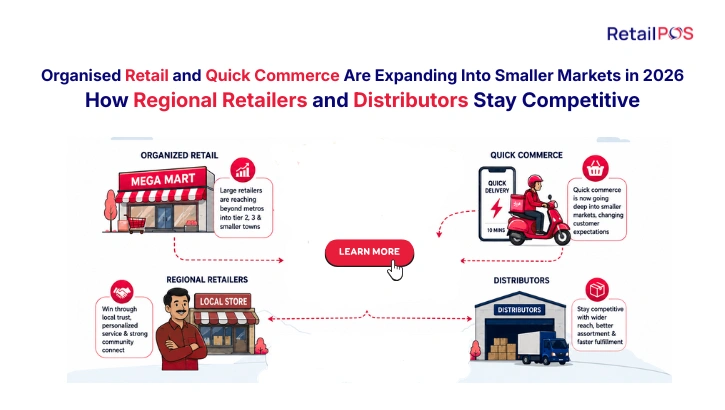
Section 1: The Expansion Pattern Every Regional Retailer Is Noticing
If you run a regional supermarket chain, a multi-outlet apparel business, or an FMCG distribution operation anywhere in India, you have probably noticed the same pattern over the last year. Large, well-capitalised retail groups are no longer concentrating only on metro cities. They are pushing actively into Tier 2 and Tier 3 towns, into suburban corridors, and into the exact regional markets that independent retail chains and distributors have historically considered their own territory.
At the same time, quick commerce platforms that started as a dense, urban, metro-only phenomenon have expanded their delivery networks into thousands of additional pin codes across the country. Customers in towns that never had access to 10 to 30 minute delivery are now experiencing it for the first time, and their expectations of every retailer in that market, including the regional retailer who has served them for years, are shifting accordingly.
On the distribution side, several large consumer goods groups are investing heavily in their own manufacturing and direct-to-retail distribution capability, building food parks, automating production, and using their own retail and digital infrastructure to reach consumers without depending on the traditional multi-tier distributor network that has been the backbone of FMCG distribution in India for decades.
None of this is a future possibility. It is the competitive environment unfolding right now in 2026. The question every regional retailer and distributor needs to answer honestly is not whether this expansion will reach their market. For most regions, it already has, or it will within the next 24 months. The real question is what specifically a regional business can do to remain competitive and profitable as this expansion continues.
Section 2: What Is Actually Changing in Indian Retail and Distribution
Industry-wide data points to a consistent set of structural shifts happening across Indian retail and FMCG distribution in 2026.
Trend | What Is Happening | What It Means for Regional Players |
Large organised retail groups expanding store networks | Major national retail chains are adding hundreds of new stores annually, with explicit strategies targeting smaller towns and suburban markets | Direct competition arriving in markets that were previously underserved by organised retail |
Quick commerce reaching far beyond metro cities | Delivery networks that started in dense urban areas have expanded into thousands of additional pin codes and smaller cities | Customer delivery expectations are rising in markets where regional retailers previously had no organised competition on speed |
Consumer goods companies investing in direct manufacturing-to-retail models | Large FMCG groups are building their own manufacturing capacity and distributing through their own retail and digital networks | Traditional distributor roles are being bypassed for certain product categories and certain retail relationships |
AI and automation adoption accelerating across retail and FMCG supply chains | Demand forecasting, inventory optimisation, and production efficiency increasingly rely on automated, data-driven systems | The operational efficiency gap between data-driven retailers and manually managed regional businesses is widening |
Organised retail’s overall share of the market continuing to grow | India’s retail sector is projected to grow substantially over the coming decade, with organised and technology-enabled formats capturing a disproportionate share of that growth | The market is growing, but a regional business standing still on outdated systems is effectively losing relative ground every year |
The pattern across every one of these trends is consistent. Organised, well-capitalised, technology-driven retail and distribution is no longer confined to large cities. It is actively and deliberately extending into the regional markets that independent businesses have built their customer relationships around.
Section 3: Why This Wave of Expansion Feels Different
Regional retailers and distributors in India have weathered organised retail expansion before. The arrival of early hypermarket formats, the initial growth of supermarket chains, and the first wave of e-commerce were all absorbed, adapted to, and in many cases successfully competed against by regional players who knew their local markets intimately.
What makes the current wave feel different is the combination of three factors happening simultaneously rather than sequentially.
Manufacturing-to-shelf integration. When a company manufactures its own products and distributes them through its own retail network, an entire layer of the traditional distribution chain that regional distributors have historically occupied can disappear for that specific product category. A traditional FMCG distributor sources from a manufacturer and sells to retailers. When the manufacturer and the retailer increasingly belong to the same organisation, the distributor’s role in that specific relationship weakens.
Hyperlocal fulfilment reaching smaller markets. Quick commerce infrastructure that was once limited to dense metro pin codes is now reaching thousands of smaller towns and suburban areas. This means delivery speed, once a metro-only differentiator, is becoming a baseline customer expectation in markets regional retailers assumed were too small or too dispersed to attract this kind of investment.
Automation-driven operational efficiency at a scale regional players cannot match unassisted. Across the retail and FMCG sector broadly, demand forecasting, inventory management, and supply chain decisions are increasingly automated and data-driven. This operational efficiency translates into pricing power and stock availability advantages that a regional player using manual processes or basic billing software cannot easily replicate at the same cost structure.
The combined effect is that regional retailers and distributors are facing a structurally different model of retail and distribution, one that is reaching into their specific markets with advantages in sourcing cost, operational efficiency, and customer reach that did not exist in the same combination during previous competitive waves.
Section 4: The Five Disadvantages Regional Retailers and Distributors Face Right Now
Disadvantage 1: Sourcing scale. Large retail and FMCG groups with integrated manufacturing and large-scale procurement achieve cost structures that a regional retailer or distributor sourcing through traditional multi-tier channels cannot match on price alone.
Disadvantage 2: Brand and marketing reach. Large national players have the marketing budgets and digital presence to build strong brand awareness in markets that regional players have served for years through relationship and reputation, but often without comparable digital visibility.
Disadvantage 3: Capital for technology investment. Automated forecasting, optimised supply chains, and integrated retail-to-manufacturing systems require capital investment that is simply unavailable to most regional businesses at the scale larger players deploy.
Disadvantage 4: Quick commerce delivery expectations. Once a customer in a smaller town experiences fast organised delivery from a quick commerce platform, their expectation of every retailer in that market shifts, including the regional retailer who cannot match that delivery infrastructure independently.
Disadvantage 5: Operational visibility at scale. This is the disadvantage most directly within a regional retailer’s or distributor’s own control to fix, and it is the focus of the rest of this guide. Larger, more organised competitors typically operate with real-time visibility into every store, every SKU, and every transaction. Most regional chains and distributors, even those running five, eight, or fifteen outlets, are still managing significant parts of their operation through manual processes, disconnected systems, or basic billing software that was never designed for multi-outlet, data-driven competition.
Section 5: The Five Advantages Regional Players Still Have and How to Use Them
This expansion is real and significant, but it does not mean regional retailers and distributors are without genuine, defensible advantages. The retailers and distributors who continue to grow over the next decade are the ones who combine these existing advantages with the operational technology that closes the gap described in Disadvantage 5 above.
Advantage 1: Local relationship depth. A regional retailer who has served a neighbourhood for years knows customer preferences, local festival buying patterns, and community relationships in a way that no standardised national approach replicates as effectively for that specific locality.
Advantage 2: Speed of local decision making. A regional retail chain owner can change pricing, run a local promotion, or adjust stock allocation for a local event within hours. A large organisation’s decision-making process for a single store’s local promotion typically moves through multiple layers of approval.
Advantage 3: Category and assortment flexibility. Regional retailers can stock and prioritise hyper-local preferences, religious and cultural specifics, and regional brand loyalties that a standardised national assortment cannot fully serve.
Advantage 4: Distributor relationship trust. For FMCG distributors specifically, years of built trust with retailer networks, flexible credit terms tailored to long-standing relationships, and deep market knowledge of which retailers move which products remain genuinely valuable, provided the distributor can also deliver the operational reliability that retailers now expect.
Advantage 5: Lower fixed cost structure. Regional retailers and distributors typically operate with lower overhead than the large integrated infrastructure being built by national players, which means a smaller margin improvement from better operations translates into a proportionally larger competitive benefit.
The critical insight is that none of these five advantages matter on their own if the underlying operations cannot execute reliably. Local relationship depth does not help if a customer cannot find the right stock size on the shelf. Speed of local decision making does not help if a pricing change takes a week to actually reach the billing counter because there is no centralised system. The advantages are real, but they require an operational foundation to convert into actual competitive results.
Section 6: The Technology Gap That Decides Who Stays Competitive
The fundamental principle behind large-scale, AI-driven retail and FMCG operations is straightforward even though the scale involved is enormous: these organisations know what is happening in their business in real time, and they use that information to make faster, better decisions than competitors operating on delayed or incomplete data.
A regional retail chain or distributor does not need enterprise-scale automation infrastructure to compete on this same principle. What is needed is the same fundamental capability at a scale appropriate to the business: real-time visibility into stock, sales, and customer behaviour across every outlet or every retailer relationship, available the moment it is needed rather than discovered weeks later in a monthly report.
What Large, Organised Competitors Have | What Regional Players Need to Match the Principle, Not the Scale |
Automated demand forecasting across thousands of locations | Sales-history-driven stock planning per outlet, even across just 5 to 15 locations |
Real-time inventory visibility across large store networks | Real-time inventory visibility across every outlet the regional chain operates |
Integrated data flow connecting manufacturing, distribution, and retail | Centralised distributor system connecting purchase, secondary sales, and retailer credit in one view |
Hyperlocal fulfilment infrastructure | Fast, reliable in-store and local delivery execution supported by accurate real-time stock data |
Automation-driven production and supply chain efficiency | Efficient, error-free billing and inventory management that removes manual cost and waste |
The gap that decides whether a regional retailer or distributor stays competitive over the next several years is not access to large amounts of capital. It is whether the business has moved from manual, disconnected operations to a centralised, real-time system that gives ownership and management the same fundamental visibility, scaled appropriately, that larger organisations are using to expand into regional markets in the first place.
Section 7: The Problem vs Solution Breakdown
Competitive Disadvantage | Why Regional Players Struggle With It | Technology Response |
Slower local decision execution | Pricing and promotion changes require manual updates at each outlet | Centralised pricing pushed to all outlets instantly from head office |
Stockouts on fast-moving items | No real-time stock visibility across outlets to anticipate demand | Real-time multi-outlet inventory with low-stock alerts before shelves empty |
Inconsistent customer experience across locations | Each outlet operates independently with different systems or practices | Unified billing, loyalty, and pricing system across the entire chain |
Inability to compete on delivery speed | No integrated stock and order visibility to fulfil quick local delivery | Real-time stock data enabling reliable same-day or local delivery commitments |
Distributor relationships at risk from direct manufacturer distribution | No differentiated value beyond product delivery | Faster, more accurate secondary sales reporting and retailer servicing that builds retailer loyalty beyond price |
No data to defend or grow market share | Manual reporting means insights arrive too late to act on | Real-time analytics dashboard showing sales trends, slow movers, and customer behaviour as it happens |
Section 8: How RetailPOS Helps Regional Retail Chains and Distributors Compete and Win
RetailPOS by Unipro Tech Solutions exists specifically to give regional retail chains, supermarket operators, and FMCG distributors the operational infrastructure to compete on the same fundamental principle that larger, more organised players use at far greater scale: real-time visibility translated into faster, better decisions.
For regional retail chains facing increased competition from organised retail expansion:
RetailPOS Enterprise connects every outlet through a centralized database, giving real-time stock visibility across the entire chain, scaled appropriately for a 5 to 50 outlet regional chain. Centralised pricing and promotion management allows a regional chain to respond to local market conditions and competitive moves within hours rather than days. The Cockpit
dashboard gives ownership the same real-time, data-driven view of the business that larger competitors use to make faster decisions.
For apparel and fashion chains defending their regional customer base:
Variant-level inventory management and inter-branch transfer capability ensure that fast-moving sizes and styles are available where customers are actually shopping, closing the stock availability gap that can otherwise drive customers toward larger competitors with bigger individual store inventories.
For FMCG distributors navigating the shift toward direct manufacturer distribution:
The distribution management module gives distributors the secondary sales tracking, retailer credit management, and beat planning efficiency that allows them to demonstrate measurable value to their retailer network beyond simple product delivery, the relationship depth advantage described in Section 5, now backed by operational reliability that retailers can depend on.
For every regional player:
Real-time analytics turn the data every business already generates into the kind of forward-looking insight that larger competitors use automation and dedicated data teams to produce. A regional retailer does not need enterprise-scale automation infrastructure to know which products are running low at which outlet this week, or which customer segments are shifting their buying patterns. That information already exists inside daily transactions. RetailPOS makes it visible the moment it matters rather than the month after.
Conclusion: The Expansion Is Real. So Is Your Path to Compete.
Organised retail expansion into smaller towns, quick commerce reaching thousands of new pin codes, and direct manufacturer-to-retail distribution models are not exaggerated trends. They are happening now, they are well funded, and they are specifically reaching into the regional markets that independent retail chains and distributors have built their businesses around.
But this expansion does not eliminate the genuine advantages that regional players hold: local relationship depth, decision-making speed, assortment flexibility, and trusted distributor relationships built over years. What it does eliminate is the margin for operational inefficiency. A regional retailer or distributor still managing their business through manual processes, phone calls between outlets, and monthly rather than real-time reporting is competing against increasingly data-driven infrastructure with one hand tied behind their back.
The retailers and distributors who will still be growing five years from now are not the ones who out-fund larger organised competitors. They are the ones who close the operational visibility gap, converting their existing local advantages into a business that can execute as reliably, as quickly, and with as much data-driven precision as the competitors now arriving in their market.
Frequently Asked Questions
Direct, head-to-head competition on capital, manufacturing scale, or marketing budget is not realistic for most regional players. What is realistic, and what consistently determines which regional retailers continue growing, is competing on operational reliability, local relationship depth, and decision-making speed, all of which depend on having real-time visibility into your own business rather than trying to match a competitor's infrastructure scale directly.
For a retail chain of this size migrating from disconnected outlet systems or basic billing software, implementation including data migration, configuration, staff training, and a parallel run period typically takes four to six weeks. The chain does not need to wait months to begin closing the operational visibility gap.
It applies directly to FMCG distributors. As some manufacturers increasingly build direct-to-retail distribution capability, traditional distributors need to demonstrate measurable value beyond simple delivery, which depends on operational reliability: accurate and fast secondary sales reporting, efficient beat planning, and dependable retailer credit management that builds loyalty even as the competitive landscape shifts.
The first step is gaining real-time visibility into your own current operations, specifically stock levels across all outlets or retailer accounts, sales trends by location or by product, and any operational bottlenecks that are currently invisible because they are tracked manually or not tracked at all. This visibility, more than any single feature, is the foundation that every other competitive response depends on.

 Book your demo
 Talk to our POS experts
- 📧 Email: salesenquiry@uniprotech.co.in
Book a free demo and see how RetailPOS Dineazy gives you complete financial visibility across your restaurant operations..
Or WhatsApp our team directly – we respond within minutes.
Or call us at 95662 44611
About RetailPOS
RetailPOS is an enterprise retail, restaurant, and distribution POS and ERP solution by Unipro Tech Solutions Pvt Ltd, headquartered in Chennai, Tamil Nadu. With over 20 years of experience and 10,000 plus businesses served across India and globally, RetailPOS gives regional retail chains, supermarket operators, apparel chains, and FMCG distributors the real-time operational infrastructure to compete effectively in a fast-changing retail and distribution landscape. Products include RetailPOS Enterprise, Cockpit multi-outlet dashboard, Distribution Management System, Analytics, and consumer loyalty integration.