
Powered by Unipro Tech
Point of Sale Systems for Retail: The Complete Guide Every Indian Chain Owner Needs in 2026
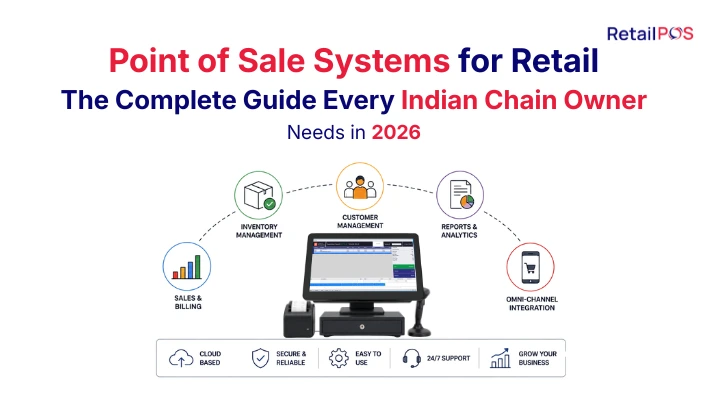
1. Introduction
Every retail business in India uses some version of a point of sale system today. From the neighbourhood kirana store running a basic billing application on a tablet to a fifty-outlet supermarket chain managing inventory, GST compliance, customer loyalty, and real-time analytics from a unified enterprise platform, the point of sale system sits at the operational heart of every retail transaction in the country.
But the phrase point of sale system for retail covers an enormous range of technology. A free billing app downloaded from the Play Store is technically a point of sale system. So is an enterprise retail management platform that connects 200 outlets across twelve Indian states to one centralised management dashboard. The gap between these two ends of the spectrum is not measured in features. It is measured in what they make possible for the businesses that use them.
This guide is written for Indian retail business owners and chain operators who want a complete, honest picture of what point of sale systems for retail actually are, what they must do at every scale of retail operation, how to evaluate the options available in India in 2026, and how to make the decision that fits both where your business is today and where it is going.
Whether you run one store or are managing ten, this guide gives you the framework to understand, evaluate, and choose the right point of sale system for your retail business in India.
2. What Point of Sale Systems for Retail Actually Are in 2026
A point of sale system for retail is the combination of software and hardware that enables a retail business to process transactions, manage inventory, maintain compliance, and understand business performance. In 2026, a modern retail POS system is far more than a billing tool. It is the operational infrastructure of the entire retail business.
At the most basic level, a retail POS system processes the transaction. When a customer brings products to the counter, the system identifies each product, applies the correct price and GST rate, calculates the total, accepts payment, generates a compliant invoice, and records the sale. This is the function every retail POS system performs regardless of its sophistication level.
At the enterprise level, the same transaction simultaneously reduces the inventory of each sold product at the specific outlet, updates the customer’s loyalty balance if they are a registered member, contributes to the outlet’s real-time revenue figure visible on the management dashboard, adds to the month’s GST return data in the correct table automatically, triggers a reorder alert if the product has dropped below the configured minimum stock level, and updates the customer’s purchase history in the CRM.
This is the difference between a point of sale system that processes transactions and one that manages the retail business. Both are technically point of sale systems. The gap between them is the difference between recording what happened and understanding and managing the business in real time.
3. Why Retail POS Systems Have Become Business Critical in India
Three specific developments have transformed point of sale systems from a convenience to a business necessity for Indian retailers in 2026.
GST Compliance
India’s GST framework requires every retail transaction to carry the correct HSN code, the correct tax rate, and the correct invoice fields. For businesses above the e-invoicing threshold, every qualifying B2B invoice must be registered on the Invoice Registration Portal before reaching the buyer. Monthly return filings require accurate categorisation of every transaction into the correct tables. A retail business without a GST-integrated point of sale system is managing this compliance manually, which is both operationally expensive and compliance-risky at any meaningful transaction volume.
Digital Payments
India’s digital payment revolution, driven by UPI, has transformed consumer expectations at the retail counter. Customers across every income segment and every city expect seamless digital payment acceptance as a baseline retail experience, not a premium feature. A POS system that cannot integrate cleanly with UPI, card payments, and digital wallets is falling behind customer expectations in the current Indian retail environment.
Organised Retail Competition
The expansion of organised retail chains across Indian cities has raised the operational standard that all retailers must meet to remain competitive. When a customer can shop at a well-organised chain outlet with fast billing, consistent pricing, and a loyalty programme that rewards repeat visits, the neighbourhood retailer operating on a manual system or basic billing app is competing at a structural disadvantage that no amount of product selection or personal service can fully overcome.
4. The Evolution From Cash Register to Enterprise Retail Platform
Understanding where point of sale systems have come from helps clarify what they are capable of now.
Generation One: The Cash Register
The original cash register did one thing. It recorded the sale amount and kept the cash secure. No itemised record of what was sold. No connection to inventory. No tax calculation. Just a transaction total and a secure drawer.
Generation Two: Basic Billing Software
The first generation of computerised billing software added the ability to record what was sold alongside the amount. Invoices could be printed with itemised details. Basic daily sales reports became available. GST compliance was added as the tax framework demanded it.
Generation Three: Integrated POS Systems
The current generation of retail POS systems integrates billing with inventory management, customer loyalty, GST compliance, purchase management, and business analytics. This generation is what most Indian retailers mean when they say they are looking for a POS system.
Generation Four: Enterprise Retail Management Platforms
The leading edge of retail technology in India today is the enterprise retail management platform, which combines the speed and simplicity of a purpose-built POS front end at every outlet with a full ERP backend managing every operational and compliance function of the retail chain from one centralised system. This is the category where RetailPOS operates.
5. What Every Retail POS System Must Do at the Billing Counter
Regardless of the sophistication level of the overall platform, every point of sale system for retail must perform the following functions reliably at the billing counter:
Fast Transaction Processing
The billing interface must allow counter staff to find products quickly, apply correct pricing, process transactions, and generate invoices without delay. During peak trading periods, counter speed directly determines customer throughput and queue length. A system that requires multiple steps or searches to complete a standard transaction is costing the business revenue every busy hour it operates.
GST-Compliant Invoice Generation
Every invoice must carry the correct HSN code, tax rate, invoice number, supplier details, and all mandatory fields required under Indian GST law. For B2B transactions above the e-invoicing threshold, the system must generate an IRN through direct IRP integration at the moment of billing.
Multiple Payment Mode Acceptance
Cash, UPI, debit and credit cards, and digital wallets must all be accepted seamlessly at the billing counter with automatic payment reconciliation at end of shift.
Offline Billing Capability
The billing counter must continue operating normally during internet connectivity disruptions, with complete GST accuracy maintained offline and automatic synchronisation when connectivity is restored.
Receipt Generation
Printed and digital receipts must be generated correctly with all required invoice information included for every transaction type.
6. What Separates Basic POS From Enterprise Retail Management
This is the distinction that matters most for Indian retail chain owners evaluating point of sale systems. Understanding it protects business owners from investing in a system that fits today but fails at the next growth milestone.
Capability | Basic POS System | Enterprise Retail Management |
Inventory tracking | Reduces stock at billing only | Tracks every movement from purchase to transfer to sale |
GST compliance | Generates compliant invoice | Automates full return preparation and e-invoicing |
Multi-outlet management | Separate instances per outlet | Single centralised backend connecting all outlets |
Reporting | Daily sales summary per outlet | Real-time consolidated analytics across all outlets |
Customer loyalty | Basic per-outlet or none | Chain-wide unified CRM with campaign management |
Purchase management | Not integrated | Linked to real-time sales data for automated reorder |
Staff management | Basic cashier login | Full shift tracking with labour cost reporting |
Pricing control | Manual per outlet | Centralised with instant push to all outlets |
Scalability | 1 to 3 outlets efficiently | Designed for 1 to 200 plus outlets on same platform |
GST return preparation | Manual export required | Automatic from central billing data |
Business intelligence | Transaction reports only | Margin, vendor, and customer behaviour analytics |
Festival promotion | Manual per outlet update | Centralised scheduled activation across all outlets |
7. The 12 Features Every Indian Retail Chain Must Have
These are the twelve features that every retail chain in India must verify in any point of sale system before making a purchasing decision. If a vendor cannot demonstrate all twelve in a live system, they are not ready for a serious multi-outlet retail operation.
Feature 1: Real-Time Centralised Inventory
Stock must update across all outlets simultaneously after every transaction. Not hourly. Not daily. In real time after each event.
Feature 2: Automatic GST Rate Application
HSN codes must be mapped at the product master level so the correct rate applies without any operator decision at the counter.
Feature 3: E-Invoicing With Direct IRP Integration
For qualifying B2B transactions, IRN must be generated automatically at the billing counter through direct IRP connectivity without any separate portal step.
Feature 4: Automated GSTR-1 and GSTR-3B Preparation
Return data must be prepared automatically from billing transactions. The accounts team reviews and approves. They do not build from scratch.
Feature 5: Centralised Pricing and Promotion Management
All pricing and promotions must push from head office to all outlets simultaneously. Festival promotions must activate and deactivate automatically.
Feature 6: Inter-Outlet Stock Transfer Management
Moving stock between outlets must create a documented system entry with complete trail rather than an informal adjustment.
Feature 7: Chain-Wide Customer Loyalty and CRM
Points earned at any outlet must be redeemable at any other. Customer profiles must be accessible from every billing terminal.
Feature 8: Role-Based Access Control
Store managers see their outlet. Area managers see their cluster. Owners see everything. This must be configurable without requiring separate system installations.
Feature 9: Offline Billing Capability
Full billing functionality must continue during internet outages with automatic synchronisation on restoration.
Feature 10: Consolidated Real-Time Reporting
The owner must see all outlet performance from one screen without manual data collection. Updated after every transaction at every outlet.
Feature 11: Automated Purchase Order Generation
Reorder alerts and purchase orders must be generated automatically based on real-time sales velocity without requiring manual stock count triggers.
Feature 12: Scalable Architecture for Growth
Adding a new outlet must be a configuration task within the existing system, not a new implementation or system replacement.
8. Point of Sale Systems for Retail by Category
Different retail categories in India have specific point of sale requirements beyond the universal features listed above. Here is what each major category needs:
Supermarkets and Grocery Chains
Supermarkets need weighing scale integration for loose products sold by weight, automatic HSN-level GST rate application across nil-rated, 5%, 12%, and 18% products within one transaction, expiry date tracking for perishables, and purchase management linked to real-time daily sales velocity for automated reorder.
A supermarket chain in Chennai managing outlets across Anna Nagar, Velachery, and Tambaram needs centralised stock visibility updated in real time, festival promotion management for Pongal and Diwali pricing across all outlets simultaneously, and inter-outlet transfer capability for fast-moving products running low at specific locations.
Pharmacy Chains
Pharmacy chains need batch number and expiry date tracking at the unit level, scheduled drug restriction enforcement at the billing counter, multi-slab GST application across pharmaceutical categories from nil-rated to 12%, and near-expiry stock alerts that prevent wastage and margin loss.
A pharmacy chain in Hyderabad expanding across Jubilee Hills, Madhapur, and Kukatpally needs centralised near-expiry monitoring across all outlets with automated transfer suggestions to move at-risk stock to higher-velocity locations before it expires unsold.
Apparel and Textile Chains
Apparel chains need size and colour variant matrix management where each combination is tracked as an individual SKU, variant-level sell-through reporting, price-based GST rate determination for the Rs 1,000 threshold, and inter-outlet variant transfer management for balancing stock when specific sizes are needed at different locations.
A garment chain in Bengaluru with outlets in Jayanagar, Koramangala, and Whitefield needs centralised festival sale management for Dasara and Diwali pricing across all outlets and sell-through data at the variant level for buying decisions that minimise slow-moving season-end stock.
Electronics and Mobile Retail
Electronics retailers need individual serial number tracking from purchase receipt to customer sale, warranty management linked to customer records, high-value transaction authorisation controls, and correct 12% and 18% GST slab application across different product categories.
Quick Service Restaurants
QSR chains need Kitchen Display System integration with unified Zomato and Swiggy order management into one kitchen queue, recipe-linked food cost tracking, table management with QR-based ordering, and channel-wise revenue reporting separating dine-in from delivery contribution.
9. GST Compliance Inside Your Retail POS System
GST compliance is the dimension where Indian retail point of sale systems vary most significantly in their actual capability, and where the gap between what vendors claim and what their systems deliver is widest.
Here is the five-level framework to assess any retail POS system’s GST capability honestly:
Level 1 is invoice display. The invoice shows GST amounts. This is the absolute minimum and every system in India provides it.
Level 2 is automatic rate application. HSN codes mapped at the product level drive rates automatically without operator selection. This eliminates the most common source of GST errors.
Level 3 is e-invoicing integration. Qualifying B2B invoices receive IRNs through direct IRP integration at the billing counter without any separate portal login.
Level 4 is return automation. GSTR-1 and GSTR-3B data is prepared automatically from billing transactions without manual export or reformatting.
Level 5 is multi-GSTIN management. Separate compliance records for multiple state registrations are managed automatically with state-wise return data generated per registration alongside a consolidated chain-wide overview.
For any Indian retail chain with serious compliance requirements, Levels 1 and 2 are the bare minimum. Levels 3, 4, and 5 are what transform GST from a monthly two-week manual burden to a two-hour review and approval exercise.
10 . Multi-Outlet Management Through One POS Platform
For retail chains managing multiple outlets, the point of sale system is not just the billing terminal. It is the operational nervous system connecting every outlet to one management centre.
Here is what multi-outlet management through a unified POS platform looks like in practice for a supermarket chain owner managing seven outlets across Bengaluru:
Every morning the owner opens one screen. Without calling any store manager or waiting for any manual report, they see yesterday’s revenue at each outlet compared to the same day the previous week. Products that dropped below reorder level overnight at any of the seven outlets, with system-generated purchase orders ready for approval. Cash reconciliation variances above the configured threshold at any outlet, with the specific cashier and shift identified automatically.
By 9 AM the owner has approved three purchase orders, initiated one inter-outlet transfer, and reviewed one discrepancy, all without visiting a single outlet.
This is what a genuine multi-outlet point of sale platform makes possible every single morning, compared to the one to two hours of phone calls, WhatsApp messages, and manual report compilation that the same information gathering requires on a disconnected system.
11. How to Evaluate Any Point of Sale System for Your Retail Business
Use this evaluation framework during every vendor demonstration:
Before the Demo
Document your current pain points, outlet count and growth plan, category-specific requirements, and the three operational problems that cost your business the most time or money every month. Every vendor response must be measured against these specific requirements rather than a generic feature checklist.
During the Demo
Require live demonstrations of every critical feature using your own product examples and outlet structure rather than vendor sample data. Specifically:
Ask the vendor to disconnect the internet and complete a full transaction to verify offline billing capability. Ask to see a price update propagated to multiple outlets simultaneously. Ask to see GSTR-1 data generated automatically from billing transactions. Ask to see stock levels at multiple outlets visible simultaneously from one screen. Ask to see a customer loyalty balance updated after a transaction at one outlet and then verifiable at a second outlet.
After the Demo
Calculate the total cost of ownership across three years including subscription, hardware, implementation, training, and maintenance. Ask for references from retail businesses similar to yours in category and outlet count. Contact those references and ask specifically about GST accuracy, system performance during festival season peak loads, and support response quality after go-live.
12. Common Mistakes Indian Retailers Make When Choosing a POS System
Choosing on Subscription Price Alone
The monthly fee is rarely the largest cost over three years when hardware, implementation, integration, and maintenance are included. A system that appears cheaper often has a significantly higher total cost once these elements are calculated.
Evaluating for Today’s Outlet Count
The system that handles one outlet today may show significant limitations at three or five outlets. Always evaluate for your expected outlet count in 24 months, not just your current situation.
Not Testing Offline Capability
Vendors who do not want their offline capability tested during the demo are telling you something important about how it performs in real conditions.
Accepting Vague GST Compliance Claims
Every vendor claims GST compliance. Ask specifically which level of the five-level framework they operate at and require a live demonstration of each level they claim.
Skipping Reference Checks
The most reliable indicator of how a system will perform for your business is how it has performed for a similar business that has been using it for at least one year. Always ask for and contact references.
13. What RetailPOS Delivers as an Enterprise Point of Sale System
RetailPOS has been serving Indian retail chains for over 20 years and is purpose-built for the multi-outlet enterprise retail environment across supermarkets, apparel, pharmacy, electronics, and food businesses throughout India.
RetailPOS delivers every feature in the twelve-point checklist in this guide as core architecture rather than optional add-ons:
- Fast touchscreen billing on tablet, mobile, and desktop hardware with barcode scanning and category-specific integrations including weighing scales and kitchen displays
- Automatic HSN-level GST rate application across all product categories and tax slabs
- E-invoicing with direct IRP integration for automatic IRN generation at every qualifying outlet
- Automated GSTR-1 and GSTR-3B preparation from all outlet billing data across all state registrations
- Multi-GSTIN support for retail chains operating across multiple Indian states
- Real-time centralised inventory management with variance alerts and inter-outlet transfer management
- Centralised pricing and festival promotion management with instant push to all outlets simultaneously
- Chain-wide customer loyalty and CRM with WhatsApp and SMS campaign management
- Automated purchase order generation based on real-time outlet-level sales velocity
- Role-based access with outlet-level, area-level, and chain-level permission configuration
- Full offline billing with automatic cloud synchronisation on connectivity restoration
- Mobile owner dashboard for complete chain visibility from any device at any location
- Scalable architecture that grows from two outlets to two hundred on the same platform without system replacement
- Size and colour variant management for apparel chains
- Batch and expiry tracking for pharmacy chains
- Serial number and warranty management for electronics chains
- Kitchen Display System and delivery platform integration for restaurant chains
For retail chains currently operating on disconnected single-outlet billing systems, the transition to RetailPOS delivers centralised inventory visibility, automated GST compliance, and consolidated real-time reporting from day one of go-live.
Explore how RetailPOS works for your specific retail category and outlet structure by visiting our multi-store retail management page or reading our complete buying guide for point of sale systems for Indian retail chains. You can also read our guide on how to choose POS software for your retail business in India for a step-by-step evaluation framework.
14. Conclusion
Point of sale systems for retail in India in 2026 span the full range from a basic billing application that records transactions to an enterprise retail management platform that connects every function of a multi-outlet chain to one centralised management system. The decision of which system fits your business is not simply a feature comparison. It is a decision about the operational infrastructure you are building for the growth stage your business is entering.
The retail businesses in India that are growing most profitably are doing so on systems that match their operational complexity, their compliance requirements, and their management information needs. They are not the biggest businesses or the ones with the most technology budget. They are the ones that made the right technology decision at the right time, before their complexity outgrew their systems rather than after.
If you are evaluating point of sale systems for your retail business in India, the RetailPOS team is ready to show you exactly what the right system looks like for your specific category, outlet structure, and growth plan in a live demonstration built around your actual business.
Book a free demo with the RetailPOS team today.
Frequently Asked Questions
The best point of sale system for retail in India in 2026 is one that delivers fast, reliable billing at the counter with automatic GST compliance, alongside the management capabilities your specific business scale requires. For single-outlet businesses, this means strong billing speed, automatic HSN-based GST rate application, and offline billing capability. For multi-outlet retail chains, it additionally requires real-time centralised inventory, centralised pricing and promotion management, automated return preparation, chain-wide customer loyalty, and scalable architecture that grows with the chain without system replaceme
A POS system primarily manages the transaction at the billing counter. A retail management system manages the entire business including billing, inventory, purchasing, compliance, customer relationships, and analytics from one unified platform. For retail chains in India, the practical distinction is that POS capability handles what happens at the counter while retail management capability handles everything that happens across the business behind and beyond the counter.
POS system costs for Indian retail chains vary significantly by outlet count and capability level. For a single-outlet retailer, expect Rs 1,500 to Rs 5,000 per month in subscription costs alongside one-time hardware costs of Rs 30,000 to Rs 1,00,000. For a five-outlet chain, subscription costs typically range from Rs 15,000 to Rs 30,000 per month across all outlets with proportionally higher implementation and hardware investment. Always calculate the total cost of ownership across three years including subscription, hardware, implementation, training, and maintenance before comparing options.
Good retail POS systems designed for Indian conditions work fully offline during internet outages. This means the billing counter continues processing transactions, applying correct GST rates, and generating compliant invoices without any internet connection. Transactions are stored locally and synchronised to the central system automatically when connectivity is restored. Not all POS systems have genuine offline capability, so it is essential to test this specifically during any vendor demonstration.
A retail POS system with genuine GST automation applies the correct tax rate automatically from HSN code mapping at the product master level, generates e-invoices with IRN through direct IRP integration for qualifying B2B transactions, and prepares GSTR-1 and GSTR-3B data automatically from billing transactions without manual export or reformatting. For multi-state retail chains, it manages separate compliance records per state GSTIN and generates state-wise return data automatically. This transforms monthly GST filing from a two-week manual exercise to a two-hour review and approval process.
For a retail chain with three to five outlets, a typical implementation runs four to six weeks from contract to full go-live. This includes product master data preparation and HSN mapping, system configuration and GSTIN setup, hardware installation, staff training at each outlet, a parallel running period to validate accuracy, and phased go-live outlet by outlet. The most important factor in timeline is data preparation quality before configuration begins. Chains with clean, well-organised product data consistently achieve faster and more accurate implementations.

 Book your demo
 Talk to our POS experts
- 📧 Email: salesenquiry@uniprotech.co.in
Book a free demo and see how RetailPOS gives you complete financial visibility across your operations..
Or WhatsApp our team directly – we respond within minutes.
Or call us at 95662 44611