
Powered by Unipro Tech
POS System With Weighing Scale Integration: The Complete Guide for Indian Supermarkets and Grocery Chains 2026
A complete guide for supermarket owners, hypermarket operators, grocery chain managers, and specialty food retailers across India
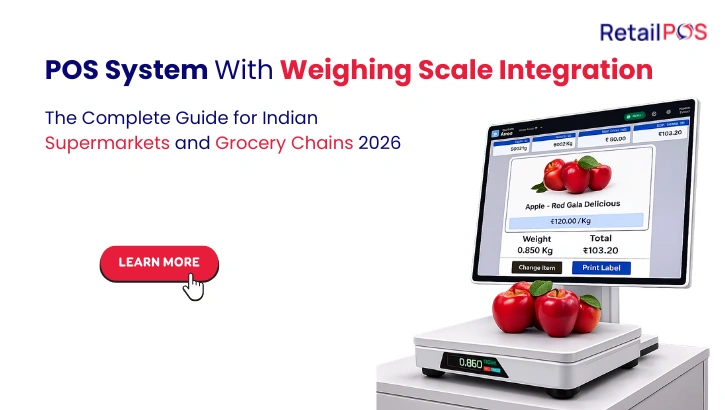
Section 1: Why Weighing Scale Integration Is the Most Important Feature Your Supermarket POS Must Have
Walk into any busy supermarket in India during peak hours and you will immediately identify the queue. Not the checkout queue, though that matters too, but the produce section queue. The line of customers waiting for a staff member to weigh their loose vegetables, tap in a PLU code that nobody can remember, print a label, stick it on the bag, and send the customer to the billing counter where the barcode is scanned and the transaction finally completes.
This process, which seems like a minor operational detail, is in practice one of the biggest throughput constraints and one of the most significant revenue leak sources in Indian supermarket and grocery retail. Every step in the traditional weighing workflow, the code lookup, the manual entry, the label printing, the counter scan, is a step where time is wasted and errors can enter. A wrong PLU code means a tomato billed as a more expensive variety. An illegible label means a billing counter rescan that holds up the queue. A staff member who is unavailable means a customer who leaves their vegetables in the produce section and walks out.
For a supermarket or grocery chain competing in India’s increasingly demanding retail market in 2026, the weighing counter is not a back-of-house detail. It is a direct customer experience touchpoint, a revenue accuracy point, and an inventory accuracy point simultaneously. The quality of your POS system’s integration with your weighing infrastructure determines how well you manage all three.
Section 2: What POS System Weighing Scale Integration Actually Means
POS system weighing scale integration is the connection between a weighing device and the billing software that allows the weight measured by the scale to flow directly into the billing transaction without any manual data entry step.
At its most basic level, this means a customer places a bag of rice on the scale, the scale measures 2.3 kg, and the POS billing screen shows 2.3 kg at the configured price per kg automatically, with the correct rupee total calculated without any operator input. The billing operator does not type a weight, does not look up a PLU code, and does not manually calculate the price. The integration does all of this instantly.
At a more sophisticated level, AI-powered weighing scale integration goes further. The system not only captures the weight automatically but identifies the product itself through computer vision, cross-references the measured weight against the expected weight range for the identified product to detect potential fraud or error, and sends both the product identification and the weight to the POS billing system simultaneously.
The workflow comparison:
Stage | Traditional Manual Process | Basic Scale-POS Integration | AI Weight Machine Integration |
Customer places item | Staff weighs item | Staff places item on integrated scale | Item placed on AI scale |
Product identification | Staff looks up PLU code | Staff selects product on POS screen | AI identifies product automatically |
Weight capture | Staff reads display and types weight | Weight flows to POS automatically | Weight flows to POS automatically |
Price calculation | Calculated from weight and code | Calculated automatically | Calculated automatically |
Fraud detection | None | None | Weight vs expected range checked automatically |
Time per item | 45 to 90 seconds | 20 to 40 seconds | 5 to 15 seconds |
Error probability | High, multiple manual steps | Lower, but product selection still manual | Near zero, AI handles identification |
Section 3: The Four Types of Weighing Scale POS Setup in Indian Retail
Indian supermarkets and grocery stores use four different weighing and billing configurations, each with different levels of automation, accuracy, and customer experience quality.
Type 1: Completely Manual Weighing with Separate Billing
The scale stands alone with no connection to the POS system. The staff member weighs the item, manually calculates or reads the price, writes or prints a label, and the customer takes it to the billing counter where the barcode is scanned. This configuration is still common in traditional Indian grocery stores and smaller supermarkets.
Limitations: Maximum error opportunity. Every step is manual. Price calculation errors, wrong PLU selection, illegible labels, and label detachment are all common. No inventory update from the weighing transaction.
Type 2: Scale with Label Printer but No POS Integration
The scale has its own product database (PLU memory) and a built-in or connected label printer. The staff member selects the product from the scale’s menu, the scale calculates the price and prints a barcode label. The customer takes the labelled item to the billing counter for scanning.
Limitations: PLU code memorisation remains a challenge with hundreds of produce items. Scale database must be manually updated when prices change. No real-time connection between the weighing transaction and the POS inventory system.
Type 3: Direct POS-Integrated Scale (Traditional)
The weighing scale connects directly to the POS billing software via cable or wireless interface. When an item is placed on the scale and a product is selected in the POS, the weight transfers automatically to the billing line item without manual entry. This is the most common form of what is marketed as POS scale integration or weighing scale POS in India.
Limitations: Product selection is still manual, requiring the billing operator to find the right item in the POS interface. The scale sends weight but the system does not verify whether the weight is consistent with the product selected. No fraud detection capability.
Type 4: AI Weight Machine with POS Integration
The most advanced configuration, using computer vision and artificial intelligence to identify the product placed on the scale automatically, capture the weight, verify both against expected parameters, and send the complete billing information, product, weight, and price, to the POS system simultaneously. This is what WeighSense AI delivers.
Advantage: Eliminates PLU code memorisation entirely. Eliminates manual product selection at billing. Adds real-time fraud detection. Reduces average transaction time at the weighing counter from 45 to 90 seconds to 5 to 15 seconds.
Section 4: How Traditional POS Scale Integration Works and Where It Falls Short
Traditional POS with scale integration, where a physical scale connects to the billing software and transmits weight data, is a significant improvement over completely manual weighing. But it has specific limitations that become operationally significant in busy Indian supermarkets.
The PLU code problem. A medium-sized Indian supermarket produces section carries 80 to 150 different loose items at any time. Seasonal variation adds and removes items constantly. Each item needs a PLU code in the scale’s memory and in the POS system. A billing operator who weighs 200 to 300 items per shift needs to correctly identify each item from this list every single time. Mistakes happen. Tomatoes are billed as more expensive cherry tomatoes. Standard bananas are entered as a premium variety. Economical rice is weighed against a premium price per kg.
The weight-product mismatch problem. Traditional scale-POS integration sends the weight to the billing system for whatever product the operator selected. If the operator selects the wrong product, the system has no mechanism to detect that the selected product and the actual measured weight are inconsistent with each other. A 1 kg item billed as a 200g item, or vice versa, generates no alert in a traditional integrated scale setup.
The queue problem. Even with a properly functioning scale-POS integration, the product selection step, whether on the scale’s touchscreen or in the POS interface, takes 10 to 30 seconds per item. In a busy produce section serving a continuous stream of customers, these seconds accumulate into the queues that define the customer experience at Indian supermarkets.
The price update problem. When produce prices change, which in Indian retail happens frequently due to seasonal availability and market fluctuations, every scale’s PLU database must be updated separately. In a supermarket with five weighing stations, five separate databases need updating. In a chain with ten outlets each having five weighing stations, 50 separate database entries need updating for every price change. Manual price update management across multiple scales at multiple locations is one of the most common sources of billing errors in Indian supermarket chains.
Section 5: What an AI Weight Machine Does That Traditional Scales Cannot
The term AI weight machine or AI weight scale refers to weighing systems that use artificial intelligence, specifically computer vision, to automatically identify the product on the scale rather than requiring manual PLU selection. This is the capability that fundamentally changes the economics and accuracy of loose item billing in Indian supermarkets.
Automatic product identification. The AI system has been trained to visually identify hundreds of different fresh produce items, dry goods in transparent packaging, and other loose retail items. When a customer places an item on the AI scale, the camera identifies what it is automatically and confirms the identification on a screen. No PLU code. No menu navigation. No staff training on code memorisation.
Weight verification against expected range. Because the AI system knows what product is on the scale, it also knows the expected weight range for typical customer quantities of that product. If the measured weight is significantly outside the expected range for the identified product, the system flags this automatically. This is the fraud detection capability: a billing item claimed to be loose grapes but measuring 4 kg when the average customer purchase is 500g generates an immediate alert before the transaction is completed.
Real-time synchronisation with POS pricing. Because the AI scale is connected to the central POS system rather than maintaining its own PLU database, price updates made centrally in the POS are immediately reflected at every AI scale in the store and across all stores in the chain. One price update in one place reaches every weighing point simultaneously.
The customer experience impact. A customer who walks up to a fresh produce counter, places their items on the AI scale, sees the product identified and the price calculated on the screen, and approves the transaction in 10 to 15 seconds is having a fundamentally different experience from a customer waiting for a staff member to look up a PLU code and manually enter a weight. In high-footfall Indian supermarkets, this speed difference translates directly into how many customers can be served per hour and how long queues form during peak periods.
Section 6: The Real Cost of Manual Weighing Errors in Indian Supermarkets
Manual weighing errors in Indian supermarkets generate costs in three distinct categories that most store owners are not measuring separately.
Revenue leakage from wrong product selection. When a billing operator selects a cheaper product than what is actually on the scale, the supermarket charges less than it should. When a more expensive product is selected by mistake, the customer is overcharged, creating both a customer complaint and a potential reputation risk. Both directions of error cost money.
Error Type | How It Happens | Financial Impact |
Under-billing from wrong PLU | Operator selects cheaper item in rush | Revenue loss on every affected transaction |
Over-billing from wrong PLU | Operator selects more expensive item | Customer complaint, refund, reputation damage |
Weight entry error | Operator misreads scale display | Either direction, accumulates across hundreds of daily transactions |
Label detachment or illegibility | Label printed but falls off or is unreadable | Billing counter delay, potential skip of item |
Produce price not updated on scale | Scale PLU database not updated when prices change | Systematic billing at wrong price for the entire period until discovered |
Queue-driven lost revenue. A produce section queue that extends past customer patience levels drives a specific and damaging behaviour: customers who intended to buy produce but did not want to queue leave without it. This loss never appears in any report because the item was never billed. It is invisible revenue that the store would have captured if the weighing process had been faster.
Staff training cost and ongoing PLU management. Training new staff on PLU codes for 80 to 150 produce items takes significant time. In Indian retail where staff turnover is high, this training cost recurs frequently. Beyond initial training, the ongoing management of PLU databases across multiple scales and multiple outlets represents a permanent operational overhead that a properly integrated AI weight machine eliminates.
Section 7: What to Look For in a POS System With Scale Integration
Integration depth, not just connectivity. Ask whether the scale sends weight to the POS or whether it also shares product identification with the POS. A scale that sends weight alone still requires manual product selection. A fully integrated system sends both product and weight, requiring no manual input from the billing operator.
Centralised price management. Confirm whether price updates made in the POS system are automatically reflected at the weighing scale without a separate update process. If scale prices must be updated separately, you have two systems to maintain rather than one.
Fraud detection capability. Ask whether the system can detect when the measured weight is inconsistent with the product identification. This is the specific capability that prevents the most common forms of weighing fraud and billing error in Indian supermarkets.
Offline capability. Confirm that the weighing integration continues to function when the store’s internet connection is interrupted. A scale that stops working when connectivity drops creates exactly the queue problem you are trying to solve.
Multi-outlet price synchronisation. For retail chains with multiple outlets, confirm that a price change in the central system updates weighing scale prices at all outlets simultaneously, not outlet by outlet.
Inventory integration. Confirm whether every weighed and billed item deducts the correct quantity from the live inventory count in the POS system. Without this, loose item sales create inventory discrepancies that compound over time.
Section 8: Weighing Scale POS Requirements by Store Type
Store Type | Primary Weighing Need | Key Integration Requirement |
Supermarket and hypermarket | High-volume fresh produce, dry bulk goods, loose grains | AI identification to eliminate PLU lookup queues, multi-scale synchronisation |
Grocery chain with multiple outlets | Consistent pricing across locations, price change management | Centralised price update reaching all scales at all outlets |
Bakery and sweet shop | Weighed confectionery, per-piece and per-gram pricing | Flexible pricing rules combining per-unit and per-weight billing |
Dry fruit and nut specialty store | High-value loose items, precise gram-level accuracy | Gram-level accuracy, AI identification for similar-looking items at different prices |
Meat and fish counter | Perishable item weighing, tare management for packaging | FEFO integration, tare function, hygienic scale design |
Organic and premium produce store | Premium item identification, price transparency | Customer-facing display showing product identification and price calculation |
Section 9: How WeighSense AI Delivers Next-Generation POS Scale Integration
WeighSense AI by RetailPOS is a next-generation retail weighing solution designed specifically for Indian supermarkets, hypermarkets, grocery chains, and specialty food stores. It addresses every limitation of traditional POS scale integration while adding the AI-powered capabilities that traditional weighing solutions do not offer.
Automatic AI Product Identification
WeighSense AI uses computer vision to automatically identify the product placed on the scale without any PLU code entry or manual product selection from the billing operator. The AI has been trained to distinguish between hundreds of similar-looking fresh produce items, dry goods, and loose retail products. Staff do not need to memorise codes. New staff are immediately operational on their first day. The identification happens in under a second.
Real-Time Fraud Detection
WeighSense AI automatically detects weighing fraud at billing counters in real time, monitoring weight mismatches, alerting staff instantly, and helping retailers prevent revenue loss without slowing down checkout operations. When the measured weight is inconsistent with the expected weight range for the identified product, the system flags the discrepancy before the transaction completes. This capability protects against both accidental billing errors and deliberate fraud at the weighing counter.
Seamless POS Integration
WeighSense AI integrates with RetailPOS and with existing traditional POS systems, making it suitable both for retailers already on the RetailPOS platform and for those using a different billing system who want to upgrade their weighing capability without changing their entire POS infrastructure.
- Weight and product identification sent to POS simultaneously, no manual data entry
- Pricing calculated automatically based on current prices from the central POS system
- Every weighed sale deducted from live inventory count in real time
- GST applied automatically to weighed items based on product HSN configuration
Two Deployment Models
WeighSense AI can be deployed in two configurations based on the store’s layout and operational model.
Standalone in the fresh produce section: The WeighSense AI unit is placed in the produce zone, away from the main billing counter. Customers or staff weigh items at the produce station, the AI identifies and prices them, and a label is printed for scanning at the main billing counter. This configuration reduces the dependency on main counter staff for weighing and creates a self-serve or staff-assisted weighing zone that handles produce traffic separately from the main checkout queue.
Integrated at the checkout counter: The WeighSense AI connects directly to the main billing counter POS system. The billing operator places loose items on the scale during checkout and the AI identification and weight transfer happen automatically within the billing workflow, eliminating the separate weighing station step entirely.
Centralised Price Management Across All Outlets
For retail chains with multiple outlets, all WeighSense AI units across all outlets connect to the same centralised RetailPOS price database. A price change for tomatoes made once at head office is instantly reflected at every WeighSense AI unit at every outlet, simultaneously, with no separate scale update process required.
What WeighSense AI Delivers vs Traditional POS Scale Integration:
Capability | Traditional Scale-POS Integration | WeighSense AI |
Product identification | Manual PLU code entry required | Automatic via AI computer vision |
Billing speed per item | 20 to 40 seconds with manual selection | 5 to 15 seconds fully automated |
PLU code training required | Yes, ongoing as products change | Not required |
Fraud detection | Not available | Real-time weight vs product mismatch alert |
Price update process | Manual per scale, per outlet | Centralised, all scales updated instantly |
Similar product discrimination | Dependent on operator knowledge | AI trained to distinguish similar-looking items |
Inventory integration | Varies by implementation | Automatic deduction from live inventory |
Multi-outlet synchronisation | Manual or complex network setup | Native centralised management |
Conclusion: The Weighing Counter Is Not a Detail. It Is Where Revenue Is Made or Lost.
Every loose item transaction in your supermarket is a moment where product identification, weight accuracy, price calculation, and billing integrity all happen simultaneously. In a traditional manual or basic scale-integrated setup, each of these four elements is handled by a staff member under time pressure, with the error probability that this implies.
In an AI-powered POS scale integration setup, three of these four elements are handled automatically by the system with near-zero error probability, leaving the staff member to focus on customer interaction rather than code memorisation and manual data entry.
The practical outcome is faster queues, fewer billing errors, no PLU code training overhead, real-time fraud detection that protects revenue, and centralised price management that keeps every weighing point across every outlet accurate the moment a price changes.
For Indian supermarkets and grocery chains competing in a market where customer experience and operational efficiency are increasingly the differentiating factors between growing businesses and struggling ones, the weighing counter is not a back-of-house technical detail. It is a direct revenue, accuracy, and experience touchpoint that deserves the best available technology.
Frequently Asked Questions
A basic POS system with scale integration connects a weighing scale to the billing software so that the weight measured by the scale flows automatically into the billing transaction. The billing operator still needs to manually select the product from the POS menu. An AI weight machine goes further by using computer vision to automatically identify the product on the scale, eliminating the manual product selection step entirely. WeighSense AI additionally detects when the measured weight is inconsistent with the expected range for the identified product, providing real-time fraud and error detection that basic scale integration does not offer.
WeighSense AI is designed to integrate both with RetailPOS and with existing traditional POS systems. Retailers who want to upgrade their weighing capability without replacing their entire POS infrastructure can deploy WeighSense AI as a standalone or integrated addition to their current setup. The specific integration compatibility for your existing POS system can be confirmed during a demonstration.
WeighSense AI has been trained to identify hundreds of fresh produce items, loose dry goods, and similar retail products. The AI model is designed to distinguish between visually similar items that would be easy for a human operator to confuse, such as different varieties of apple, different grain types, or similar-looking root vegetables at different price points. The specific product range and identification accuracy can be demonstrated with your store's actual product mix during an evaluation.
WeighSense AI monitors the relationship between the product identified by its computer vision system and the weight measured by the scale. When a customer or staff member places an item on the scale, the AI identifies what the item appears to be and checks whether the measured weight falls within the expected range for typical customer quantities of that product. Significant weight-to-product mismatches trigger an instant alert to the billing operator or supervisor before the transaction is completed. This capability addresses both accidental billing errors and deliberate fraud where a high-value item is substituted for a lower-value item on the scale.
When WeighSense AI is integrated with RetailPOS, all weighing units across all outlets connect to the same centralised price database. A price change for any product made once in the RetailPOS central system is immediately reflected at every WeighSense AI unit at every outlet in the chain, simultaneously, with no separate update process required for individual scales. This centralised price management eliminates the systematic billing errors that occur in supermarket chains where individual scale databases are not updated consistently when prices change.
About RetailPOS
RetailPOS is an enterprise retail POS and ERP solution by Unipro Tech Solutions Pvt Ltd, headquartered in Chennai, Tamil Nadu. With over 20 years of experience and 10,000 plus businesses served across India and globally, RetailPOS provides purpose-built retail technology for supermarket chains, grocery retailers, hypermarkets, apparel chains, electronics retailers, and multi-format retail groups. Products include RetailPOS Enterprise, WeighSense AI, Cockpit multi-outlet dashboard, TapZap mobile POS, Analytics, and consumer loyalty integration.

Book a free demo and see how RetailPOS gives you complete financial visibility across your operations..
Or WhatsApp our team directly – we respond within minutes.
Or call us at 95662 44611