
Powered by Unipro Tech
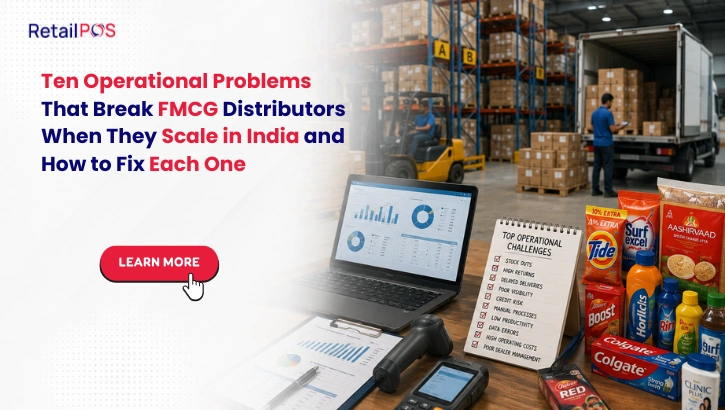
Ten Operational Problems That Break FMCG Distributors When They Scale in India and How to Fix Each One
A complete operational guide for FMCG distributors, pharma distributors, and consumer goods distribution businesses across India
Section 1: The Distribution Business That Grows Into Its Own Problems
Every successful FMCG distributor in India starts the same way. One principal company. One warehouse. One or two salespeople covering a manageable number of retailers. The owner knows every retailer personally. They can tell you on any given day what is in the warehouse, which salesperson is on which beat, and roughly what this month’s secondary sales are going to look like.
This model works perfectly at small scale. The owner’s personal presence and knowledge are the operating system of the business. Every operational function, from credit decisions to scheme application to stock management, runs through the owner’s judgement because the owner is close enough to the operation to exercise that judgement accurately.
Then the business grows.
A second principal company is added. Then a third. The retailer count doubles. A second salesperson is hired, then a third. A second vehicle is added. The warehouse expands. Secondary sales volume grows to a level where the monthly reporting cycle is no longer a half-day exercise but a three-day ordeal.
At this point, the operating system that served the business beautifully at small scale starts to fail. Not dramatically and all at once, but quietly and incrementally. Secondary sales data becomes unreliable. Schemes are applied inconsistently. Credit limits that the owner used to enforce personally are extended beyond safe levels because no system is tracking them automatically. Retailer accounts that should have been flagged for collection weeks ago slip past the monthly deadline.
These are the ten specific operational problems that break FMCG distributors when they scale in India. Each one is invisible when the business is small and devastating when the business is large. And each one has a specific, permanent fix.
Problem 1: Secondary Sales Data That Nobody Trusts
Secondary sales tracking is the foundation of every FMCG distributor’s relationship with their principal companies. The manufacturer depends on accurate secondary sales data to understand real sell-out velocity, plan production, adjust supply chain, and design scheme structures. The distributor depends on accurate secondary sales data to claim schemes, demonstrate performance, and justify territory expansion.
When secondary sales data is compiled manually, through end-of-day salesperson reports, handwritten beat registers, or exported billing data that is reformatted in Excel, the data degrades at every step. Orders recorded in the field are summarised at day end. Summaries are aggregated by the accounts team. Aggregated data is formatted for the principal company report. Each step introduces the possibility of error, omission, and delay.
What this costs:
- Scheme claims based on incorrect secondary sales data are either rejected or generate disputes that take months to resolve
- Principal companies that cannot trust their distributor’s secondary sales data give smaller allocations and fewer scheme benefits
- Territory expansion decisions made by the principal company on the basis of unreliable data may disadvantage the distributor even when actual performance is strong
The fix: A distribution management system that captures every retailer invoice as secondary sales data automatically at the point of billing. No manual compilation. No end-of-day summary. Every invoice is a secondary sales record the moment it is generated, available immediately in the format required for principal company reporting.
Problem 2: Scheme Management That Leaks Lakhs Every Quarter
FMCG scheme management is one of the most financially significant and most commonly mismanaged aspects of Indian distribution. Principal companies run dozens of simultaneous schemes across their brand portfolios at any given time — primary purchase schemes, secondary sales schemes, fast-forward incentive schemes, seasonal push schemes, and loyalty programs for specific retailer categories.
Each scheme has specific terms: applicable brands, applicable SKUs, minimum quantities, eligibility periods, and claim formats. Keeping track of which schemes are active, which invoices qualify under which scheme, and what the correct claim value is for each period is a genuinely complex task.
When scheme management is handled manually or through a basic billing system without scheme intelligence:
Scheme Management Failure | How It Happens | Financial Cost |
Scheme not applied at billing | Salesperson unaware or forgets | Retailer receives no scheme benefit, disputes arise |
Wrong scheme applied | Multiple active schemes, salesperson applies incorrect one | Over or under-claiming on the affected invoices |
Scheme claim filed too late | No system tracking claim deadlines | Claim rejected by principal company, money lost |
Free goods not accounted | Manual free goods recording missed | Inventory variance, scheme claim understated |
Scheme eligibility miscalculated | Manual calculation of cumulative purchase threshold | Under-claiming when threshold is actually met |
For a distributor handling three to five principal companies with multiple concurrent schemes each, the annual financial leakage from scheme management errors can run into significant lakhs. These are not unavoidable losses. They are the direct financial cost of managing scheme complexity manually.
The fix: A distribution management system that stores every active scheme from every principal company with all eligibility criteria. The system applies the correct scheme automatically at the point of invoice generation, generates free goods as separate line items, tracks cumulative purchase thresholds per retailer, and produces claim reports in the required format for each principal company at the click of a button.
Problem 3: Beat Planning Built on Habit, Not Data
Every FMCG distributor in India organises their sales force into beats – defined routes that each salesperson covers on a scheduled cycle. In a small distribution operation, beat planning is simple and the owner can oversee it personally. As the operation scales, beat planning becomes increasingly difficult to manage without data.
The most common beat planning failure in growing Indian distribution businesses is that beats are built on habit rather than on actual retailer productivity data. A salesperson covers the same 40 retailers on the same route every week because that is how the beat was structured when they joined. Nobody has analysed whether those 40 retailers represent the highest-value use of that salesperson’s time, whether some retailers should be covered more frequently, or whether the route sequence wastes significant travel time between visits.
What poor beat planning costs:
- High-value retailers not visited at the optimal frequency, losing sales to competing distributors
- Low-value retailers consuming salesperson time that would generate more revenue elsewhere
- Travel inefficiency adding hours to each beat day that could be used for additional calls
- No visibility into which retailers were actually visited versus planned visits on any given day
The fix: Beat planning module within a distribution management system that assigns every retailer to a beat and every beat to a salesperson, tracks actual visit compliance daily against planned beats, generates retailer-level productivity data showing which accounts generate the most secondary sales per visit, and enables data-driven beat restructuring when the evidence supports it.
Problem 4: Retailer Credit That Nobody Is Actually Controlling
Credit management is the single most dangerous scaling problem for FMCG distributors in India. When the business is small, the owner knows every retailer personally and makes credit decisions based on direct knowledge of each retailer’s payment behaviour. As the business scales, this personal knowledge cannot extend to every retailer in a growing network.
The result is that credit decisions are progressively delegated to salespeople who have different risk tolerances, different incentives, and different levels of collections discipline. A salesperson whose target is secondary sales volume has an incentive to extend credit generously because credit enables orders. The same salesperson has less personal incentive to collect aggressively because collection is uncomfortable and does not directly affect their sales target.
The receivables accumulation pattern in scaling distribution businesses:
Business Size | Typical Receivables as % of Monthly Revenue | Primary Control Mechanism |
Small, 100 to 200 retailers | 15 to 25% | Owner personally knows every account |
Medium, 200 to 500 retailers | 25 to 40% | Salesperson discretion, monthly review |
Large, 500 to 1,000 retailers | 35 to 60%+ | No effective control without a system |
When receivables as a percentage of monthly revenue exceed 40 to 50%, the working capital pressure on the distribution business becomes severe. The distributor is essentially financing their retailer network’s operations through their own capital, often while paying interest on the loans they have taken to fund their own primary purchases.
The fix: Hard credit limits configured per retailer in the distribution management system, enforced automatically at the point of invoice generation. When a retailer has reached their credit limit, the system prevents new invoices from being generated for that retailer until outstanding amounts are collected. Collection target reports generated daily per salesperson, per beat, and per ageing bucket. Overdue alerts that fire automatically rather than being discovered at month-end review.
Problem 5: Stock at the Warehouse That Does Not Match the System
Warehouse inventory accuracy is fundamental to distribution operations. A distributor whose warehouse stock records do not match actual physical stock is making purchase decisions, delivery commitments, and scheme claim calculations on data that is wrong.
Inventory discrepancies in distribution warehouses accumulate from four specific sources:
Goods receipt errors. When a primary purchase delivery from the principal company is received and counted manually, discrepancies between what was invoiced and what physically arrived are frequently missed, particularly in large deliveries with many SKUs. A short delivery of 10 cases on a 200-case order representing 5% variance may go undetected until a physical count reveals the gap weeks later.
Pick and pack errors. When orders are picked and packed without a formal verification step, the quantity dispatched to a retailer may differ from the quantity invoiced. A case picked as 24 units but actually containing 22 units creates a 2-unit discrepancy on that SKU that accumulates across hundreds of deliveries.
Van return discrepancies. When a van returns unsold stock at the end of a route, the returned quantity is often counted and added back to warehouse stock manually. Manual counting errors in this process create ongoing discrepancies between system stock and physical stock.
Unrecorded damage and shrinkage. Products that are damaged in the warehouse and written off informally, without a formal system entry, reduce actual stock below the system count without being recorded.
The fix: Goods receipt verification against purchase order with mandatory count confirmation before system update. Pick and pack verification using barcode scan before dispatch. Van return counting with system entry at the point of return rather than at the end of the day. Damage write-off module with reason codes that maintains an audit trail of all inventory adjustments.
Problem 6: Van Sales That Operate Completely Off the Grid
For FMCG distributors running van sales operations, the van salesperson is simultaneously the inventory manager, the order taker, the delivery driver, and the cashier for their route. In a manual van sales setup, all of this activity is recorded on paper throughout the day and entered into the main system either at the end of the day or the following morning.
This creates a 12 to 24 hour gap between when van sales activity happens and when it is visible to management. During this gap, the distributor has no way to know how much stock each van has sold, how much stock remains on each van, which retailers have been visited and which have not, how much cash has been collected and how much is still outstanding, and whether any scheme has been applied correctly.
Additional risks in a manual van sales operation:
- Cash collected from retailers may not match invoices for the same retailers
- Stock on the van may not match the difference between opening stock and invoiced quantities
- Salesperson visit records may not reflect actual versus planned beat coverage accurately
The fix: A mobile van sales application that operates fully offline, allowing the van salesperson to invoice, collect, and record every transaction in the field on a mobile device. All activity synchronises to the main distribution management system when connectivity is available. Management can see van-by-van stock positions, revenue, and collection status in real time throughout the day rather than the following morning.
Problem 7: Principal Company Reporting That Takes Five Days Every Month
Every principal company requires their distributor to submit secondary sales reports in a specific format on a specific schedule. A distributor handling five principal companies submits five different report formats, each requiring data extracted from the billing records for that specific brand, formatted according to each company’s template, and submitted within each company’s deadline.
When this process is manual, it consumes an extraordinary amount of administrative time every month. The sequence typically looks like this:
Step | Who Does It | Time Required |
Extract all invoices for the period from billing records | Accounts team | 4 to 8 hours |
Separate invoices by principal company brand | Accounts team | 2 to 4 hours per company |
Format data to match principal company template | Accounts team | 2 to 4 hours per company |
Verify totals against billing summary | Owner or senior account manager | 2 to 3 hours |
Submit reports and handle principal company queries | Owner or account manager | Ongoing |
Total for 5 principal companies | 2 to 3 staff members | 3 to 5 working days per month |
Three to five working days of senior staff time every single month, recurring without exception, dedicated entirely to a reporting task that a properly configured distribution management system completes automatically in under an hour.
The fix: A distribution management system that captures every invoice as secondary sales data by brand, SKU, beat, and retailer at the point of billing. Report generation for any principal company in any required format is a matter of selecting the parameters and clicking generate. Monthly secondary sales reporting goes from a three-day manual exercise to a 30-minute review and submission.
Problem 8: Salesperson Productivity That Nobody Can Actually Measure
A distribution business with 8 salespeople covering different beats faces a specific management challenge: how do you know which salespeople are performing well, which are underperforming, and what specifically is causing the difference?
In a manual operation, the primary measure of salesperson performance is secondary sales volume. Whoever invoiced the most secondary sales this month is the top performer. But secondary sales volume alone is a deeply incomplete measure of salesperson performance:
- A salesperson covering a high-volume urban beat will naturally generate more secondary sales than one covering a rural beat, regardless of effort or skill
- A salesperson who extends credit generously to drive volume is generating future collection problems that will not show up in their current secondary sales number
- A salesperson who is not visiting all the retailers on their beat, concentrating only on the easy accounts, may show acceptable volume while leaving significant potential untapped
Without beat-level coverage data, retailer-level secondary sales data, and collection performance data alongside volume, the distributor cannot make genuinely informed decisions about salesperson management, training, territory restructuring, or incentive design.
The fix: A distribution management system that generates salesperson performance dashboards showing secondary sales per beat, retailer coverage rate per planned beat, average order value per retailer visit, collection performance as a percentage of outstanding, and new retailer acquisition per period. These metrics together give a multi-dimensional view of performance that secondary sales volume alone cannot provide.
Problem 9: FEFO Failures That Create Expiry Write-Offs Nobody Forecasted
For FMCG distributors handling packaged food, beverages, personal care products, or pharmaceuticals, batch tracking and FEFO enforcement are not optional extras. They are fundamental requirements of compliant, efficient distribution operations.
First Expiry First Out means the oldest batch of any product should always be the first to be invoiced to retailers. In a warehouse managed manually, FEFO compliance depends entirely on warehouse staff correctly identifying and pulling the oldest batch for every pick. Under time pressure, in a warehouse with limited clear labelling and mixed batch storage, FEFO is inconsistently applied.
The financial consequences of FEFO failure accumulate slowly and invisibly:
- Newer batches dispatched before older batches means older batches sit in the warehouse approaching their expiry date
- Products that reach their expiry date in the warehouse cannot be sold and must be written off
- Products dispatched to retailers near expiry generate returns from retailers who discover the short date after delivery
- Regulatory exposure for distributors found to have dispatched products past their expiry date
For a FMCG distributor with Rs 50 lakh in monthly primary purchases across multiple brands, an expiry write-off rate of even 1 to 2% represents Rs 50,000 to Rs 1 lakh in monthly inventory destruction that better FEFO management would have prevented.
The fix: Batch and expiry tracking built into the distribution management system, with FEFO automatically enforced at the point of invoice generation. When an order is created for a specific product, the system selects the oldest available batch automatically. Near-expiry alerts fire with enough lead time to enable proactive retailer placement or principal company return before the expiry date is reached.
Problem 10: No Visibility Into the Business While It Is Happening
This is the meta-problem that underlies every other problem in this guide. A distribution business owner who only discovers what has happened in their operation at the end of the day, the end of the week, or the end of the month is always responding to situations rather than managing them.
By the time the end-of-month review reveals that a specific retailer has outstanding receivables of Rs 2.5 lakh, the distributor has already extended six more weeks of credit to that retailer. By the time the quarter-end scheme claim reveals a miscalculation, the claim deadline may have already passed. By the time the year-end stocktake reveals an inventory discrepancy of Rs 8 lakh, the accumulated loss cannot be recovered.
Real-time visibility is not a luxury feature for a growing distribution business. It is the operational foundation that makes proactive management possible rather than perpetual firefighting.
Section 12: The Problem vs Solution Breakdown
Problem | Root Cause | Technology Solution | Monthly Value |
Unreliable secondary sales data | Manual compilation at day end | Auto-capture of every invoice as secondary sales record | Accurate claims, better principal relationships |
Scheme leakage | No automated scheme application | Scheme engine applying correct scheme at billing automatically | Rs 50,000 to Rs 5 lakh recovered per quarter |
Habit-based beat planning | No visit data to inform restructuring | Beat compliance tracking and retailer productivity reports | 15 to 25% improvement in call productivity |
Uncontrolled retailer credit | Salesperson discretion, manual tracking | Hard credit limits enforced automatically at billing | Receivables reduction of 20 to 35% |
Warehouse stock discrepancies | Manual receipt and pick processes | Barcode-verified GRN and pick confirmation | Inventory accuracy improvement to 97%+ |
Van sales off the grid | Paper-based field recording | Offline mobile van sales app with real-time sync | Same-day visibility into all van activity |
5-day principal reporting | Manual data extraction and formatting | One-click secondary sales report generation per brand | 3 to 5 days saved monthly per 5 principal companies |
Unmeasured salesperson performance | Volume as the only metric | Multi-dimensional performance dashboard per salesperson | Identifies underperformers, improves team productivity |
FEFO failures and expiry write-offs | Manual batch selection in warehouse | FEFO-enforced automatic batch selection at invoicing | 1 to 2% inventory value saved monthly |
No real-time business visibility | End-of-day manual compilation | Live dashboard showing all key metrics in real time | Proactive management instead of reactive firefighting |
Section 13: How RetailPOS Solves All Ten Distribution Problems
RetailPOS by Unipro Tech Solutions provides a purpose-built distribution management system designed specifically for Indian FMCG, pharma, and consumer goods distributors. Unlike generic ERP systems adapted for distribution, the RetailPOS distribution module was built from its foundation for the specific operational workflows of Indian distribution businesses.
Secondary sales tracking. Every retailer invoice is automatically captured as secondary sales data by brand, SKU, beat, and retailer at the point of billing. Reports in principal company formats are generated in minutes, not days.
Multi-brand scheme management. All active schemes from all principal companies are configured in the system with their full eligibility criteria. The system applies the correct scheme at billing automatically, generates free goods as separate invoice line items, tracks cumulative thresholds, and produces claim reports by brand and by period.
Beat planning and field force management. Every retailer is assigned to a beat, every beat to a salesperson. Daily beat compliance reports show which retailers were visited and which were skipped. Salesperson performance dashboards show multi-dimensional productivity metrics across the entire field force.
Retailer credit control. Hard credit limits enforced automatically at invoice generation. New invoices blocked for retailers above their limit until outstanding amounts are collected. Daily collection targets per salesperson with overdue alerts and aging reports.
Warehouse management with FEFO. Batch and expiry tracking from goods receipt through storage to invoice. FEFO enforced automatically at invoice generation. Near-expiry alerts with configurable warning windows per product category.
Mobile van sales with offline capability. Full invoicing, collection recording, and returns management on the van salesperson’s mobile device, operating completely offline in areas without connectivity. All activity syncs to the central system when connectivity is available. Management visibility into all van activity in real time.
Live management dashboard. Real-time visibility into secondary sales, collection status, warehouse inventory, beat coverage, salesperson performance, and scheme utilisation from one screen on any device.
Conclusion: The Distribution Business That Scales Successfully Is the One That Builds Systems Before It Needs Them
Every distribution problem described in this guide gets worse as the business grows. Secondary sales data that is slightly unreliable at 200 retailers becomes completely untrustworthy at 600. Credit that the owner personally controlled with 150 retailer relationships becomes unmanageable at 400 without a hard system control. Scheme leakage that cost Rs 30,000 per quarter at one principal company costs Rs 3 lakh at five principal companies.
The distributors who scale successfully in India are not the ones who hire more staff to manage complexity manually. They are the ones who implement the right distribution management system while the business is still small enough to do it smoothly, so that every additional retailer, every additional principal company, and every additional salesperson is managed by the system rather than adding proportionally to the management overhead
Frequently Asked Questions
The right time is before the problems in this guide become painful, not after they have already cost significant money. A distributor with more than 150 active retailer accounts, more than two salespeople, or more than two principal companies is already at the scale where manual management of secondary sales, schemes, and credit is creating the problems described above. Implementing a distribution management system at this stage is faster, cheaper, and less disruptive than implementing after the problems have compounded.
RetailPOS captures all secondary sales data in a standardised internal format at the point of invoicing. Report generation is then configured per principal company, mapping the standardised internal data to each company's specific template, column structure, and naming conventions. Once the mapping is configured, generating any principal company's secondary sales report is a one-click operation that can be completed in minutes rather than days.
Yes. The RetailPOS van sales mobile application is designed for full offline operation. Salespeople in the field can generate invoices, record collections, process returns, and check retailer outstanding balances entirely offline. All data synchronises automatically to the central distribution management system whenever internet connectivity is available, whether at the end of each beat visit, on return to the warehouse, or at any point during the day when connectivity is established.
When a salesperson or warehouse picker creates an invoice for a specific product, the distribution management system automatically identifies all available batches of that product in the warehouse and selects the oldest batch, based on expiry date, for the invoice line item. The picker is directed to the location of that specific batch. If the oldest batch is insufficient to fulfil the full order quantity, the system allocates the remaining quantity from the next oldest batch and records both batch numbers on the invoice. The picker never has to manually determine which batch to pick.
When a retailer has reached their configured credit limit, the distribution management system prevents new invoices from being generated for that retailer until sufficient outstanding amount is collected to bring their balance below the credit limit. The salesperson is informed at the time of order attempt, with the retailer's current outstanding balance and credit limit displayed. To release the credit block, a collection must be recorded in the system, which immediately updates the retailer's available credit and allows new orders to proceed.
About RetailPOS
RetailPOS is an enterprise retail, restaurant, and distribution POS and ERP solution by Unipro Tech Solutions Pvt Ltd, headquartered in Chennai, Tamil Nadu. With over 20 years of experience and 10,000 plus businesses served across India and globally, RetailPOS provides purpose-built distribution management systems for FMCG distributors, pharma distributors, and consumer goods distribution businesses across India. Distribution products include the Distribution Management System, Van Sales Mobile Application, Vendor Portal, and secondary sales tracking and scheme management modules.

Book a free demo and see how RetailPOS gives you complete financial visibility across your operations..
Or WhatsApp our team directly – we respond within minutes.
Or call us at 95662 44611