
Powered by Unipro Tech
How Multi-Chain Supermarkets Keep Pricing and Promotions Consistent Across Every Outlet
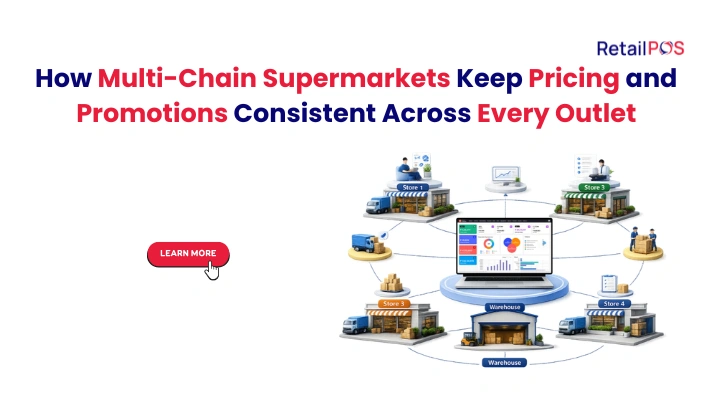
A customer buys a kilogram of rice at your Anna Nagar branch for one price, then notices it’s ten rupees cheaper at your Velachery branch the following week. It’s a small discrepancy in absolute terms, but it’s the kind of thing customers remember and mention to each other, and it quietly signals that the chain isn’t as tightly run as it should be. Multiply that across hundreds of SKUs, seasonal promotions, and festival discounts running simultaneously at every outlet, and pricing inconsistency stops being a minor annoyance and starts being a genuine trust problem.
This is one of the most common, least discussed operational gaps in growing supermarket chains. It rarely shows up as a dramatic failure, it shows up as a slow accumulation of small inconsistencies that add up to real damage: lost margin from outdated pricing, customer confusion, and staff who can’t confidently answer a simple question about why two branches charge differently for the same item. This guide covers why pricing drift happens as chains grow, and what centralized pricing and promotion management actually needs to look like to prevent it.
Why Pricing Drifts Apart as a Chain Grows
A single supermarket rarely has a pricing consistency problem, there’s only one price list, updated by one team, applied at one counter. The moment a second outlet opens, that single source of truth needs to somehow reach a second location, and the moment a third or fourth outlet opens, manual coordination (a phone call, a WhatsApp message, an emailed spreadsheet) becomes the weak link. A price change intended for the whole chain reaches some outlets faster than others. A local manager makes a well-intentioned adjustment at their branch that never gets communicated back to head office. A supplier price change gets updated at one location and forgotten at the rest.
None of this happens because staff are careless. It happens because pricing coordination across multiple physical locations is a genuinely hard manual problem, one that gets harder, not easier, as a chain adds outlets, precisely the growth that owners are usually most excited about.
What Centralized Pricing Actually Needs to Do
Centralized pricing means a price set once at head office applies automatically and immediately across every outlet in the chain, or across a specific subset of outlets if that’s the intent, without requiring manual replication at each individual counter. This needs to work at the SKU level, not just broad category adjustments, since supermarket pricing decisions frequently happen item by item based on supplier cost changes, competitive positioning, or inventory clearance needs.
It also needs to handle exceptions cleanly. Not every price should necessarily be identical across every outlet, a branch in a higher-rent commercial area might reasonably carry a slightly different price structure than one in a residential neighborhood. Good centralized pricing systems support this kind of intentional variation while still preventing the accidental drift that happens when pricing isn’t coordinated at all.
Managing Promotions Across Multiple Outlets Without Chaos
Promotions add a layer of complexity beyond base pricing. A “buy one get one” offer, a festival discount, or a clearance promotion on slow-moving stock all need to launch and end at the same time across every participating outlet, and need clear rules about which outlets, which customer groups, and which time windows they apply to. Run this manually across multiple locations and you get exactly the failure mode most chains experience at some point: a promotion that’s still active at one branch after it’s supposed to have ended at the others, creating both a pricing inconsistency and, often, a real financial loss from discounts applied longer than intended.
The fix is promotions configured and launched centrally, with outlet-specific, customer-specific, and time-bound controls built into the system itself, not enforced through staff remembering to manually start and stop a promotion at the right moment at every single counter.
Category and Customer-Group Pricing Complexity
Supermarket pricing rarely stops at a flat per-item price. Many chains run different pricing for different customer segments, wholesale or bulk-buyer pricing, loyalty member pricing, or staff discounts, layered on top of standard retail pricing. Managing this complexity manually across multiple outlets multiplies the coordination problem significantly: instead of one price list to keep consistent, you effectively have several overlapping price lists that all need to stay synchronized simultaneously.
Flexible, centrally managed pricing formulas that apply consistently by category and customer group, updated once and reflected everywhere, are what keep this complexity manageable as a chain scales, rather than becoming an increasingly fragile manual process that’s one missed update away from a customer-facing pricing error.
Loyalty and Redemption Consistency
Pricing consistency and loyalty consistency are closely related problems. If loyalty point accumulation or redemption rules differ, even accidentally, between outlets, customers notice quickly, particularly loyal, frequent shoppers who visit multiple branches and compare their experience directly. Centralized loyalty management, with consistent point accumulation, consistent redemption rules, and OTP-secured redemption to prevent misuse, needs to work identically no matter which outlet a customer visits, reinforcing rather than undermining the trust that a well-run pricing system builds.
The Cost of Getting This Wrong
Pricing inconsistency has both a direct financial cost and a slower, harder-to-measure reputational cost. Directly, outdated pricing at even one outlet means either lost margin (selling below intended price) or lost sales (pricing higher than intended and losing price-sensitive customers to a competitor or even to your own other branch). A promotion that runs longer than intended at one location is a direct, quantifiable loss.
The reputational cost is subtler but arguably more damaging over time. Customers who notice pricing inconsistency don’t necessarily complain, they simply trust the chain a little less, and that erosion compounds across every visit and every branch comparison, particularly in an era where customers can and do compare prices across locations easily, sometimes within the same shopping trip if they visit more than one branch.
How RetailPOS Centralizes Pricing for Supermarket Chains
RetailPOS lets you set and control item prices centrally and apply them across selected outlets or the entire chain, with flexible pricing formulas that support category-level and customer-group-level complexity without requiring manual replication at each location. Promotions, discounts, gift vouchers, and coupons are designed and managed from one system, with outlet, customer, and time-based controls that launch and end automatically rather than depending on staff remembering to act at the right moment across every branch.
Loyalty programs run centrally too, with consistent point accumulation and OTP-secured redemption across every outlet, so a customer’s experience is identical no matter which branch they shop at. For chains managing this alongside inventory and purchasing, supermarket chain ERP brings pricing, promotions, purchasing, and stock control into one connected system rather than a set of disconnected tools each managed separately.
Frequently Asked Questions
Pricing drift happens because manual coordination, phone calls, messages, spreadsheets, becomes unreliable as a chain adds locations. A price change intended for the whole chain reaches outlets at different times, or gets missed entirely at some locations, without a centralized system to apply it everywhere automatically.
Yes, and this is different from accidental pricing drift. A well-designed centralized pricing system supports deliberate variation, for example different pricing by location type, while still preventing the unintentional inconsistency that happens when pricing isn't coordinated at all.
By configuring and launching promotions centrally, with built-in outlet, customer, and time-based controls that start and end automatically, rather than relying on staff at each individual location to manually activate and deactivate offers at the right time.
It shows up in two ways: direct losses from outdated pricing or promotions that run longer than intended, and a slower, harder-to-measure erosion of customer trust as shoppers notice inconsistency between branches, particularly loyal customers who visit multiple locations.
It should. Supermarket chains that offer loyalty member pricing, bulk or wholesale pricing, or staff discounts alongside standard retail pricing need centralized formulas that apply these variations consistently across every outlet, not a separate manual price list to maintain per customer segment per location.
Both depend on the same underlying need: rules set once at head office, applied identically everywhere. If point accumulation or redemption rules differ between outlets, even accidentally, customers experience it as the same kind of trust erosion that inconsistent pricing causes.
Running a multi-chain supermarket and dealing with pricing inconsistency across outlets? Book your free RetailPOS demo today →
Or WhatsApp our team directly, we respond within minutes: 95662 44611

Book a free demo and see how RetailPOS gives you complete financial visibility across your operations..
Or WhatsApp our team directly – we respond within minutes.
Or call us at 95662 44611