
Powered by Unipro Tech
Self Ordering Kiosk for Restaurants in India: Complete 2026 Guide for QSR, Cafes and Food Courts
A complete guide for QSR operators, cafe owners, food court managers, and multi-outlet restaurant chains evaluating self ordering kiosk systems in India
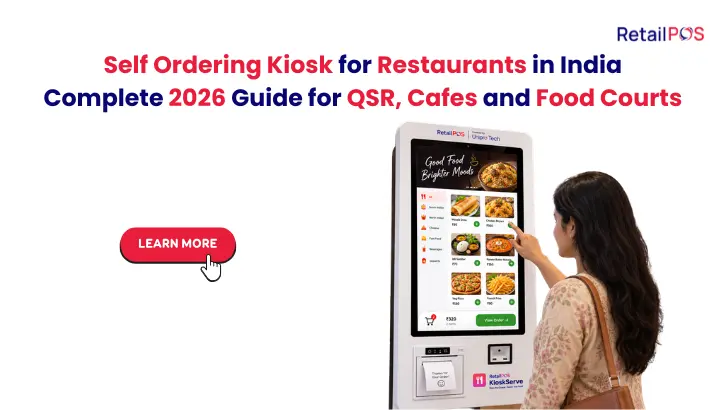
Quick Answer: What a Self Ordering Kiosk Does for Your Restaurant
A self ordering kiosk is a touchscreen terminal that lets customers browse your menu, customise their order, and pay without any staff involvement at the counter. Every order goes directly to your kitchen display system. Your staff focuses on food preparation and delivery instead of managing queues and taking orders.
The three things Indian restaurants gain immediately:
Benefit | What It Means in Practice | Typical Impact |
Faster throughput | Multiple customers order simultaneously instead of queuing one at a time | Wait time cut by up to 40% |
Higher average order value | Smart upselling suggests combos and add-ons automatically at point of order | Average ticket increase of 15 to 30% |
Fewer order errors | Customer customises their own order directly, no mishearing or miscommunication | Near zero order error rate on kiosk orders |
Section 1: Why Indian Restaurants Are Installing Self Ordering Kiosks in 2026
India’s restaurant industry is experiencing a convergence of three forces that make 2026 the most important year for self ordering kiosk adoption.
Force 1: Labour costs and availability.
Finding, training, and retaining counter staff for Indian QSRs and cafes has become consistently harder and more expensive. Staff turnover in Indian food service is among the highest of any industry. Every time a counter staff member leaves, the restaurant absorbs a training cost and a productivity gap that takes weeks to recover. A self ordering kiosk handles the order-taking function without turnover risk, training cost, or the variable performance that comes with depending on human counter staff for every customer interaction.
Force 2: Customer behaviour shift.
India’s UPI revolution has made Indian consumers among the most digitally comfortable payment users in the world. A customer base that processes billions of digital transactions monthly is entirely comfortable browsing a touchscreen menu, customising an order, and paying via UPI at a kiosk without any hesitation. The friction that slowed kiosk adoption in earlier years has largely disappeared as digital interaction has become the default for Indian urban consumers.
Force 3: Revenue pressure from delivery commissions.
Delivery platform commissions of 25 to 35% are compressing restaurant margins on delivery orders. Dine-in and takeaway orders processed through a self ordering kiosk carry no platform commission, support a better in-restaurant customer experience, and generate the kind of upselling that delivery platform orders rarely achieve. Restaurants that are building profitable in-restaurant channels to offset delivery margin pressure are finding that self ordering kiosks are among the most effective tools available.
India’s self-service kiosk market is growing at over 11% CAGR through 2030 with QSRs as the fastest-adopting segment. In 2026 self-service kiosks are no longer a competitive advantage. They are a baseline requirement for QSRs that want to thrive in an increasingly digital, efficiency-driven marketplace.
Section 2: How a Self Ordering Kiosk Works: The Complete Customer Flow
Understanding the complete customer flow through a self ordering kiosk reveals why the experience generates higher order values and better customer satisfaction than traditional counter ordering.
Step | What the Customer Does | What the System Does |
Approach the kiosk | Touches screen to begin | Menu loads instantly with visual images and categories |
Browse the menu | Scrolls through categories and items | High quality food images displayed with prices and descriptions |
Select items | Taps desired items | Item added to order and customisation options appear automatically |
Customise | Selects size, spice level, add-ons, removals | Every customisation recorded precisely with no staff interpretation |
Smart upsell | System suggests relevant combos and add-ons | Automated upsell prompt based on current order composition |
Review order | Sees complete order on screen before paying | Total calculated with any applicable promotions |
Pay | Selects UPI, card, or wallet | Payment processed at kiosk and receipt printed or sent digitally |
Order confirmed | Order confirmation displayed | Order sent simultaneously to kitchen display system |
Wait for food | Customer moves to collection point | Kitchen prepares against KDS display and Q-Display shows order status |
The critical difference from QR ordering:
In QR ordering, the customer uses their own phone. In kiosk ordering, the restaurant controls the entire interface, the upsell logic, the promotion display, and the payment flow. This control is what enables the 15 to 30% average order value increase. The kiosk is configured by the restaurant to suggest the right add-ons at the right moment, consistently, for every customer, without depending on a staff member remembering to make the suggestion.
Section 3: The Business Case: Real Numbers From Restaurant Kiosk Implementations
The business case for self ordering kiosks in Indian restaurants is built on four measurable financial improvements.
3.1 Average Order Value Increase
Restaurants implementing self-service kiosks are seeing average ticket sizes increase by 15 to 30%.
For an Indian QSR with a current average order value of Rs 280:
Scenario | Average Order Value | Daily Revenue (200 orders) | Annual Revenue (300 days) |
Before kiosk | Rs 280 | Rs 56,000 | Rs 1.68 crore |
After kiosk at 15% increase | Rs 322 | Rs 64,400 | Rs 1.93 crore |
Additional annual revenue | Rs 42 more per order | Rs 8,400 more per day | Rs 25.2 lakh more per year |
The mechanism is specific and consistent. When a customer orders a burger, the kiosk automatically suggests the fries and beverage that most frequently accompany that burger. When a customer’s order total is Rs 240, the kiosk highlights that adding one more item brings them to Rs 300 and qualifies for a promotional discount. None of these suggestions require a staff member to make them. The kiosk makes them every time, for every customer, with the same consistency whether it is the first order of the day or the three hundredth.
3.2 Wait Time Reduction
A traditional counter order in a busy Indian QSR takes 2 to 4 minutes per customer from the moment they reach the front of the queue to the moment their order is placed. In a restaurant with three counters and a 40-customer lunch rush, that creates a queue that stretches for 10 to 13 customers even at maximum counter speed.
A self ordering kiosk allows multiple customers to order simultaneously. Four kiosk units in the same space as three counters can process four concurrent orders, each taking 60 to 90 seconds for the customer to complete. KioskServe cuts order wait time by up to 40% with an efficient self-service ordering flow that removes the counter as a bottleneck.
3.3 Order Accuracy Improvement
Order errors in Indian restaurants occur primarily at two points: when the customer communicates their order to counter staff and when counter staff communicates the order to the kitchen. Both of these human communication steps are eliminated by a self ordering kiosk.
The customer specifies every customisation directly on the touchscreen. The order goes directly to the kitchen display system in the exact form the customer specified. No mishearing. No ambiguous note on a ticket. No interpretation at any stage. The accuracy rate on kiosk orders approaches 100% for every specification the customer made on the kiosk interface.
The financial impact of order accuracy improvement comes from two directions: reduced food waste from remake orders and improved customer satisfaction leading to higher return visit rates and better review scores.
3.4 Staff Reallocation Value
The value of a self ordering kiosk is not primarily in reducing headcount. It is in redeploying the staff who were managing the counter to functions that directly improve customer experience and food quality.
A counter staff member who is freed from order-taking can instead assist customers at the kiosk who need help, focus on food preparation quality and speed, manage the collection point where customers pick up their orders, and maintain the restaurant environment during peak service. The result is a better in-restaurant experience that generates better reviews and higher return visit rates, funded entirely by the efficiency gain of moving order-taking to the kiosk.
Section 4: Which Indian Restaurant Formats Benefit Most From Self Ordering Kiosks
Self ordering kiosks deliver different levels of benefit depending on the restaurant format. Understanding which formats benefit most helps operators make investment decisions based on their specific operation.
4.1 Quick Service Restaurants — Highest Benefit
QSRs are the fastest-adopting segment for self ordering kiosk technology in India. The QSR format is where self ordering kiosks deliver the most immediate and most measurable return. High transaction volume, standardised menu with known customisation patterns, price-sensitive customers who respond to combo upselling, and peak hour queue management pressure all align perfectly with what a self ordering kiosk does best.
A QSR in a busy commercial area in Bangalore, Chennai, or Hyderabad handling 300 to 500 orders per day during a 10-hour operating window is the ideal environment for kiosk deployment. The order-per-hour processing rate improves dramatically, the upselling consistency generates meaningful daily revenue additions, and the reduced peak-hour queue improves the street-level visibility of the restaurant for passing customers.
4.2 Food Courts — High Benefit
Food courts in Indian malls and commercial complexes create a specific ordering challenge. Customers approach multiple counters, compare menus, and make purchase decisions while competing operators are visible around them. A self ordering kiosk handles the moment when a customer has chosen your stall but needs to navigate the ordering process quickly.
A food court counter that processes 80 orders in the 12 to 2 PM window with three staff members can process 120 to 140 orders with the same three staff members redirected to preparation and service with two kiosks handling order intake.
4.3 Cafes and Bakeries — Good Benefit
Morning rush hours in Indian cafes and bakeries create the specific queue problem that kiosks solve most visibly. A customer who wants a coffee and a croissant at 8:30 AM will wait 4 minutes in a queue or walk to the competitor next door. A kiosk that completes that transaction in 60 seconds eliminates the walkaway.
The customisation capability is particularly valuable in cafe environments where every beverage order involves multiple specifications including coffee type, milk type, size, temperature, and sweetener. A kiosk handles this complexity flawlessly while a counter staff member under morning rush pressure makes errors.
4.4 Multi-Outlet QSR Chains and Franchises — High Benefit for Consistency
For a QSR chain or franchise with multiple outlets, the self ordering kiosk standardises the customer experience across every location. When menu updates, price changes, and promotional offers are managed centrally and pushed to every kiosk simultaneously, every customer at every outlet receives the same menu, the same prices, and the same promotional suggestions. This is operationally impossible with staffed counters where individual outlet staff interpret and apply menu changes at different speeds and with different accuracy.
Section 5: Self Ordering Kiosk vs QR Ordering: Choosing the Right Channel
Both self ordering kiosks and QR ordering are direct ordering channels that reduce staff involvement in order-taking. Understanding the specific advantages of each helps restaurant operators choose the right technology for their format and customer base.
Factor | Self Ordering Kiosk | QR Ordering |
Hardware requirement | Kiosk unit at Rs 50,000 to Rs 1.5 lakh per unit | QR codes printed on table or counter at minimal cost |
Customer device | Restaurant’s kiosk touchscreen | Customer’s own smartphone |
Suitable format | QSR, food courts, high-footfall counters | Dine-in restaurants, cafes with seated service |
Order placement | At entrance or counter before seating | At the table after seating |
Upselling control | Restaurant controls full interface and upsell logic | Limited by customer’s phone browser interface |
Average order value impact | Higher due to restaurant-controlled upsell interface | Moderate |
Queue management | Handles multiple simultaneous counter orders | Does not address counter queue |
Best for | High-volume quick service environments | Table service restaurants reducing order-taking labour |
The combined approach:
The most effective multi-channel restaurant operations in India in 2026 deploy both technologies for different parts of the customer journey. Kiosks handle the walk-in quick service ordering flow. QR handles table ordering for dine-in customers. Together they eliminate counter order-taking entirely while serving different parts of the customer base appropriately.
RetailPOS supports both KioskServe for kiosk ordering and QR+ for table QR ordering, both integrated into the same Dineazy kitchen management system so all orders from all channels enter one unified kitchen queue.
Section 6: What to Look For in Self Ordering Kiosk Software for Indian Restaurants
The hardware of a self ordering kiosk is relatively standard across providers. The software running on that hardware determines whether the kiosk generates meaningful revenue improvement or becomes an expensive piece of equipment that customers avoid.
Requirement 1: Full UPI and digital payment integration.
India’s payment landscape is dominated by UPI with 16.6 billion monthly transactions by March 2026. Any self ordering kiosk that does not accept UPI seamlessly is creating friction for the majority of Indian restaurant customers. The kiosk must support all major UPI apps, QR payment, cards, and digital wallets with immediate confirmation and automatic receipt generation.
Requirement 2: Smart upselling configured for your menu.
Generic upselling that suggests random add-ons does not generate meaningful average order value improvement. Effective kiosk upselling is menu-specific. When a customer orders a specific biriyani, the kiosk suggests the raita and beverage that most frequently accompany it. When a customer’s order total approaches a combo threshold, the kiosk highlights the saving from adding one more item. This intelligence must be configurable for your specific menu and your specific customer behaviour patterns.
Requirement 3: Direct integration with your POS and kitchen display system.
A kiosk that generates orders that must be manually entered into the main POS or called out to the kitchen is not a self ordering system. Genuine integration means every kiosk order enters the kitchen display queue automatically, deducts from the same ingredient inventory as counter orders, and appears in the same daily sales report as all other channels.
Requirement 4: Centralised menu management for multi-outlet operations.
For any restaurant group with more than one location, menu updates, price changes, and promotional offers must be configurable centrally and deployable to all kiosks across all outlets simultaneously. A self ordering kiosk that requires individual in-outlet menu updates creates exactly the consistency problem it is supposed to solve.
Requirement 5: Customer-friendly interface that works for all age groups.
A kiosk interface that is intuitive for a 25-year-old tech professional must also be navigable by a 55-year-old family member who has never used a touchscreen ordering system. The interface must be visual-first with high-quality food images that communicate what each item is without requiring the customer to read detailed descriptions.
Section 7: How KioskServe Delivers Self Ordering for Indian Restaurants
KioskServe is RetailPOS’s self ordering kiosk software built specifically for Indian restaurants, cafes, QSRs, food courts, and multi-outlet F&B chains.
Touch-friendly ordering interface.
KioskServe’s interface is designed for all age groups with no training or instructions needed. High-quality food imagery drives item selection. Category navigation is visual and immediate. Item customisation is handled through clear option screens that present every available modification in a single view. The complete order flow from first touch to payment confirmation takes under 90 seconds for a typical QSR order.
Integrated payments including UPI.
KioskServe accepts UPI, credit and debit cards, wallets, and QR payments directly at the kiosk. Receipts print automatically or send digitally. Checkout is never the bottleneck because payment processing is built into the same hardware flow as ordering.
Smart upselling and combo management.
KioskServe’s upselling engine suggests combos, add-ons, and promotions based on what the customer is already ordering. These suggestions are configured from the central management system to reflect your most effective upselling patterns. A customer ordering a dosa gets a specific suggested accompaniment. A customer with Rs 180 in their order sees the Rs 50 beverage that brings them to a Rs 230 combo that saves Rs 20. Every suggestion is intentional and profitable.
Full POS and kitchen integration.
Every KioskServe order syncs instantly with Dineazy and the kitchen display system. No manual entry at any stage. The kitchen team sees the complete kiosk order in their display queue the moment the customer confirms payment. Ingredient inventory deducts automatically. The order appears in the daily sales report alongside all other channels.
Multi-outlet centralised management.
For restaurant chains and franchises, KioskServe menu updates, pricing changes, and promotional configurations are managed centrally and deployed to every kiosk across every outlet simultaneously. A Diwali special offer configured at head office activates at every franchise location’s kiosk at the exact configured time without any outlet-level action required.
Built for every Indian restaurant format:
Format | How KioskServe Serves It |
QSR chain | High-volume simultaneous ordering, combo upselling, peak hour queue elimination |
Cafe and bakery | Morning rush order processing, beverage customisation, quick payment |
Food courts | Multi-counter simultaneous ordering, quick decision to payment flow |
Food trucks | Compact kiosk configuration, all-weather outdoor operation |
Multi-outlet franchise | Centralised menu control, consistent upselling across all locations |
Conclusion: The Queue at Your Counter Is Costing You More Than You Think
Every customer who joins the queue at your restaurant counter and leaves before reaching it is a lost sale that never appears in any report. Every customer who reaches the counter and orders without being offered the combo that would have increased their order value by Rs 80 is a missed revenue opportunity. Every counter staff error that results in a wrong order reaching a customer is a refund, a remake, and a review that damages your rating.
A self ordering kiosk eliminates all three of these losses simultaneously. Customers order faster, spend more because the kiosk consistently presents the right upsell at the right moment, and receive exactly what they ordered because they specified it themselves.
For Indian QSRs, cafes, and food courts, KioskServe delivers this capability in a system designed for the Indian payment environment, integrated with the Indian restaurant POS ecosystem, and managed centrally for multi-outlet chains.
Frequently Asked Questions
The cost of a self ordering kiosk for an Indian restaurant includes hardware and software components. Hardware for a standalone kiosk unit including touchscreen, payment terminal, and receipt printer typically ranges from Rs 50,000 to Rs 1.5 lakh per unit depending on screen size and specification. KioskServe software is available as part of the RetailPOS restaurant technology platform. The return on investment calculation for most high-volume Indian QSRs and food court operators shows full cost recovery within 6 to 18 months from the combination of average order value increase and staff reallocation savings.
KioskServe integrates natively with Dineazy, RetailPOS's restaurant management system, as well as with the KDS kitchen display system and QDisplay for order status display. Every kiosk order syncs instantly with the core POS without any manual entry at any stage. For restaurants already running Dineazy, KioskServe adds the self ordering channel to the existing system without any change to kitchen operations or billing workflows.
They serve different parts of the customer journey and work best in combination. A self ordering kiosk is better for high-volume counter service environments including QSRs, food courts, and cafes where customers are standing and ordering before being seated. QR ordering is better for table service environments where customers are seated and ordering from their own phones. Restaurants that deploy both KioskServe for counter ordering and QR+ for table ordering have the most complete self-service ordering infrastructure, with all orders from both channels entering the same kitchen display queue through Dineazy.
Customers who have never used a self ordering kiosk typically complete their first order in 90 to 180 seconds. Repeat users complete orders in 45 to 90 seconds. KioskServe's interface is designed with visual-first navigation, large food imagery, and single-screen customisation to minimise the learning curve for all age groups. The interface requires no instructions or training for the majority of customers.
Yes. For restaurant chains and franchise operations, KioskServe menu updates, price changes, and promotional configurations are managed centrally from the head office management interface and deployed to every kiosk at every outlet simultaneously. A menu item added to the central configuration appears on every outlet's kiosk immediately. A promotional offer configured with a specific activation date and time activates at every outlet's kiosk at exactly that moment without any local action required from outlet managers or staff.
About RetailPOS
RetailPOS is an enterprise restaurant and retail POS solution by Unipro Tech Solutions Pvt Ltd, headquartered in Chennai, Tamil Nadu. With over 20 years of experience and 10,000 plus businesses served across India and globally, RetailPOS provides purpose-built restaurant technology including KioskServe self ordering kiosk software, Dineazy restaurant management, KDS kitchen display systems, QR+ table ordering, QSR+ fast service billing, and the Cockpit multi-outlet dashboard for restaurant chains, QSR operators, food courts, cafes, and multi-outlet F&B groups across India.

Running a supermarket or grocery business and evaluating billing software?
Or WhatsApp our team directly – we respond within minutes.
Or call us at 95662 44611