
Powered by Unipro Tech
Omnichannel Retail in India: How to Keep Online and In-Store Stock in Sync (2026 Guide)
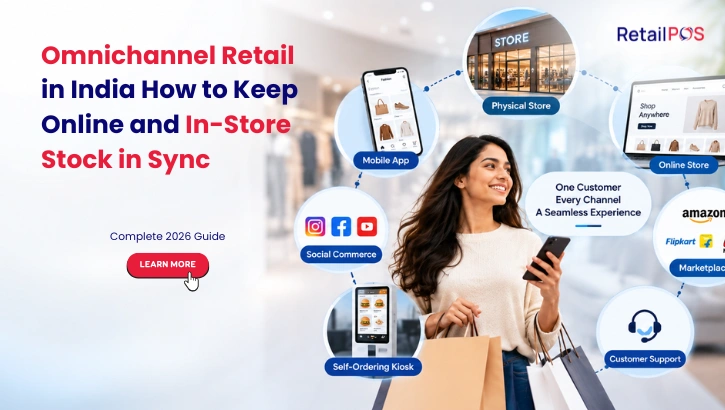
A customer orders a product on your website, pays for it, and gets an order confirmation. Twenty minutes later, an apologetic email arrives, the item is actually out of stock, it was sold in-store an hour earlier, but your online store didn’t know that yet. The refund gets processed, but the trust does not come back so easily. That customer now thinks twice before ordering from you online again, and there’s a good chance they mention the experience to someone else.
This exact scenario plays out daily across Indian retail businesses that have added an online store, a delivery app listing, or a WhatsApp ordering channel on top of their existing in-store operations, without actually connecting the stock data behind them. Each channel looks modern individually. Together, they behave like three or four separate businesses that occasionally happen to sell the same products.
This guide covers what real omnichannel stock sync looks like for Indian retail, why most “online plus offline” setups are not actually connected the way they appear to be, and what it takes to fix that without ripping out your existing systems and starting over.
What Omnichannel Actually Means vs What Most Retailers Have
The term “omnichannel” gets used to describe almost any business that sells through more than one channel, a physical store plus a website, or a store plus a delivery app listing. But having multiple channels is not the same as being omnichannel in any meaningful operational sense.
True omnichannel retail means every channel draws from and updates a single, shared stock count in real time. A product sold in-store instantly reduces what’s available online. A product sold online instantly reduces what a store associate sees as available on the shelf. There is one truth about how much stock exists, visible identically across every channel, at every moment.
What most Indian retailers actually have is multichannel, not omnichannel. Multiple channels exist, but each one runs its own separate stock count, updated on its own schedule, sometimes hourly, sometimes only once a day, sometimes only when someone remembers to manually export and re-upload a spreadsheet. The channels coexist, but they don’t actually talk to each other in real time, and the business absorbs the resulting mismatches as a routine cost of doing business online.
Why Stock Mismatches Happen in the First Place
Understanding the root causes makes the fix far more obvious than treating stock mismatches as an unavoidable side effect of selling in multiple places.
Separate systems for separate channels. A common setup involves in-store billing on one system, an ecommerce store on a completely different platform, and perhaps a delivery app with its own separate inventory panel. Each was set up to solve its own channel’s problem, with stock sync as an afterthought bolted on later, if at all.
Batch updates instead of live updates. Even businesses that do sync stock between channels often do it on a schedule, every few hours, or once overnight, rather than instantly at the moment of sale. In the gap between updates, both channels believe stock exists that has already been sold elsewhere.
Manual exports and re-uploads. Some retailers manage sync through manual spreadsheet exports from one system and uploads into another, a process that is slow, error-prone, and entirely dependent on someone remembering to actually do it consistently.
No single source of truth for stock. Without one system that every channel reads from and writes to, “current stock” becomes a question with multiple different answers depending on which system you ask, and reconciling those differences becomes an ongoing manual task rather than a solved problem.
The Real Cost of Disconnected Online and In-Store Stock
The financial impact of stock mismatches is often underestimated because it doesn’t show up as one clear expense line. It shows up scattered across several different costs.
Lost sales from false out-of-stock listings. When online stock counts lag behind actual in-store sales, products can show as available online when they’ve actually sold out, or worse, show as unavailable when stock genuinely exists, either way costing a sale that should have gone through.
Order cancellations and refund processing. Every order placed against stock that turns out to be unavailable results in a cancellation, a refund, and a customer service interaction, all of which cost staff time and, more importantly, damage the customer’s confidence in ordering from you again.
Customer trust erosion. A single stockout apology email is forgivable. A pattern of it teaches customers that your online store’s stock information cannot be trusted, pushing them toward competitors or marketplaces with more reliable fulfillment.
Overstocking to compensate. Some retailers respond to sync problems by deliberately holding back stock from online listings as a buffer, “showing” less than what’s actually available to avoid overselling. This avoids cancellations but also directly suppresses online sales that could have happened.
Staff time spent on manual reconciliation. Hours spent each week manually checking and correcting stock differences between channels is time that could go toward actually growing the business, not fixing a problem that shouldn’t exist with the right system in place.
What True Real-Time Stock Sync Requires
Fixing this is not primarily about picking flashier individual tools for each channel. It’s about the underlying stock architecture connecting them.
1. One Central Stock Ledger
Every channel, in-store billing, ecommerce, delivery app listings, should read from and write to the same underlying stock count, rather than each maintaining its own separate number that has to be reconciled after the fact.
2. Instant Updates at the Moment of Sale
Stock should update the moment a sale happens on any channel, not on a batch schedule, so that a sale on one channel is immediately reflected as reduced availability everywhere else, within seconds rather than hours.
3. Reserved Stock Handling for Online Orders
When an online order is placed, that stock needs to be reserved instantly so a near-simultaneous in-store sale of the same last unit doesn’t create a conflict, rather than both transactions completing against stock that only actually exists once.
4. Multi-Location Stock Visibility for Online Fulfillment
For chains with multiple stores, the system should be able to fulfill an online order from whichever location actually has the stock, rather than being tied to a single central warehouse that might be out while a nearby store has plenty.
5. Consistent Product and Pricing Data Across Channels
Stock sync alone isn’t enough if product descriptions, images, and pricing differ across channels. A unified system keeps product data consistent everywhere it’s displayed, reducing customer confusion and support queries.
6. Return and Exchange Handling That Updates Stock Correctly
A product returned through one channel needs to correctly re-enter the shared stock count, so it becomes available for sale everywhere again, rather than sitting in a separate return queue that never rejoins sellable inventory.
Omnichannel Fulfillment Models Indian Retailers Use
Beyond just keeping stock counts accurate, omnichannel retail also involves choosing how orders actually get fulfilled. Different models suit different business types and city footprints.
Fulfillment model | How it works | Best suited for |
Ship from central warehouse | Online orders are packed and shipped from one dedicated warehouse location | Retailers with a strong central distribution setup and lower urgency delivery expectations |
Ship from nearest store | Online orders are fulfilled from whichever store location has stock and is closest to the customer | Multi-store chains wanting faster delivery without a separate warehouse |
Buy online, pick up in store (BOPIS) | Customer orders online and collects from a chosen store, often within hours | Retailers wanting to drive footfall and cross-sell opportunities alongside online convenience |
Endless aisle | In-store staff place an order for a customer using online-only stock when the store doesn’t have their size or variant | Apparel, footwear, and variant-heavy categories avoiding lost in-store sales |
Reserve online, pay in store | Customer reserves a product online and completes purchase at the counter | Categories where customers prefer to see or try a product before paying |
Most growing Indian retail chains end up using a combination of these rather than committing to just one, which makes accurate, real-time stock visibility across every location even more essential, since the fulfillment model itself depends on knowing exactly what’s available and where.
Disconnected Channels vs Unified Commerce: A Side-by-Side View
Operational area | Disconnected multichannel setup | Unified, connected omnichannel setup |
Stock accuracy | Different counts on different systems | One shared, real-time stock count everywhere |
Update frequency | Batch updates, hourly or daily | Instant, at the moment of every sale |
Order fulfillment flexibility | Tied to whichever system took the order | Can fulfill from any location with available stock |
Overselling risk | High, especially during promotions or peak demand | Minimized through reserved stock handling |
Customer trust in online availability | Erodes over repeated stockout cancellations | Builds as online stock reliably matches reality |
Staff reconciliation effort | Manual, recurring, time-consuming | Largely automated, exceptions only |
Returns handling | Often disconnected from resellable stock | Automatically rejoins the shared stock count |
Reporting across channels | Compiled manually from separate exports | Consolidated, live, comparable across channels |
Channel-by-Channel Sync Requirements
Different sales channels have slightly different technical and operational needs, even though they should all ultimately connect to the same central stock system.
Channel | Sync requirement | Common failure point without proper integration |
In-store billing counter | Instant stock deduction on every sale | Works fine in isolation, but online never sees the update in real time |
Own ecommerce website | Live stock read and reserved stock on order placement | Stock only updates on a scheduled batch job, causing overselling |
Third-party marketplaces | API-based sync respecting each platform’s update limits | Manual updates lag far behind actual sales, especially during high demand |
Delivery and quick commerce apps | Near-instant sync given short delivery windows | Separate panel stock never matches actual store shelf stock |
WhatsApp or social commerce orders | Manual or semi-automated check against live stock | No connection to central stock at all, relying entirely on staff memory |
How to Move From Disconnected Channels to True Sync
For retailers currently running fragmented channels, the transition doesn’t have to mean replacing every system overnight. A practical path looks like this.
Audit what’s actually connected today. Map out every sales channel and honestly assess whether stock sync between it and the rest of the business is real-time, batch, or entirely manual. Most retailers are surprised by how much manual reconciliation is happening without anyone officially owning that task.
Establish one system as the central stock source of truth. Rather than trying to sync every system with every other system in a tangle of individual connections, route all channels through one central platform that holds the authoritative stock count.
Prioritize your highest-volume channel first. If ecommerce drives the most online orders, get that connection to real-time sync working reliably before tackling lower-volume channels like social commerce or a single marketplace listing.
Build reserved stock handling before scaling promotions. Before running a major sale or promotional campaign online, make sure reserved stock handling is actually working, this is exactly when overselling problems become most visible and most damaging to customer trust.
Review mismatches weekly during the transition period. Even a well-integrated system benefits from a regular check during the early weeks of a new sync setup, catching and correcting edge cases before they become a pattern that erodes customer confidence.
Questions to Ask Before You Buy Omnichannel Software
- Does stock update in real time across every channel, or only on a batch schedule?
- Is stock reserved instantly when an online order is placed, to prevent overselling against the same unit?
- Can online orders be fulfilled from any store location with available stock, not just one central warehouse?
- Does the system keep product data and pricing consistent across every channel automatically?
- Do returns from any channel correctly rejoin the shared, sellable stock count?
- Can it connect to your existing ecommerce platform and marketplace listings without a full system replacement?
- Does reporting consolidate sales and stock data across every channel in one place?
How RetailPOS Powers Omnichannel Retail
RetailPOS connects in-store billing, ecommerce, and mobile ordering through ConsumerApp into one system built around a single, real-time stock count, rather than treating each channel as a separate business that occasionally needs manual reconciliation with the others. A sale at the counter instantly reflects online, and an online order instantly reflects on the shelf, across single stores and multi-outlet chains alike.
With reserved stock handling to prevent overselling, multi-location fulfillment for faster delivery, and consolidated reporting across every channel, RetailPOS gives growing retail chains the infrastructure to sell everywhere their customers are, without the stock mismatches that usually come with expanding into new channels.
Backed by more than 20 years of retail-specific experience and trusted by 10,000+ businesses across India, RetailPOS is built to make omnichannel retail an operational strength rather than a constant source of cancelled orders and customer service escalations.
Frequently Asked Questions
Multichannel means selling through more than one channel, in-store, online, marketplaces, with each typically running its own separate stock count. Omnichannel means every channel draws from and updates a single, shared stock count in real time, so availability is accurate and consistent everywhere.
This usually happens because stock sync between the in-store billing system and the online store runs on a batch schedule rather than updating instantly, so there's a lag between an in-store sale and that reduction reflecting online.
Reserved stock handling temporarily holds a unit as unavailable the moment an online order is placed, preventing a near-simultaneous in-store sale of the same last unit from creating an overselling conflict where both transactions try to complete against stock that only exists once.
Yes, with proper multi-location stock visibility, an omnichannel system can route an online order to whichever store actually has the stock and is best positioned to fulfill it quickly, rather than being limited to one central warehouse.
Yes. RetailPOS connects in-store billing, ecommerce, and ConsumerApp mobile ordering to one central, real-time stock count, so every channel reflects the same accurate availability. Book a free demo to see it for your business.
Yes. A product returned through any channel needs to correctly rejoin the shared, sellable stock count, otherwise returned inventory sits unused and unavailable across every channel until someone manually corrects it.
Not necessarily. Auditing existing channel connections, establishing one central stock source of truth, and prioritizing the highest-volume channel first gives most retailers a manageable path without needing to replace every system simultaneously.
Ready to stop losing sales to stock mismatches between your store and your website? Book your free RetailPOS demo today →