
Powered by Unipro Tech
Best POS and ERP Software in South India for Retail Chains 2026: The Complete Guide for Chennai, Bangalore, Hyderabad, Kochi and Coimbatore
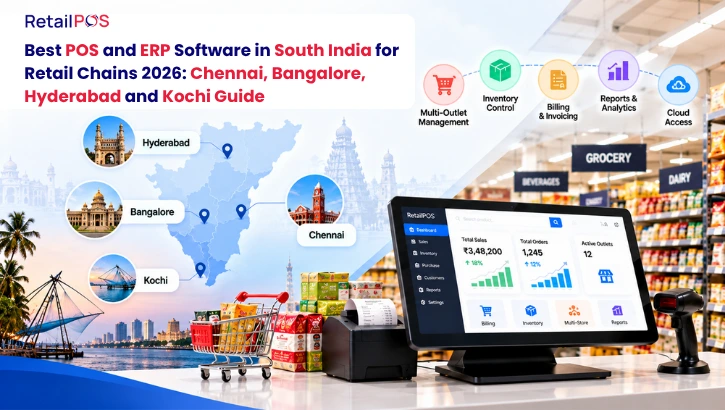
A complete guide for retail chain owners across South India who want the right POS and ERP software for their specific market, format, and growth plans.
Why South India Needs a Dedicated Retail Technology Guide
South India’s retail landscape in 2026 is not a smaller version of North India’s retail landscape. It is a distinct market with its own consumer behaviour patterns, its own festival calendar, its own leading retail formats, its own language requirements, and its own specific compliance demands that a national-market guide written from Delhi or Mumbai will not address with the accuracy that South Indian retail chain owners need.
India’s retail sector remained resilient in FY26, supported by stable consumption, digital-led channel expansion and strong growth in food, grocery, apparel and quick service restaurants, according to KPMG. Within this national picture, South India is driving a disproportionate share of the organised retail growth. Tamil Nadu, Karnataka, Kerala, Andhra Pradesh, and Telangana together represent one of the largest and most sophisticated retail markets in Asia. The retail chain owner in Chennai managing 8 supermarket outlets has different operational requirements from the Delhi NCR apparel chain. The Bangalore QSR chain operator expanding from 4 to 12 outlets across the city has different technology needs from a Mumbai restaurant group.
This guide is written specifically for South Indian retail chain owners. It covers what the right POS and ERP software looks like for the specific retail formats that dominate South Indian markets, what the South India-specific requirements are that national vendors without South India deployment experience frequently miss, and why the choice of a technology partner with deep South Indian market knowledge makes a material difference in implementation quality and ongoing operational support.
The South Indian Retail Market in 2026: What Makes It Distinct
South India’s five major retail markets each have specific characteristics that shape what retail technology needs to do.
Tamil Nadu is the most mature organised retail market in South India. Chennai has India’s highest density of supermarket chains per capita among major Indian cities. The Tamil Nadu consumer is price-sensitive, quality-conscious, and loyal to local brands. Festival retail peaks around Pongal in January and the Tamil New Year in April are unique to this market and require specific promotional management capabilities.
Karnataka and Bangalore specifically is India’s most rapidly evolving retail technology adoption market. Bangalore’s consumer base includes a large, digitally sophisticated population with high expectations for seamless checkout, loyalty programme recognition, and omnichannel experience. The Bangalore retail technology buyer is among the most demanding in India and evaluates POS systems with a level of technical scrutiny that few other Indian markets match.
Telangana and Andhra Pradesh represent the fastest-growing organised retail opportunity in South India right now. Hyderabad’s organised retail sector is expanding rapidly into secondary neighbourhoods and into Tier-2 cities across both states. The specific retail formats dominant in these markets include large-format grocery chains, branded apparel chains expanding from Hyderabad into smaller cities, and a rapidly growing QSR and casual dining sector driven by the region’s large young professional population.
Kerala has India’s highest per-capita organised retail penetration outside the metros. The Kerala consumer is highly educated, brand-aware, and willing to pay premium prices for quality. Onam is Kerala’s equivalent of Diwali for retail intensity and requires specific operational preparation. The Kerala market has specific local brand preferences that a generic national POS system’s product master configuration will not accommodate without local market knowledge.
Coimbatore and Tamil Nadu Tier-2 cities represent the current frontier of South Indian organised retail expansion. Retail chains that built their base in Chennai are now expanding into Coimbatore, Madurai, Trichy, and Salem. The technology infrastructure that served a Chennai chain well needs to scale efficiently to these new markets without requiring a new system for each city.
Retail Technology Requirements Specific to South Indian Markets
Beyond the universal POS requirements, South Indian retail markets have specific technology needs that a national guide or an international product recommendation will not address.
South Indian festival calendar management. The promotional calendar for a South Indian retail chain includes Pongal, Tamil New Year, Ugadi, Vishu, Onam, Navratri (especially strong in Tamil Nadu and Andhra Pradesh), Diwali, and Christmas. Each festival has specific promotional mechanics, specific product categories that surge in demand, and specific regional variations in the timing and nature of demand. A POS system that cannot configure and deploy festival-specific promotions with the granularity this calendar demands creates consistent seasonal management problems.
Multi-language product management. Tamil Nadu retail chains serving customers across Chennai’s diverse neighbourhoods frequently need product labelling and customer-facing displays in Tamil as well as English. Kerala retail chains need Malayalam support. Andhra Pradesh and Telangana retail chains need Telugu support. A POS system without multilingual product master and receipt capability creates operational friction in South Indian markets.
South Indian fresh produce categories. Supermarket chains in South India manage a fresh produce section that includes South India-specific varieties not present in North Indian or global product databases: specific banana varieties, specific leafy greens, specific tuber varieties, and wet coconut products that require specific weighing and billing configurations. The WeighSense AI training data must include these South Indian produce categories for accurate AI identification.
Local brand and regional supplier management. South Indian retail chains carry a significantly higher proportion of local and regional brands than chains in North India. Aachi masalas in Tamil Nadu, Malabar products in Kerala, MTR in Karnataka, Priya in Andhra Pradesh — these regional brands have specific scheme structures and specific promotional expectations that a product master configured for national brands will not accommodate correctly without local market knowledge.
South Indian FMCG distribution patterns. The secondary distribution network for FMCG in South India operates through regional distributors with strong principal company relationships. The RetailPOS Distribution Management System’s scheme management and secondary sales tracking capabilities need to be configured for the specific scheme structures used by South Indian regional principals, which differ from the national brand scheme patterns more familiar to systems primarily deployed in North Indian markets.
Best POS Software for Retail Chains in Chennai 2026
Chennai is the capital of India’s most mature organised retail market and the city where the widest range of POS and ERP solutions have been deployed across the full spectrum of South Indian retail formats: supermarkets, apparel chains, electronics, pharmacy, jewellery, and multi-format retail groups.
What Chennai Retail Chains Specifically Need From POS Software
Chennai’s supermarket market is the most competitive in South India. Major national chains operate alongside strong regional players, and the consumer’s switching cost is low in a city where multiple supermarket options exist within a short drive of most residential areas. Availability, price, and customer experience are the competitive battleground. A POS system that allows stockouts on bestsellers, fails to deploy promotions consistently across all outlets, or creates friction at checkout is directly damaging competitive position in Chennai’s dense retail market.
The Tamil Nadu GST compliance context: Tamil Nadu has a large number of registered GST businesses and a well-developed GST audit infrastructure. The state’s GST authorities are among the most active in India for audit and notice issuance. Chennai retail chains with any compliance gaps in their POS system’s HSN code mapping, rate application, or e-invoice generation are exposed to a higher-than-average probability of receiving notices. GST automation that is complete and correct is not optional in Chennai retail.
Key Chennai retail formats and their specific needs:
Format | Chennai Specifics | Key POS Requirement |
High competition, price-sensitive consumer, strong local brands | Real-time inventory, WeighSense AI for produce, fast checkout | |
Apparel chains | Strong ethnic wear demand, festival collection pressure, size management | Variant matrix, slow-mover detection, inter-outlet transfers |
Electronics chains | High EMI purchase proportion, warranty management, brand schemes | Serial number tracking, manufacturer scheme management |
Very high density of pharmacies, strong competition, regulatory scrutiny | FEFO enforcement, Schedule H compliance, near-expiry alerts | |
Jewellery chains | Dhanteras and Akshaya Tritiya peaks, high-value item management | Weight-based pricing, unique item tracking, high-value security |
RetailPOS in Chennai: RetailPOS is headquartered in Chennai. Unipro Tech Solutions’ physical presence in Chennai means that Chennai retail chains get on-site implementation, on-site training, and on-site support from a team that knows the city’s retail market, its supplier landscape, and its GST compliance environment from direct, daily experience. This is not a theoretical advantage. It is the difference between an implementation team that knows Koyambedu wholesale market’s produce price patterns when configuring WeighSense AI and a remote team that does not.
Best POS Software for Retail Chains in Bangalore 2026
Bangalore’s retail technology buyers are among the most sophisticated in India. The city’s large population of technology professionals means that the benchmark for digital experience in any retail interaction is higher in Bangalore than in most Indian cities. A POS system that creates visible friction at checkout, that has a loyalty programme that does not recognise customers correctly, or that shows a management dashboard that is hours behind real-time will be noticed and negatively evaluated by Bangalore retail customers and owners with a sharpness that other markets may be more forgiving about.
What Bangalore retail chains specifically need:
Speed and seamlessness at checkout. Bangalore’s tech-savvy consumer expects a checkout experience that is as smooth as any digital interaction. Sub-second product load times, immediate UPI confirmation, instant loyalty recognition, and frictionless receipt delivery are the baseline expectation, not a differentiator.
Multi-neighbourhood management. A Bangalore retail chain expanding from Koramangala to Whitefield to Jayanagar to Hebbal is managing customer bases with different demographics, different income levels, and different product preference patterns across outlets. Category-level product mix customisation per outlet and outlet-specific slow-mover detection is more important in Bangalore than in any other South Indian city because the demographic variation between city zones is more pronounced.
Delivery platform integration depth. Bangalore has India’s highest density of food delivery orders per capita. For Bangalore restaurant chains using Dineazy, the Zomato and Swiggy integration quality described in previous guides is not a convenience feature. It is an operational necessity. For Bangalore supermarket chains exploring quick commerce and delivery, the integration between in-store POS inventory and any delivery channel must be real-time and bidirectional.
Festival calendar note for Bangalore: Bangalore’s festival retail calendar is shaped by its diverse population. Navratri is very strong (Dasara in Karnataka is a major state festival), Diwali is significant, and Ugadi is Karnataka’s major spring festival. A POS system that cannot flexibly configure different promotional calendars for different outlet locations based on their neighbourhood demographic is mismatched with Bangalore’s retail reality.
Best POS Software for Retail Chains in Hyderabad and Telangana 2026
Hyderabad’s retail market is one of the most rapidly expanding in South India. The city’s organised retail penetration is growing faster than Chennai or Bangalore’s current growth rate, which means that technology decisions made by Hyderabad retail chains now will need to scale significantly over the next three to five years.
What Hyderabad retail chains specifically need:
Scalability for rapid outlet expansion. A Hyderabad retail chain that has 6 outlets today and plans to have 18 outlets in three years needs a POS system that is architecturally ready for the target size, not the current size. The specific question for Hyderabad retail chains is not “does this work for 6 outlets?” but “when we reach outlet 15 in two years, what changes in the system, the cost, and the operations?” Any vendor who cannot answer this question specifically has not thought through Hyderabad’s expansion trajectory.
Telugu language support. Hyderabad and the broader Telangana and Andhra Pradesh market has strong consumer preference for Telugu-language customer communications, receipts, and product labelling in relevant retail formats. A POS system without Telugu language capability creates a customer experience gap in markets outside central Hyderabad.
Biryani and Mughlai restaurant requirements. Hyderabad’s restaurant technology market is dominated by the biryani segment, which has specific inventory management requirements. Large protein batch purchasing, FEFO enforcement for marinated proteins, high-volume counter service during lunch rush, and delivery management for Hyderabad’s extremely active biryani delivery market require restaurant POS capabilities specifically tested for this format.
Eid and Ramadan retail peak. Hyderabad’s large Muslim population creates a significant retail and restaurant peak during Ramadan and around Eid that is proportionally larger than in any other South Indian city. A POS system that can configure and deploy Eid-specific promotional calendars with the same flexibility as Diwali or Onam promotions is operationally important for Hyderabad retail chains serving this customer base.
Best POS Software for Retail Chains in Kochi and Kerala 2026
Kerala has India’s highest per-capita organised retail penetration outside the top four metros. The Kerala consumer is educated, brand-aware, and spends more per retail transaction on average than consumers in comparable-income markets elsewhere in India. The retail chain owner in Kochi is serving one of India’s most demanding and most rewarding consumer bases.
What Kerala retail chains specifically need:
Onam management capability. Onam is Kerala’s equivalent of Diwali for retail intensity. The 10-day Onam period generates festive retail revenues comparable to a major metro’s Diwali performance. A POS system used by Kerala retail chains must be able to configure, deploy, and manage Onam promotional calendars with the same precision and automation that any South Indian retail chain needs for Diwali. Vendors who do not have significant Kerala deployment experience may not have tested their promotional management under Onam peak conditions specifically.
Kerala-specific fresh produce management. Kerala’s supermarket fresh produce section includes varieties and packaging formats not found in mainland India retail markets. Raw coconut products, specific banana varieties (Nendran, Palayamkodan, Robusta), and specific tropical produce categories require specific PLU configurations and WeighSense AI training data to manage accurately.
Malayalam language support. For retail chains serving Kerala’s secondary markets beyond Kochi, Malayalam-language customer communications, receipts, and product information are important for customer experience quality.
Multi-state GSTIN management. Kerala retail chains expanding into Tamil Nadu or Karnataka need multi-state GSTIN management within their POS system. The ability to manage separate state registrations while maintaining consolidated management reporting is a specific requirement for chains crossing state lines.
Best POS Software for Retail Chains in Coimbatore and Tamil Nadu Tier-2 Cities 2026
Coimbatore, Madurai, Trichy, Salem, and Vellore represent the current frontier of South Indian organised retail expansion. Chennai-based chains are expanding into these cities. Regional chains headquartered in these cities are scaling within their home markets. The specific technology challenge is deploying enterprise-grade retail management in markets that have historically been served by basic billing software.
What Tier-2 Tamil Nadu retail chains specifically need:
Implementation in markets without deep technology infrastructure. A Coimbatore retail chain implementing enterprise POS for the first time is making a significantly larger operational transition than a Chennai chain switching from one enterprise system to another. The implementation team must be capable of conducting the product master setup, staff training, and go-live support without assuming existing technology familiarity among the retail team.
Tamil language support throughout. Retail chains in Coimbatore and Tamil Nadu Tier-2 cities are typically staffed by teams whose primary language is Tamil. A POS system where the billing interface, training materials, and support communications are available in Tamil reduces the staff adoption barrier significantly.
Connectivity for semi-urban locations. While Coimbatore’s internet infrastructure has improved significantly, retail outlets in the city’s older commercial areas and in smaller towns within the expansion corridor may experience more frequent connectivity interruptions than Chennai or Bangalore outlets. Full offline capability is even more critical in these markets than in the metros.
Local supplier and produce integration. Coimbatore’s retail market has strong local supplier relationships for fresh produce, dairy, and FMCG categories that differ from Chennai’s wholesale market ecosystem. A POS system’s product master and supplier management configuration must accommodate the specific local supplier landscape rather than assuming a standardised national supply chain.
The South India Retail Format Guide: What Each Category Needs
Format | South India Presence | Key Requirements | RetailPOS Product |
Supermarket chains | Very strong across all 5 major markets | WeighSense AI produce, batch tracking, multi-outlet dashboard | |
Apparel and ethnic wear | Dominant in Chennai, Coimbatore, Hyderabad | Variant matrix, festival collection management, slow-mover detection | RetailPOS Enterprise |
Electronics and durables | Strong in all markets, Hyderabad growing fastest | Serial number tracking, manufacturer schemes, warranty management | RetailPOS Enterprise |
Pharmacy chains | Extremely high density across South India | FEFO enforcement, Schedule H, near-expiry alerts, regulatory compliance | RetailPOS Enterprise |
Jewellery chains | Strong in Chennai (T. Nagar), Coimbatore, Thrissur (Kerala) | Weight-based pricing, unique item tracking, high-value security | RetailPOS Enterprise |
QSR and fast food | Bangalore and Hyderabad fastest growing | Kiosk integration, delivery platform, KDS, combo management | Dineazy + KioskServe |
Restaurant chains | Strong across all markets | Multi-outlet food cost, delivery integration, recipe management | Dineazy |
FMCG distributors | Strong across all markets, Andhra Pradesh and Telangana growing | Secondary sales, scheme management, van sales, FEFO | Distribution Management System |
How to Choose a POS and ERP Vendor in South India
Beyond the universal evaluation criteria covered in other guides, South Indian retail chains should apply these specific additional criteria when choosing a technology partner.
Criterion 1: South India-Specific Deployment Evidence
Ask the vendor how many active retail chain customers they have in your specific city and in your retail format. A vendor with 50 active supermarket chain customers in Chennai has tested their system under Pongal peak conditions, under Tamil Nadu GST audit scenarios, and with South Indian produce categories in WeighSense AI. A vendor with 500 customers nationally but only 3 in South India has not.
Criterion 2: On-Site Support Capability in Your City
For implementation, training, and ongoing on-site support, the vendor’s ability to dispatch a team member to your specific city within 24 hours matters significantly during the first six months after go-live. Ask specifically: where is your nearest service team? What is the committed response time for an on-site visit in your city? A remote-only support model from a vendor headquartered in another region is a genuine operational risk for any retail chain in South India.
Criterion 3: Local Language Capability
Ask to see the POS interface in the language relevant to your market: Tamil for Chennai and Coimbatore chains, Malayalam for Kerala chains, Telugu for Hyderabad and AP chains. A vendor who says “language support can be added later” has not prioritised your market’s requirements.
Criterion 4: Festival Calendar Configuration for South Indian Festivals
Ask the vendor to demonstrate configuring an Onam promotion (if you are in Kerala), a Pongal promotion (if you are in Tamil Nadu), or a Dasara promotion (if you are in Bangalore). If the vendor defaults to demonstrating Diwali promotions without being able to demonstrate the festival most important to your specific market, their South India configuration depth is limited.
Criterion 5: Reference Quality in Your Market
Ask for three references specifically in your city and your retail format. Visit one of these references if possible rather than just calling. Walking through a RetailPOS-managed supermarket in Chennai or a Dineazy-powered restaurant chain in Bangalore during peak service gives you information about real-world performance that no demonstration or phone reference can replicate.
How RetailPOS Serves South Indian Retail Chains
RetailPOS by Unipro Tech Solutions is headquartered in Chennai, Tamil Nadu. South India is not a market RetailPOS expanded into from another base. South India is the market where RetailPOS was built, where it was first deployed, and where the majority of its 10,000 plus business customers operate.
What this South India-first history means for retail chains in the region:
GST compliance built for Tamil Nadu and South Indian compliance environments. RetailPOS’s GST automation has been tested under Tamil Nadu GST audit conditions since the day GST was introduced in 2017. Every subsequent compliance change, every e-invoicing threshold reduction, every GSTR-2B reconciliation update, has been implemented and tested against South Indian retail chain usage patterns first.
WeighSense AI trained on South Indian produce. The AI model powering WeighSense AI’s produce identification includes South India-specific varieties: Nendran banana, raw coconut, Palayamkodan, South Indian drumstick, and other produce categories that a system trained primarily on North Indian or international produce databases cannot reliably identify. This training depth makes WeighSense AI’s South Indian supermarket deployment significantly more accurate than a generic AI produce identification system.
On-site implementation and support across South India. Unipro Tech’s implementation and support team covers Chennai and Tamil Nadu directly from the Porur headquarters, with coverage extending to Bangalore, Hyderabad, Kochi, and Coimbatore through both direct team deployment and trained partner networks. Implementation projects in South Indian Tier-2 cities have been completed by the same team across Coimbatore, Madurai, Trichy, Mysuru, Vijayawada, and Thrissur.
South Indian festival promotional calendar knowledge. Pongal, Tamil New Year, Vishu, Onam, Ugadi, Dasara, Eid in Hyderabad — RetailPOS’s implementation teams have configured promotional calendars for all of these festivals across hundreds of South Indian retail chain deployments. The knowledge of which product categories surge for which festival in which South Indian market is embedded in how RetailPOS implementations are configured, not something that needs to be rediscovered for each new customer.
Active South Indian retail chain references. RetailPOS currently serves active customers including Greens Supermarket, Subasri Super Market, Surya Supermarket, Subiksham Super Stores, Pazhamudir Nilayam, and Metro Bazaar among many others. These are South Indian supermarket chains whose operations the RetailPOS team knows from direct ongoing service rather than from case study documentation.
Every outlet in a South Indian chain, whether in one state or across several, can be monitored from the Cockpit dashboard, with deeper performance reporting through RetailPOS Analytics and fast mobile billing through TapZap.
Conclusion: The Right Technology Partner for South India Is One Who Knows South India
The best POS and ERP software for a South Indian retail chain in 2026 is not determined by which system has the longest global feature list or which vendor has the most recognisable brand name. It is determined by which system was built to operate effectively in South Indian retail conditions — the festival calendar, the produce varieties, the local brands, the regulatory environment, and the connectivity realities of South Indian retail markets — and which vendor has the deployment density and the on-site support capability in South Indian markets to make the implementation work and keep it working.
Today is October 26, 2026. Diwali is 13 days away on November 8. If your current POS system has been creating operational problems during the festive season, the decision about what to change and when needs to be made this week. A January 2027 implementation, beginning planning and vendor evaluation now, is the right timeline for most South Indian retail chains to upgrade after the festive season without peak-period disruption.
Book a free demo and see how RetailPOS serves retail chains across South India. Visit retailpos.co.in/register-demo | Call 044-421 421 40 / 95660 44300 | Email salesenquiry@uniprotech.co.in
Frequently Asked Questions
RetailPOS Enterprise is the strongest choice for supermarket chains in Chennai in 2026 for three specific reasons. First, it is built and headquartered in Chennai, which means the implementation team has direct, daily knowledge of Chennai’s retail market, its fresh produce categories, its local brand landscape, and its Tamil Nadu GST compliance environment. Second, WeighSense AI’s produce identification model has been trained on South Indian and Tamil Nadu-specific produce varieties including Nendran banana, raw coconut, and South Indian drumstick categories that generic AI produce systems do not identify accurately. Third, RetailPOS has active supermarket chain customers currently operating in Chennai whose performance during Chennai’s specific festival peaks including Pongal and Tamil New Year provides verified deployment evidence in your specific market.
Yes. RetailPOS supports multilingual configurations including Tamil, Telugu, and Malayalam for customer-facing interfaces, receipts, and product labelling in South Indian retail deployments. The specific language requirements for each South Indian market can be configured during implementation. South Indian retail chains serving customers in regional language markets benefit from this localisation capability in both customer experience quality and staff adoption speed, particularly in Tamil Nadu Tier-2 city deployments where the retail team’s primary working language is Tamil rather than English.
Onam promotional management in RetailPOS works exactly like Diwali or Navratri promotional management: all offers are configured centrally and deployed to all outlets simultaneously at the configured activation time. The Onam promotional calendar, including the specific product categories that surge during Onam in the Kerala market, the traditional Onam sadya ingredient promotions, and the gift set and household product offers that characterise Onam retail in Kerala, can all be pre-configured and activated automatically. RetailPOS has active Kerala retail chain customers for whom Onam promotional management has been executed successfully, which means the implementation team’s configuration knowledge for Onam is tested and proven rather than theoretical.
The fastest path to a live RetailPOS deployment for a Bangalore retail chain is to book a demonstration using your actual product data and outlet configuration, receive a specific implementation timeline and cost proposal for your outlet count and format, and begin the implementation within the first two weeks of the engagement. For a Bangalore retail chain with 3 to 6 outlets and an existing product master in any digital format, a fully live RetailPOS deployment across all outlets is achievable within 4 to 6 weeks from contract signing. January 2027, following the current festive season, is the optimal implementation window for Bangalore chains who want to complete the festive period on their current system and begin 2027 on RetailPOS.
RetailPOS manages multi-state GSTIN configurations within a single platform, with each state registration maintaining its own separate GSTR-1 and GSTR-3B filing data while sharing the same centralised inventory, loyalty, and management dashboard. A retail chain with outlets in Tamil Nadu and Karnataka maintains separate Tamil Nadu and Karnataka GSTINs within the same RetailPOS system. Inter-state stock transfers between outlets generate the appropriate e-way bill documentation automatically within the billing workflow. Consolidated management reporting across all states is available on the Cockpit dashboard while maintaining the state-specific compliance filings required by each registration.
Ready to choose a POS partner that knows South India? Book your free RetailPOS demo today →