
Powered by Unipro Tech
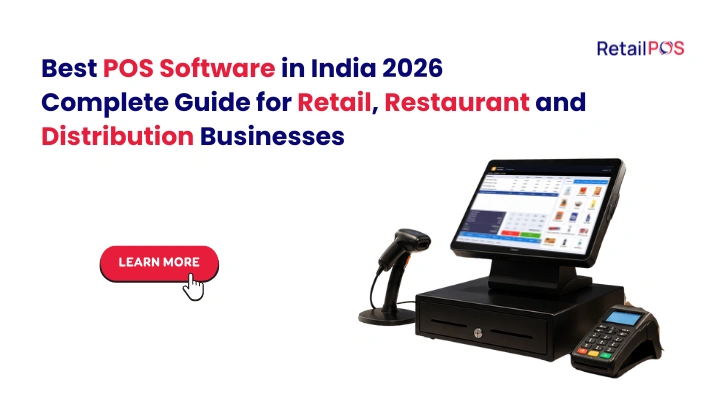
Best POS Software in India 2026: Complete Guide for Retail, Restaurant and Distribution Businesses
The most comprehensive and honest guide to choosing POS software in India, written specifically for Indian business owners across retail, restaurant, and distribution segments
Quick Answer: What Is the Best POS Software in India in 2026
If you want a straight answer before reading the full guide:
The best POS software in India depends on your business type:
Business Type | What You Need | RetailPOS Solution |
Retail chain with 2 or more outlets | Enterprise POS with real-time multi-outlet management | |
Supermarket or grocery chain | POS with weighing scale integration and batch tracking | RetailPOS Enterprise + WeighSense AI |
Restaurant or QSR chain | Restaurant management with KDS and delivery integration | Dineazy |
FMCG or pharma distributor | Distribution management with secondary sales tracking | Distribution Management System |
Single retail shop | Fast billing with GST compliance and inventory | RetailPOS UniMini |
The most important buying advice in this entire guide: Do not choose POS software based on price alone or on a feature list comparison. Choose based on three things: offline billing capability, genuine multi-outlet management architecture, and India-specific GST automation. These three separate the software that works in Indian business conditions from software that looks good in a demonstration.
Section 1: Why the Best POS Software in India Is Not a Global Product
Every list of best POS software in India published by international comparison websites includes Square, Shopify POS, Lightspeed, Toast, and similar global platforms. These are excellent products for the markets they were built for. They are not the best POS software in India for most Indian businesses.
Here is why.
GST compliance. India’s GST framework, with its HSN code requirements, GSTR-1 and GSTR-3B filing obligations, e-invoice IRN generation, and e-way bill workflow, is specific to India and has no equivalent in the markets where global POS products were originally designed. International POS platforms have added GST support as a module, but built-from-the-ground-up GST integration is fundamentally different from GST support bolted on after the fact.
Offline billing. Power cuts, internet outages, and connectivity drops happen regularly across India, including in major cities. Global cloud-only POS products that stop functioning when internet connectivity is interrupted are genuinely not suitable for Indian retail, restaurant, and distribution operations. Indian-built POS software has been designed from its foundation to operate offline because the Indian context demands it.
Indian payment modes. UPI is India-specific. The integration depth required for seamless GPay, PhonePe, Paytm, and BHIM acceptance at a retail or restaurant counter in India is something global POS products support as an add-on rather than as a native, deeply integrated capability.
Weighing scale integration for Indian retail. Fresh produce billing, loose grain sale, and weight-based items are central to Indian supermarket and grocery operations in a way that is less common in Western retail. The weighing scale integration requirements of an Indian supermarket chain are deeply India-specific.
Festival demand management. Pongal in Tamil Nadu, Onam in Kerala, Diwali across North India, Eid in Telangana, Ugadi in Karnataka — the festival-driven retail demand calendar in India requires promotional management capabilities that global products have not been designed to serve.
The conclusion: The best POS software in India in 2026 is software that was built for India, by people who understand Indian retail, restaurant, and distribution operations from direct experience, and that has been continuously refined in the Indian market for years.
Section 2: What POS Software in India Must Do in 2026
Before comparing options, it is important to define what any POS software in India must do to be genuinely suitable for Indian business conditions in 2026.
The baseline requirements that every Indian POS software must meet:
Requirement | Why It Is Non-Negotiable in India |
Full offline billing capability | Internet and power interruptions happen. Billing must never stop. |
Automatic GST compliance | HSN codes, correct rates, GSTR generation — all must be automatic |
UPI and multi-payment mode support | India’s cashless economy demands seamless digital payment acceptance |
Fast barcode-driven billing | High-volume Indian retail and restaurant counters require sub-second product loading |
Real-time inventory management | Stock must update after every transaction, not in a batch |
E-invoice IRN generation | Mandatory for qualifying businesses, must be automatic |
India-specific support | On-ground support in India during Indian business hours |
Scalability for growth | Must handle growth from one outlet to many without system replacement |
Any POS software in India that does not meet all eight of these baseline requirements should not be on your evaluation list regardless of its other features or its price point.
Section 3: The Six Non-Negotiable Features in Any Indian POS Software
3.1 Full Offline Billing — Not Partial, Not Workaround
This is the single most important technical requirement and the one most commonly understated during sales demonstrations. Full offline billing means every function of the POS, including barcode scanning, price calculation, GST application, promotion application, payment processing, and receipt generation, works at full speed with zero internet connectivity.
This is different from partial offline capability where basic billing works but inventory does not update, or where UPI payments require internet but cash does not. Full offline means the customer experience at your counter is identical whether your internet is working or not.
How to test this: During any vendor demonstration, physically unplug the internet router or turn off WiFi on the POS device. Then complete a full transaction from barcode scan through payment to receipt. If anything pauses, prompts a workaround, or requires a manual step, the system does not have genuine full offline capability.
3.2 Automatic GST Compliance Built Into Every Transaction
GST compliance in India in 2026 has four specific requirements that a POS system must handle automatically.
Correct HSN code on every invoice. Every product must be mapped to its correct HSN code at the product setup stage. The code must appear on every invoice automatically without any selection from the billing operator.
Correct GST rate applied automatically. The GST rate must apply based on the product’s HSN code and category without manual selection. For apparel, the rate must switch automatically between 5% and 12% based on the selling price at the Rs 1,000 threshold.
GSTR-1 and GSTR-3B generated from transaction data. Monthly returns must be generated directly from billing transaction records without any manual data compilation or export-and-reformat process.
E-invoice with valid IRN for qualifying transactions. Every qualifying B2B transaction must generate an e-invoice with a valid Invoice Reference Number from the GST portal automatically within the billing workflow.
3.3 Real-Time Inventory That Updates After Every Transaction
Every sale, purchase, return, and transfer must update your inventory count the moment it happens. Not at the end of the day. Not in a scheduled batch. Immediately.
Real-time inventory enables low-stock alerts that fire before shelves empty, purchase decisions based on current stock rather than yesterday’s count, and in multi-outlet systems, stock visibility across all outlets simultaneously.
3.4 Multi-Outlet Architecture for Growing Businesses
This is the feature that most Indian business owners discover they need only after they have already opened their second outlet on a system that was not designed for it.
Genuine multi-outlet POS software maintains one centralised database that all outlets connect to simultaneously. Every sale at any outlet updates the shared inventory count. Pricing changes made at head office reach all outlets instantly. Customer loyalty earned at one outlet is recognised at every other outlet.
The key question to ask every vendor: “Is this one database shared by all outlets or separate databases at each outlet that sync periodically?” Separate databases that sync periodically are not genuine multi-outlet management. They are multiple single-outlet systems with delayed data sharing.
3.5 Category-Specific Capabilities for Indian Business Types
Generic POS software that treats all products as simple fixed-price items cannot serve the specific requirements of Indian business categories.
Business Category | Category-Specific Requirement | What Happens Without It |
Supermarkets | Weighing scale integration | Manual weight entry errors, billing delays, PLU code chaos |
Apparel chains | Size-colour variant matrix | Thousands of SKUs managed as separate products, inventory chaos |
Pharmacies | FEFO enforcement and Schedule H tracking | Regulatory exposure, expiry write-offs |
Electronics | Serial number and IMEI tracking | No warranty management, no theft protection |
Restaurants | Recipe-level food cost tracking | No food cost visibility, margin blindspot |
Distributors | Secondary sales tracking and scheme management | Principal company reporting takes days, scheme leakage |
3.6 Mobile and Remote Management Access
In 2026, a business owner who can only review their business performance by sitting at a specific desktop computer in the office is at a competitive disadvantage. The best POS software in India provides a mobile dashboard that shows sales, inventory, and performance data in real time from any device anywhere.
For multi-outlet businesses, this means seeing all outlets’ performance simultaneously on a phone while travelling between locations, not calling store managers for updates.
Section 4: Best POS Software for Retail Businesses in India
Indian retail in 2026 spans a wide spectrum from single-outlet specialty stores to supermarket chains with hundreds of locations. The right POS software depends on where on that spectrum your business sits.
4.1 For Single-Outlet Retail Shops
A single-outlet retail shop needs fast billing, automatic GST compliance, real-time inventory, multi-payment mode support, basic loyalty, and offline capability. The most important thing to verify is that the system you choose today can scale to multiple outlets when you are ready to expand, without requiring a full system migration.
Key features for single-outlet retail:
- Barcode-driven billing with sub-second product loading
- Automatic GST with GSTR generation from transaction data
- Full offline billing capability
- Basic inventory tracking with low-stock alerts
- Customer loyalty programme
- Daily reports without manual compilation
4.2 For Supermarket and Grocery Chains
Supermarket operations have the most demanding POS requirements of any Indian retail format. High transaction volumes, weighing scale integration, fresh produce billing, batch and expiry tracking, complex promotional mechanics, and multi-counter simultaneous billing all combine to require purpose-built supermarket POS software.
Key features for supermarkets:
Feature | Why Supermarkets Need It |
Weighing scale integration | Fresh produce and loose items cannot be billed accurately without it |
AI-powered produce identification | WeighSense AI eliminates PLU code errors and reduces billing time from 60 to 10 seconds |
Batch and expiry tracking | Perishables need FEFO enforcement and near-expiry alerts |
Multi-counter billing | 8 to 15 simultaneous counters at peak hours |
Automated promotion engine | Buy one get one free, minimum purchase discounts, category offers |
Real-time multi-outlet inventory | For chains, stock at every outlet visible from one dashboard |
4.3 For Apparel and Fashion Chains
Apparel retail has one specific requirement that no other retail category has at the same scale: size-colour variant management. A single style in 5 colours and 5 sizes generates 25 individual SKUs. A showroom carrying 500 styles manages 12,500 SKUs. Without a proper variant matrix in the POS software, this catalogue is unmanageable.
Key features for apparel chains:
- Size-colour variant matrix with auto-generated barcodes per combination
- Slow-mover detection by variant, by outlet, and by collection
- Season-wise inventory separation (current collection vs carry-forward)
- Automatic GST rate switching at the Rs 1,000 apparel threshold
- Inter-outlet transfer at the variant level
4.4 For Electronics and Appliance Chains
Electronics retail requires serial number tracking that links every unit from goods receipt through sale to warranty claim. Without this, a chain cannot support warranty queries, cannot trace recalled units, and cannot prevent duplicate warranty claims.
Key features for electronics chains:
- Serial number tracking from GRN through sale
- IMEI recording for mobile and computing devices
- Warranty management with expiry calculation from invoice date
- Brand-wise scheme and EMI offer management
- High-value item security with role-based authorisation
4.5 For Pharmacy Chains
Pharmacy retail in India is regulated and requires specific compliance capabilities that generic POS software cannot provide.
Key features for pharmacy chains:
- FEFO enforcement at the point of dispensing
- Schedule H and H1 drug tracking with prescription recording
- Near-expiry alerts with configurable warning windows
- Batch-linked records for drug recall traceability
- Correct pharmaceutical GST rates applied per category
Section 5: Best POS Software for Restaurant and F&B Businesses in India
Restaurant POS software in India in 2026 is a different product category from retail POS software. The operational requirements of a restaurant, kitchen management, delivery platform integration, recipe-level food cost tracking, and table management, are distinct enough from retail requirements that a retail POS used in a restaurant creates operational gaps that cost money every service period.
5.1 What Makes Restaurant POS Software Different
Retail POS Function | Restaurant POS Equivalent | Why It Is Different |
Product sale | KOT generation and kitchen communication | Must reach kitchen instantly, not just record the transaction |
Inventory deduction | Recipe-level ingredient deduction | Every dish deducts specific ingredients in specific quantities |
Customer payment | Table settlement after service | Multiple courses, split bills, service charge, different GST treatment |
Stockout | Ingredient shortage | Must auto-pause dishes on delivery platforms when ingredient hits zero |
Multi-outlet management | Multi-outlet restaurant chain | Recipe standards, menu, and pricing must be centralised across all kitchens |
5.2 Key Features for Indian Restaurant POS Software
Kitchen Display System integration. Every order from every channel, dine-in, Zomato, Swiggy, and takeaway, must appear on the kitchen display automatically. No paper tickets. No separate tablets per channel. One unified kitchen view.
Genuine Zomato and Swiggy integration. This means orders auto-importing into the POS, inventory deducting from the same count as dine-in, and dishes auto-pausing on delivery platforms when an ingredient reaches zero. Not just an API connection that requires manual steps.
Recipe-level food cost tracking. Every dish mapped to exact ingredient quantities. Every sale deducts those quantities from live inventory. Food cost percentage per dish calculated automatically and updated when supplier prices change.
GST compliance for restaurants. 5% for non-AC restaurants without alcohol, 18% for AC restaurants or those serving alcohol, applied automatically based on outlet configuration, with correct treatment for delivery versus dine-in orders.
Multi-outlet chain management. Centralised menu and pricing management pushing to all outlets simultaneously. Live Cockpit dashboard showing all outlets’ food cost, sales, and delivery performance from one screen.
5.3 Restaurant POS for Specific Formats
Restaurant Format | Primary Software Requirement |
Dine-in chain | Table management, course-wise billing, reservation management |
QSR and fast food | Pre-configured combos, ultra-fast billing, peak hour management |
Cloud kitchen | Multi-brand order management, per-brand profitability reporting |
Bakery chain | Production planning, daily batch management, unsold item tracking |
South Indian tiffin | Unlimited meal flat-rate billing, high-volume counter management |
Section 6: Best POS Software for Distribution and FMCG Businesses in India
FMCG and pharma distribution in India requires software capabilities that are fundamentally different from retail or restaurant POS. The distributor’s operational world, secondary sales tracking, principal company reporting, scheme management, beat planning, and retailer credit control, is not served by any retail or restaurant POS product regardless of how comprehensive that product is for its intended segment.
Key features for FMCG distribution software:
Feature | What It Does |
Secondary sales tracking | Every retailer invoice captured as secondary sales data by brand, SKU, and beat automatically |
Multi-brand scheme management | Correct scheme applied at billing automatically, free goods generated as invoice line items |
Beat planning | Every retailer assigned to a beat, every beat to a salesperson, coverage tracked daily |
Retailer credit control | Hard credit limits enforced at billing, overdue alerts, daily collection targets |
Van sales mobile application | Full offline invoicing for field salespeople, syncs to central system automatically |
FEFO enforcement | Oldest batch selected automatically for every invoice |
Principal company reporting | One-click secondary sales reports in required formats for each principal company |
Section 7: How POS Software Pricing Works in India
This is the section most vendors do not want you to read carefully.
POS software pricing in India is presented as a simple monthly or annual subscription fee. The real cost of ownership is considerably more complex
Cost Component | What It Includes | Typical Range |
Base software license | Core features at a defined number of outlets and users | Rs 8,000 to Rs 2 lakh per year |
Per-outlet fee | Additional cost for each location beyond the base plan | Rs 5,000 to Rs 25,000 per outlet per year |
Per-user fee | Cost per concurrent billing user or staff login | Rs 1,000 to Rs 8,000 per user per year |
Implementation fee | Data migration, configuration, initial setup | Rs 10,000 to Rs 1 lakh |
Hardware per counter | POS terminal, barcode scanner, receipt printer | Rs 15,000 to Rs 60,000 per counter |
Annual maintenance | Software updates, bug fixes, support access | Often included in subscription, sometimes separate |
Training | Staff training across all outlets | Rs 5,000 to Rs 30,000 depending on team size |
Customisation | Category-specific modifications beyond standard product | Varies widely |
The most important cost calculation: Always get the price at your three-year target outlet count, not your current outlet count. Per-outlet pricing that seems reasonable at two outlets may become the largest line item in your operating cost when you reach eight outlets.
The hidden cost of wrong software: The operational cost of staying on inadequate software, including manual GST compilation time, pricing inconsistencies, stockout losses, and the eventual migration cost, almost always exceeds the difference in annual license fees between adequate and excellent POS software.
Section 8: The Five Biggest Mistakes Indian Business Owners Make When Choosing POS Software
Mistake | Why It Happens | The Real Cost |
Choosing based on price alone | Lowest visible cost seems prudent | Migration cost 18 months later plus months of operational inefficiency |
Choosing a global product for Indian operations | International brand recognition feels safer | GST gaps, offline failures, no India-specific support |
Not testing offline billing during demonstration | Vendor assures it works | Billing stops every time internet drops |
Buying for current scale not growth scale | Only one outlet today, feels premature | Full disruptive migration when second outlet opens |
Choosing a single-outlet system that claims multi-outlet support | Marketing language is vague | Discover the architectural limitation only after opening the second outlet |
Section 9: How to Test Any POS Software Before You Buy
Five tests every Indian business owner must run before signing any POS software contract.
Test 1: The offline test.
Disconnect internet completely. Complete a full transaction. If anything fails, reject the system. No exceptions.
Test 2: The GST live test.
Ask the vendor to generate a GSTR-1 from sample transaction data in real time during the demonstration. If they cannot show it live, compliance is theoretical.
Test 3: The your-data test.
Bring your actual product list with HSN codes and prices. Ask the vendor to load your data and demonstrate with it. Generic demonstration data hides product catalogue limitations.
Test 4: The multi-outlet test.
Ask the vendor to show two outlets’ inventory on one screen simultaneously, push a price change from head office to both outlets, and confirm it reaches both instantly. If they cannot demonstrate this, genuine multi-outlet management does not exist in that system.
Test 5: The category-specific test.
For supermarkets: demonstrate weighing scale integration with an actual scale.
For apparel: demonstrate the size-colour variant matrix with a real product.
For restaurants: show a Zomato order entering the same kitchen queue as a dine-in order.
For distributors: configure a scheme and show it applying automatically at billing.
Section 10: Why RetailPOS Is India’s Choice for Retail, Restaurant and Distribution
RetailPOS by Unipro Tech Solutions has been serving Indian retail, restaurant, and distribution businesses for over 20 years. With 10,000 plus businesses served across India and globally across 14 plus industries, RetailPOS is the only Indian-built platform that covers all three business segments, retail, restaurant, and distribution, under one integrated technology ecosystem.
Why RetailPOS is different from every other POS software in India:
Built in India for India. RetailPOS was designed from its foundation for Indian GST compliance, Indian payment modes, Indian festival demand patterns, Indian connectivity realities, and Indian retail, restaurant, and distribution workflows. Not adapted from a global product. Built for India.
Covers all three segments. Most POS software in India covers one segment well. RetailPOS covers retail through RetailPOS Enterprise and its product family, restaurant through Dineazy, and distribution through the Distribution Management System. One technology partner for the entire business across all segments.
Genuine offline capability. RetailPOS operates at full functionality with zero internet connectivity at every outlet. Data synchronises to the cloud automatically when connectivity is restored. No transaction is ever lost.
Enterprise multi-outlet architecture. All outlets connect to one centralised database. Real-time shared inventory. Instant centralised pricing. Unified loyalty. Consolidated GST. Live Cockpit dashboard.
India-specific support. Implementation, training, and ongoing support from a team based in Chennai with on-site capability across South India and support availability across India.
The complete RetailPOS product family for Indian businesses:
Product | Segment | Primary Function |
RetailPOS Enterprise | Retail chains | Multi-outlet POS and ERP |
TapZap | Supermarkets and grocery | High-speed touchscreen billing |
UniMini | Bakeries and QSR | Fast compact counter billing |
WeighSense AI | Supermarkets | AI-powered weighing scale integration |
Dineazy | Restaurants and F&B | Full restaurant management software |
KDS | Restaurants | Kitchen Display System |
QSR+ | Fast food chains | High-speed QSR billing |
Distribution Management System | FMCG and pharma distributors | Complete distribution ERP |
Cockpit | All multi-outlet businesses | Live multi-outlet dashboard |
Analytics | All businesses | 350 plus real-time reports |
FlitPos | Field sales | Mobile billing for field teams |
ConsumerApp | All businesses | Customer ordering and delivery |
Section 11: Frequently Asked Questions
For a small single-outlet retail shop in India, the best POS software combines fast barcode billing, automatic GST compliance with GSTR generation, full offline capability, real-time inventory tracking, and basic loyalty at a reasonable annual cost. RetailPOS UniMini is purpose-built for this format. The most important verification regardless of which system you choose is genuine offline capability and automatic GST rate application without manual selection by the billing operator.
Dedicated restaurant management software is significantly better for Indian restaurants for three specific reasons. First, it manages kitchen communication through KDS integration that generic POS does not provide. Second, it integrates genuinely with Zomato and Swiggy so that delivery orders enter the same kitchen queue as dine-in orders and deduct from the same ingredient inventory. Third, it tracks recipe-level food cost automatically, giving the restaurant owner visibility into which dishes are profitable and which are not. Generic POS software that processes bills but does not manage kitchen operations, delivery integration, or food cost is a billing tool, not a restaurant management system.
For Indian retail, restaurant, and distribution businesses, Indian-built POS software is better in three specific areas that matter most. GST compliance is built from the ground up for the Indian framework, not added as a module. Offline capability is designed for Indian connectivity realities where internet interruptions are part of normal operations. Support is available in India during Indian business hours from teams who understand Indian retail workflows. International POS software may have broader global integrations but consistently falls short on these three India-specific requirements.
POS software cost in India ranges from free for very basic single-outlet billing applications to Rs 2 lakh or more per year for enterprise multi-outlet systems with all advanced features. For a mid-size retail chain with three to five outlets, a realistic annual software budget for a genuinely capable POS and ERP system is Rs 60,000 to Rs 1.5 lakh, plus hardware costs of Rs 15,000 to Rs 60,000 per billing counter, and a one-time implementation investment of Rs 25,000 to Rs 75,000. The most important cost comparison is total cost of ownership over three years including hardware, implementation, and the operational cost of inadequate features, not annual license fee alone.
Yes. Unipro Tech Solutions provides RetailPOS for retail operations and Dineazy for restaurant operations under the same technology platform. A business group operating both a retail chain and a restaurant group can use both products from the same vendor with a unified Cockpit dashboard showing performance across all business types simultaneously. This single-vendor approach simplifies support, reduces integration complexity, and provides a consolidated view of the entire group's performance from one management interface.
Conclusion: The Best POS Software in India Is the One Built for How Indian Businesses Actually Operate
The best POS software in India in 2026 is not the most advertised, the most globally recognised, or the cheapest. It is the one that was built specifically for Indian retail, restaurant, and distribution operations, handles Indian GST compliance automatically from its core, operates reliably when Indian internet connectivity is not at its best, scales from your first outlet to your fiftieth without requiring a system replacement, and is supported by a team that understands Indian business from direct experience.
For retail chains, the answer is RetailPOS Enterprise with the Cockpit dashboard.
For restaurants and F&B businesses, the answer is Dineazy.
For FMCG and pharma distributors, the answer is the RetailPOS Distribution Management System.
All three are built by Unipro Tech Solutions, all three are available today, and all three can be demonstrated on your specific business data so you can verify the capability before you commit.
About RetailPOS
RetailPOS is India’s leading enterprise POS and ERP solution by Unipro Tech Solutions Pvt Ltd, headquartered in Chennai, Tamil Nadu. With over 20 years of experience and 10,000 plus businesses served across India and globally across 14 plus industries, RetailPOS provides purpose-built POS software for retail chains, restaurant businesses, and distribution operations. Products include RetailPOS Enterprise, Dineazy, Distribution Management System, Cockpit, TapZap, WeighSense AI, UniMini, Analytics, FlitPos, ConsumerApp, KDS, QSR+, and QR+.

Book a free demo and see how RetailPOS gives you complete financial visibility across your operations..
Or WhatsApp our team directly – we respond within minutes.
Or call us at 95662 44611