
Powered by Unipro Tech
Why Garment Chains in India Lose Lakhs Every Season to Dead Stock in the Wrong Size at the Wrong Outlet
A complete guide for garment chain owners, apparel retail operators, and fashion chain managers across India
Section 1: The End-of-Season Reality Every Indian Garment Chain Owner Knows
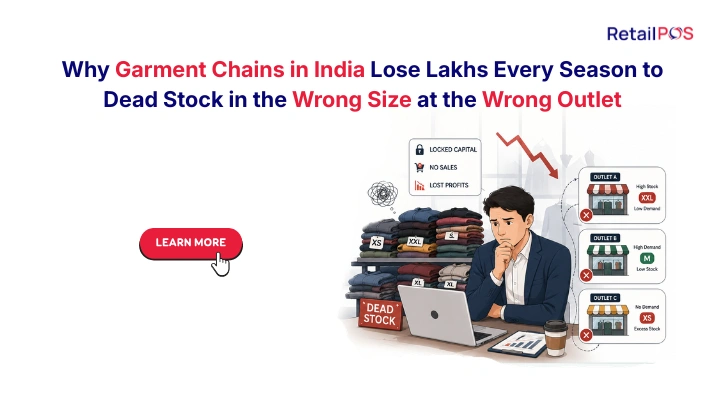
It is October. Diwali is three weeks away. Your garment chain’s five outlets across Chennai are in the middle of the festive season rush. Two of them, your T. Nagar outlet and your Anna Nagar outlet, are selling the ethnic kurta collection faster than anyone expected. Staff are pulling from the storeroom every hour. By the second week of October both outlets have run out of Medium and Large in three of your bestselling styles. Customers are walking in, finding the right design, and leaving empty-handed because their size is not available.
Meanwhile, your Tambaram outlet and your Adyar outlet are a different story. Racks full of the same ethnic kurta collection. Same styles. But the size distribution sitting on those racks is almost entirely Extra Small, Small, and Extra Extra Large. The Medium and Large have long since sold out there too, but the chain bought equal quantities of every size for every outlet, so what remains is the size distribution that was slowest to move.
By the end of November, Diwali is over. The festival buying window has closed. Those Extra Small and Extra Extra Large kurtas at Tambaram and Adyar are now dead stock. They will not sell at full price. They will not sell at 30% discount. They will eventually sell at 50% to 60% markdown in the post-season clearance, recovering perhaps Rs 200 to Rs 250 on a garment that cost Rs 380 to source and was priced at Rs 850.
Every garment chain owner in India has lived this story in some version. The names of the styles change. The cities change. The festival changes. But the outcome is always the same: lakhs of rupees of working capital locked in garment sizes that are in the wrong place at the wrong time, going into clearance at a fraction of their intended margin.
This is not bad luck. This is not an unavoidable consequence of fashion retail. This is a specific, identifiable, and entirely preventable system failure. And this guide explains exactly what is causing it and how to stop it permanently.
Section 2: Why Dead Stock in Garment Chains Is Not Just Unsold Inventory – It Is a Systems Failure
The instinctive response to an end-of-season dead stock problem is to treat it as a merchandising problem. We bought the wrong styles. We misjudged the trend. We ordered too many units. These explanations are sometimes partially true but they almost never tell the complete story.
The more common and more damaging truth is that garment chains accumulate dead stock not because they bought bad merchandise but because they had no system to see where their merchandise was going wrong fast enough to intervene before the selling window closed.
Consider what would have to be true for the Chennai scenario above to have ended differently.
The chain would have needed to know, in real time, that Medium and Large were selling significantly faster than other sizes at T. Nagar and Anna Nagar within the first week of the festival collection launch. It would have needed to see simultaneously that Tambaram and Adyar had excess Medium and Large units sitting in their storerooms from a size distribution that had not yet sold through on the smaller sizes. It would have needed a mechanism to move units from Tambaram and Adyar to T. Nagar and Anna Nagar quickly, cleanly, and with complete documentation.
With this information and this mechanism, what is currently a dead stock crisis becomes a straightforward operational decision. Transfer 30 units of Medium and 25 units of Large from the two overstocked outlets to the two understocked outlets before the second week of October. Every unit transferred sells at full price during the festival window. The remaining Extra Small and Extra Extra Large at Tambaram and Adyar still require a markdown but the volume is significantly smaller because the fast-moving sizes were reallocated.
The difference between these two outcomes is not merchandising skill or buying instincts. It is information and infrastructure. A chain that can see variant-level stock at every outlet in real time and act on what it sees can convert a dead stock crisis into a managed markdown. A chain that cannot see this information until it does a physical stocktake in November is always going to arrive at the crisis too late to prevent it.
Section 3: The Four Root Causes of Wrong-Size Dead Stock in Indian Garment Chains
3.1 Uniform Size Ratio Buying Across Diverse Outlets
The most fundamental buying error in Indian garment chains is applying a single size ratio to all outlets regardless of each outlet’s individual customer demographics.
A garment chain operating in Surat serving a predominantly younger, fashion-forward customer base will have a very different size distribution demand than the same chain’s outlet in a residential area of Delhi serving a broader age demographic. A premium fashion outlet in Bangalore’s Indiranagar serving IT professionals has a different size mix demand than a mid-price outlet in Chennai’s Velachery serving a family-oriented neighbourhood.
When the buying team purchases the Diwali collection with a uniform size ratio, for example 10% XS, 20% S, 30% M, 30% L, 10% XL, across all outlets, they are applying a chain-wide average that probably fits none of the outlets exactly. The XS-heavy outlet ends up with the right style in the wrong sizes. The L-heavy outlet faces stockouts on L while sitting on surplus XS.
The correct approach is outlet-specific size ratios based on historical sales data showing which sizes actually moved at each location in previous comparable periods. This data exists in every garment chain’s transaction records. It is simply never used for buying decisions because there is no system generating a report that shows size-wise sell-through by outlet and by collection type.
3.2 No Slow-Mover Detection Before the Selling Window Closes
In garment retail, the selling window for a collection is typically 6 to 10 weeks. Within that window, the first 3 weeks determine which styles and sizes are going to be fast movers and which are going to be slow. A size or style that has moved less than 20% of its opening stock by the end of Week 3 in a 8-week selling window is almost certainly a candidate for early inter-outlet reallocation or markdown.
The problem is that most Indian garment chains have no visibility into this within the selling window. They discover slow movers when they are doing the end-of-season stocktake, which is after the selling window has closed and the only option remaining is clearance at deeply discounted prices.
A slow-mover report that runs weekly at the variant level, showing which sizes at which outlets have sold below a threshold percentage of their opening stock, gives the chain management the information to act while action is still valuable. Moving slow movers from one outlet where they are clearly not selling to another outlet where the same size has already sold out and is in demand is only possible when this information is available during the selling window, not after it.
3.3 No Real-Time Inter-Outlet Stock Visibility
In most Indian garment chains, finding out what is in stock at another outlet requires a phone call. The phone call takes time. The information provided is based on the manager’s memory or a manual stock count, not a live system figure. The information is often wrong. And the decision about whether to transfer stock is made on unreliable data after a process that should have been a 10-second screen lookup.
The result is that inter-outlet transfers in Indian garment chains happen less often than they should, more slowly than they need to, and with less accuracy than the situation demands. Stock imbalances that would take a day to resolve with the right system take a week or more to even be recognised as a problem.
3.4 Phantom Stock Inflating Apparent Availability
Phantom stock in garment retail occurs when the system shows units as available but the shelf or storeroom is empty. In garment chains, phantom stock accumulates from four specific causes:
- A garment is returned by a customer, placed back in the storeroom without being re-tagged, and sits physically separated from the main stock while the system counts it as available
- A unit is pulled for a display, a photo shoot, or a staff trial without being recorded as a stock movement
- An inter-outlet transfer is initiated and the dispatching outlet’s system is updated but the receiving outlet never records the receipt, leaving the units in transit limbo
- Physical damage or theft reduces actual stock below the system count without any formal adjustment being made
When phantom stock reaches 4 to 8% of total SKUs, which is the range most Indian apparel chains experience without systematic controls, the buying team is making replenishment decisions based on a stock picture that significantly overstates available inventory. They believe they have more Medium and Large than they actually have. They do not rush to transfer from overstocked outlets because the system suggests adequacy that does not physically exist.
Section 4: The Real Rupee Cost of Dead Stock in Indian Garment Retail
Dead stock is not simply the cost of the garments that do not sell at full price. It is a compounding financial cost that affects working capital, storage capacity, markdown margin, and next-season buying power simultaneously.
The direct financial impact of dead stock for a mid-size garment chain:
Dead Stock Scenario | Calculation | Financial Impact |
500 units of unsold festival collection at average cost Rs 380 | 500 units carried to clearance at 50% markdown | Loss of Rs 2,32,500 vs full-price sell-through |
500 units at Rs 850 retail sold at Rs 425 clearance | Revenue Rs 2,12,500 vs potential Rs 4,25,000 | Revenue shortfall of Rs 2,12,500 |
Working capital locked in slow stock for 4 months | Rs 1,90,000 tied up at cost price for 16 additional weeks | Opportunity cost of capital that cannot be reinvested |
Storage cost for excess stock across outlets | Rack space occupied at Rs 2,000 per rack per month | Rs 20,000 to Rs 40,000 in displaced display capacity |
Staff time managing clearance operations | 20 hours across all outlets for relabelling, reorganising, accounting | Rs 8,000 to Rs 15,000 in staff time cost |
The full-season cost for a 5-outlet garment chain:
A 5-outlet garment chain in Chennai or Bangalore running three major collections annually, including summer, festive, and winter, with a dead stock rate of 12 to 18% of total buying value, faces the following annual impact:
Annual Buying Value | Dead Stock Rate | Dead Stock Value | Clearance Recovery at 45% | Annual Dead Stock Loss |
Rs 80 lakh | 15% | Rs 12 lakh | Rs 5.4 lakh | Rs 6.6 lakh |
Rs 1.2 crore | 15% | Rs 18 lakh | Rs 8.1 lakh | Rs 9.9 lakh |
Rs 2 crore | 12% | Rs 24 lakh | Rs 10.8 lakh | Rs 13.2 lakh |
For a garment chain doing Rs 1.2 crore in annual buying, a 15% dead stock rate costs approximately Rs 9.9 lakh every year in margin loss from clearance. This does not include the working capital opportunity cost, the storage displacement cost, or the competitive cost of stock that should have been in the right outlet at the right time generating full-price revenue.
Section 5: The Phantom Stock Problem: When Your System Lies to You About What Is Available
Phantom stock deserves special attention in garment retail because it operates as an invisible amplifier of every other problem. When your system shows 12 units of a Medium kurta available at your Bangalore Whitefield outlet but only 7 units are physically on the rack and in the storeroom, every decision made based on that stock figure is wrong.
The buying team believes Whitefield has adequate Medium coverage and does not prioritise it in the transfer from the Anna Nagar outlet that is showing surplus. The store manager does not flag a Medium shortage because the system shows 12 units. The customer asking for a Medium is told to come back tomorrow because the system says the stock is there. When staff physically look, they cannot find it. The customer leaves.
The four-step process to eliminate phantom stock in garment chains:
- Every garment must have a unique barcode at the size-colour variant level. Not the style level. The variant level. A blue kurta in size M must have a different barcode from the same kurta in size L.
- Every stock movement, sale, return, transfer, display pull, and damage write-off must be recorded through a barcode scan, not through manual entry. Manual entry is the primary source of phantom stock creation.
- Inter-outlet transfers must follow a complete receive-and-confirm workflow. Stock must be scanned out at the dispatching outlet and scanned in at the receiving outlet. Unconfirmed receipts must generate an alert rather than being assumed complete.
- Weekly cycle counts at the variant level must be conducted to catch and correct any discrepancies before they compound. A garment chain that conducts cycle counts only at annual stocktake has allowed 12 months of phantom stock accumulation to create decisions based on fiction.
Section 6: How Inter-Branch Stock Imbalances Create Simultaneous Overstock and Stockout
One of the most financially damaging patterns in Indian garment chains is the simultaneous existence of overstock and stockout for the same variant across different outlets. This pattern is so common that most garment chain owners accept it as normal. It is not normal. It is the predictable result of managing multiple outlets without real-time variant-level stock visibility.
A real scenario from a Surat-based garment chain:
A Surat garment chain with outlets at Varachha Road, Adajan, and Citylight is three weeks into the Navratri season. The Varachha Road outlet has sold out of Traditional Green and Traditional Red garba sets in sizes M and L. Staff are turning away the highest-spending customers of the year. An emergency supplier order has been placed at full price with a 10-day delivery lead time, meaning the stock will arrive after the festival.
The Adajan outlet, serving a more mixed neighbourhood, has 40 units of Traditional Green and 35 units of Traditional Red in M and L sitting in the storeroom. The Adajan manager has not flagged this to anyone because she is busy with her own service. Nobody at head office knows because there is no system showing variant-level stock across all three outlets simultaneously.
The Varachha Road outlet loses 3 weeks of peak festival revenue on its best-selling styles. The Adajan outlet marks down the same stock in November. The chain has effectively lost money on both ends of the same imbalance.
With a centralised variant-level inventory system, this scenario looks completely different. A dashboard alert fires in Week 2 of the Navratri selling window showing that Varachha Road’s M and L Traditional Green inventory has dropped below a configured threshold. The system simultaneously shows that Adajan has 40 units of the same variant in adequate depth. A transfer of 20 units is initiated, documented, and dispatched the same day. Varachha Road has the stock on the rack before the peak of the festival weekend. Both outlets generate full-price revenue.
Section 7: The Problem vs Solution Breakdown
Dead Stock Problem | Root Cause | Technology Solution | Financial Impact |
Wrong size ratio bought for each outlet | No outlet-level historical size sell-through data | Size-wise sell-through reports per outlet per collection | Reduce dead stock from wrong size ratio by 40 to 60% |
Slow movers not identified within selling window | No weekly variant-level slow-mover reporting | Automated slow-mover alerts at configurable sell-through threshold | Enables reallocation before selling window closes |
No inter-outlet stock visibility | Each outlet manages independently with no shared database | Real-time variant-level stock visible at all outlets from one dashboard | Enables proactive transfers instead of reactive emergency orders |
Phantom stock distorting buying decisions | Manual stock movements without barcode enforcement | Barcode-mandatory stock movement recording at every transaction | Reduces phantom stock from 6-8% of SKUs to under 2% |
Inter-outlet transfers delayed or undocumented | No system-driven transfer workflow | Transfer request, dispatch, and receipt workflow within the POS | Transfers completed in hours rather than days with full audit trail |
No clearance price management by outlet | One clearance price for all outlets regardless of remaining depth | Outlet-specific promotional pricing configuration from head office | Optimises clearance recovery by matching markdown depth to stock depth |
Section 8: How Variant-Level Inventory Management Eliminates Dead Stock Accumulation
The solution to the dead stock problem in garment chains is not better buying instincts. It is a retail management system that gives the buying and operations team the information they need to make better decisions at every stage of the collection lifecycle.
Here is what that looks like in practice across the three stages of a garment collection:
Stage 1: Pre-season buying decisions
Before purchasing the next season’s collection, the buying team runs size-wise sell-through reports from the previous comparable collection at every outlet. These reports show, by outlet, exactly which sizes sold fastest, which sold slowest, and what percentage of each size was sold at full price versus clearance.
From this data, outlet-specific buying ratios are generated. The Surat Varachha Road outlet gets a higher allocation of M and L Traditional wear. The Adajan outlet gets a more balanced allocation reflecting its mixed demographic. The Citylight outlet gets a higher allocation of premium styles in specific sizes that its customer profile has historically driven.
This one change, moving from chain-average buying ratios to outlet-specific buying ratios informed by historical data, is the single most impactful action available to any Indian garment chain to reduce dead stock.
Stage 2: In-season monitoring and reallocation
Once the collection is live, weekly slow-mover reports run automatically at the variant level for every outlet. These reports show every size at every outlet that has sold below a configured threshold percentage of its opening stock by Week 3 or Week 4 of the selling window.
Variants flagged as slow movers are assessed against the stock position of the same variant at other outlets. Where a slow mover at one outlet is the same variant that is fast-moving or already stockedout at another outlet, an inter-branch transfer alert is generated. The transfer is reviewed, approved, and initiated within the system.
This process, running continuously throughout the selling window, converts what would otherwise be end-of-season dead stock into in-season reallocations that generate full-price revenue.
Stage 3: End-of-season clearance optimisation
At the end of the selling window, some dead stock is inevitable in any fashion retail business. The question is how much and how it is cleared. With variant-level inventory data, the clearance strategy can be differentiated by outlet based on the depth and composition of remaining stock.
An outlet with 60 units of remaining slow-mover stock in a single size needs a more aggressive markdown than an outlet with 20 units spread across five sizes. An outlet in a high-footfall location can sustain a more gradual markdown strategy than an outlet in a lower-footfall area where a deeper immediate discount drives faster liquidation.
Outlet-specific promotional pricing configured from head office allows this differentiated clearance strategy to be executed consistently without manual price changes at individual counters.
Section 9: How RetailPOS Serves Garment Chains Across India
RetailPOS by Unipro Tech Solutions, headquartered in Chennai, provides enterprise retail POS and ERP software for apparel and garment chains across India. Here is how the specific RetailPOS modules address every dead stock problem described in this guide.
Size-colour variant matrix: Every style is created once as a product master. Size and colour combinations are defined as attributes and the system automatically generates every variant with its unique barcode. A style available in 6 colours and 5 sizes generates 30 individual variant barcodes from one product creation process. Every variant is tracked separately at every outlet with its own stock count updated by every transaction.
Real-time multi-outlet variant inventory: Every sale, return, receipt, and transfer updates the centralised inventory database instantly. Staff at any outlet can look up the size availability of any style at any other outlet in the chain with a single screen query. No phone calls. No manual stock checks. No unreliable information.
Slow-mover reports by outlet and variant: RetailPOS generates weekly slow-mover reports showing every variant at every outlet that has sold below a configured percentage of its opening stock in the current selling period. Reports can be filtered by outlet, by category, by collection, and by price band. Variants flagged as slow movers at one outlet are cross-referenced with stock levels at other outlets to identify reallocation opportunities.
Inter-branch transfer management: Transfer requests are raised within the system by the receiving outlet or by head office. The dispatching outlet receives the request in the system, confirms the dispatch, and the stock is recorded as in transit. The receiving outlet confirms receipt through a barcode scan and the stock immediately appears in the receiving outlet’s inventory. Both outlet counts update automatically. The complete transfer is documented with date, quantity, variant, and authorisation at every stage.
Outlet-specific promotional pricing: Clearance pricing can be configured differently for each outlet based on remaining stock depth and the outlet’s sales velocity. A single configuration action at head office pushes the relevant pricing to the relevant outlets simultaneously. Billing staff at each outlet bill at the configured clearance price automatically without any manual override.
Cockpit dashboard for garment chain owners: The Cockpit dashboard provides a live view of variant-level inventory, slow-mover alerts, pending transfers, and sell-through rates across all outlets simultaneously. A garment chain owner managing outlets in Chennai, Bangalore, and Surat can see the complete collection performance across all three markets from one screen on any device.
Conclusion: Dead Stock Is Not the Cost of Fashion. It Is the Cost of Invisibility.
Every Indian garment chain that ends a season with racks of clearance merchandise and a markdown P&L has made the same fundamental error: they made buying, allocation, and reallocation decisions without the variant-level visibility to make those decisions correctly.
The styles were not always wrong. The locations were not always wrong. The customers were there. The demand existed somewhere in the chain for most of what ended up in clearance. But the chain could not see the demand and the supply simultaneously with enough clarity and enough speed to connect them during the selling window.
Variant-level inventory management does not guarantee that every garment in every collection sells at full price. Fashion retail will always have some residual stock. But the difference between a chain running at 6% dead stock with a structured variant management system and a chain running at 18% dead stock without one is the difference between profitability and a business where the buying team is always chasing its own mistakes.
The tools to eliminate the wrong-size dead stock problem in Indian garment chains are available, proven, and built specifically for the way Indian apparel retail works. The size ratio is not always wrong. The season is not always bad. The answer is usually that the information to make the right decision existed somewhere in the chain’s own data. It just was not visible in time to act on it.
Frequently Asked Questions
RetailPOS supports unlimited variant combinations per product master. A garment available in 8 colours and 6 sizes generates 48 unique variants, all managed from one product record with individual barcodes, individual stock counts at every outlet, and individual sell-through tracking. Chains with 200 styles and 30 variants per style manage 6,000 SKUs across all outlets from the same system without performance degradation.
The slow-mover report in RetailPOS runs on demand or on a configured schedule, typically weekly during active selling periods. The report compares current stock at every outlet for every variant against the opening stock at the start of the collection period and calculates the percentage sold. Variants below a configurable threshold, for example 25% of opening stock by Week 4 of an 8-week selling window, are flagged and sorted by outlet for review by the operations or buying team.
The transition to outlet-specific buying ratios requires three inputs that RetailPOS provides automatically: historical sell-through rates by size at each outlet for comparable previous collections, current stock depth by size at each outlet, and demand trend indicators for the current selling period. The first outlet-specific buying cycle may require manual analysis. By the second comparable collection, the system provides enough outlet-level data history to make the buying ratio calculation straightforward.
RetailPOS migrates your product master, opening stock by variant at each outlet, and customer data as part of the standard implementation process. Historical transaction data from your previous system can be migrated as reference data. The first full collection lifecycle on RetailPOS generates outlet-level variant sell-through data that builds into the buying intelligence for subsequent collections. Most garment chains see meaningful improvement in buying accuracy from their second collection on RetailPOS.
Yes. RetailPOS allows variant attributes to be configured per product category. An ethnic wear collection might use Size, Colour, and Fabric as its variant dimensions. A Western wear collection might use Size, Colour, and Fit as its dimensions. A chain carrying both categories manages them within the same system with category-specific variant configurations that reflect the actual product structure of each segment.
Most garment chains see measurable operational improvement within the first 60 to 90 days of implementation. Variant imbalance between outlets becomes visible and actionable within the first inventory cycle after go-live, typically the first four to six weeks. Festival promotion inconsistencies are eliminated from the first promotion period after go-live because centralised scheduling removes the manual execution variability. Sell-through reporting at the variant level is available from the first full sales period after implementation, giving the buying team data for their next purchase cycle that they have never had access to before. Dead stock reduction is typically visible in the second buying season after implementation as purchase decisions reflect the variant-level sell-through intelligence the system has generated in its first operational season.

 Book your demo
 Talk to our POS experts
- 📧 Email: salesenquiry@uniprotech.co.in
Book a free demo and see how RetailPOS Dineazy gives you complete financial visibility across your restaurant operations..
Or WhatsApp our team directly – we respond within minutes.
Or call us at 95662 44611
About RetailPOS
RetailPOS is an enterprise retail POS and ERP solution by Unipro Tech Solutions Pvt Ltd, headquartered in Chennai, Tamil Nadu. With over 20 years of experience and 10,000 plus businesses served across India and globally, RetailPOS provides purpose-built technology for garment and apparel chains, supermarket chains, electronics retailers, pharmacy chains, and multi-format retail groups. Retail products include RetailPOS Enterprise, Cockpit multi-outlet dashboard, TapZap mobile POS, WeighSense AI, Analytics, and consumer loyalty integration.