
Powered by Unipro Tech
Multi-Location Retail Challenges and How Technology Solves Them
1. Introduction
Every retail chain owner in India knows the feeling. The first store ran smoothly. You knew every product, every supplier, every regular customer, and every staff member personally. Your instinct filled the gaps that your systems left open. The business worked.
Then you opened the second store. Then the third. And somewhere between the second and the fifth, the informal systems that held everything together in one store started showing their limits across multiple locations.
Inventory stopped matching what the system showed. Festival promotions went live at different prices at different stores because the update did not reach every outlet at the same time. GST filing consumed your accounts team for two weeks every month because data from five stores had to be manually collected and combined. You found out that a fast-moving product ran out at your busiest location three days after it happened, not three minutes after.
These are not management failures. They are the predictable consequences of running a multi-location retail chain on systems that were designed for a single store. The problems are not caused by bad people or bad processes. They are caused by a technology architecture that was never built for the operational complexity of a retail chain.
This guide maps the eight most significant multi-location retail management challenges that Indian retail chains face and explains precisely how purpose-built retail chain software solves each one. If you manage two stores or twenty, every challenge in this guide is either something you are experiencing right now or something you will experience at your next growth milestone.
2: The Multi-Location Retail Reality in India
India’s organised retail sector is experiencing one of its most significant expansion phases. Supermarket chains that started in Chennai’s Anna Nagar are opening outlets in Velachery, Tambaram, and Porur. Pharmacy chains that began in Hyderabad’s Banjara Hills have expanded across Madhapur, Kukatpally, and Secunderabad. Apparel chains rooted in Bengaluru’s Jayanagar are scaling into Koramangala, Whitefield, and Indiranagar. Garment chains from T Nagar are spreading across Tamil Nadu and into Kerala and Karnataka.
This expansion is creating enormous commercial opportunity. It is also creating operational complexity that most retail chains are managing with technology infrastructure built for a single store.
The result is a gap between what these chains could achieve operationally and what they are actually achieving. The chains that are closing this gap are doing it through unified retail chain software that connects every location to one central management platform. The chains that have not yet closed this gap are paying for it every month in inventory shrinkage, GST filing overhead, management time consumed by manual reporting, and customer loyalty programmes that do not work across their own stores.
Understanding exactly what this gap costs and how technology closes it is the foundation for making the right retail technology investment for your chain.
3: Challenge One: Inventory Visibility Across All Locations
What the Problem Looks Like
A supermarket chain owner in Bengaluru managing outlets in Koramangala, Whitefield, and Jayanagar wants to know the current stock level of their fastest-moving product across all three locations right now. In a disconnected system environment, answering this question requires calling each store manager, waiting for them to check their local system, and mentally combining three separate numbers. By the time all three numbers arrive, five to ten minutes have passed and the stock positions have already changed.
This scenario plays out hundreds of times every month across every product category in every retail chain operating without centralised inventory management. The cumulative operational cost of this visibility gap is significant.
How It Shows Up in the Business
The inventory visibility problem manifests in five specific ways that each have a direct financial cost:
- Stockouts at one location while the same product sits in excess at another location nearby
- Over-purchasing by the central buying team because they cannot see the total chain-wide stock position in real time
- Inventory inaccuracy that grows over time because stock movements, transfers, and adjustments are not systematically recorded
- Shrinkage that accumulates without detection because the system only tracks inventory at the billing counter rather than at every movement point
- Slow-moving stock that is not identified until it has been sitting for months because there is no automated slow-stock alert system
How Technology Solves It
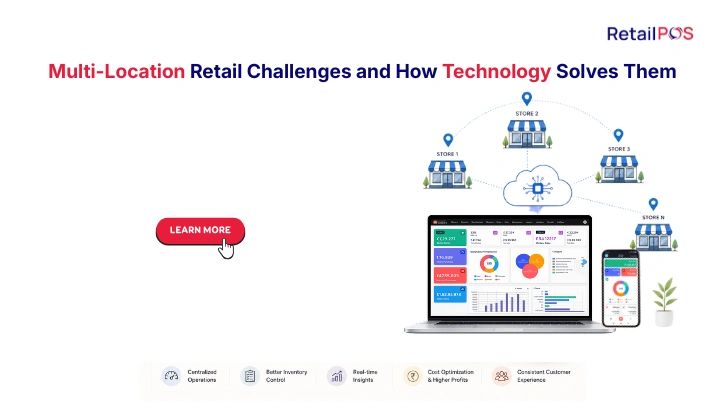
Purpose-built retail chain management software maintains a single centralised inventory database that every outlet writes to in real time. When the Koramangala outlet sells 10 units of a product, the central inventory reduces by 10 immediately. When the Whitefield outlet receives 100 units from the warehouse, the central inventory increases by 100 and creates an accounting entry simultaneously.
The chain owner sees the current stock position at every outlet from one screen at any moment without calling anyone. When stock at any outlet drops below the configured reorder level, the system generates an automatic purchase alert. When one outlet has excess and another is running low, the system suggests a transfer. When actual stock consumption consistently exceeds the theoretical consumption based on sales, the system flags the variance as a potential shrinkage issue.
Inventory Management | Disconnected Systems | Unified Retail Chain Software |
Stock visibility | One outlet at a time with manual calls | All outlets simultaneously in real time |
Reorder management | Manual weekly stock counts | Automatic alerts from real-time data |
Inter-outlet transfers | Phone calls and manual entries | Digital transfer requests with document trail |
Shrinkage detection | Monthly physical count variance | Daily actual vs theoretical consumption tracking |
Purchase planning | Based on estimates and experience | Based on real-time outlet-level velocity data |
4: Challenge Two: Consistent Pricing and Promotions Across Stores
What the Problem Looks Like
A garment chain with six outlets across Chennai decides to run a Pongal sale with 20% discount on all ethnic wear starting from January 13th at midnight. The head office sends a WhatsApp message to all six store managers instructing them to update the prices in their local POS systems before the sale begins. Three stores update correctly. Two stores apply the discount only to some products because of a misunderstanding in the message. One store does not update until the following morning because the manager missed the message.
On January 14th, a customer visits the Anna Nagar outlet and pays a discounted price. She then visits the Tambaram outlet the same day and is quoted a different price for the same item. She leaves without buying and posts about the experience online.
How It Shows Up in the Business
Pricing inconsistency across locations creates four specific problems:
- Customer trust damage when the same item carries different prices at different outlets of the same chain
- Margin loss when incorrect discounts are applied due to manual update errors
- Staff confusion when the pricing in their system does not match what customers expect based on a promotion they saw online or heard about from another outlet
- No promotion performance measurement because the system cannot link specific price periods to specific transaction data across all outlets
How Technology Solves It
Centralised pricing management in retail chain software means that every price and every promotion is configured once at head office and pushed to all outlets simultaneously through the system. No WhatsApp messages. No store manager updates. No risk of one outlet having the wrong price while another has the right one.
Festival promotions for Pongal, Diwali, Ugadi, Onam, and Eid are scheduled centrally with a precise start time and end time. At the configured start time, the promotion activates automatically at every outlet in the chain simultaneously. At the configured end time, standard pricing restores automatically. The store manager does not need to do anything. The customer gets the same price regardless of which outlet they visit.
Outlet-level pricing overrides are available for specific situations, such as a clearance promotion at one outlet for slow-moving local stock, without affecting pricing at any other outlet in the chain.
5: Challenge Three: GST Compliance Across Multiple Outlets
What the Problem Looks Like
It is the 9th of the month. The GST filing deadline is the 11th. Your accounts team has been collecting billing export files from each of your five outlets since the 1st. One outlet’s system export is in a different format from the others because that outlet is running a different version of the billing software. The data must be manually reformatted before it can be combined. The combined dataset has discrepancies that need tracing. The GSTR-1 categorisation into B2B, B2C large, B2C small, and credit note tables must be done manually for 40,000 combined transactions. Two days of accounts team time disappear before the return data is ready.
This scenario repeats every month. For chains with outlets across multiple states, it repeats separately for each state GSTIN.
How It Shows Up in the Business
The multi-location GST challenge creates four compounding problems:
- Direct labour cost of 8 to 20 person-days per month spent on manual GST preparation across all outlets
- Error risk that increases with every manual data transfer step between outlet exports and final return data
- Compliance exposure when errors reach the portal and create mismatches that attract scrutiny notices
- Management capacity consumed in compliance management rather than business growth activities
How Technology Solves It
Unified retail chain software maintains all outlet billing data in one central database from the moment of transaction. Every sale at every outlet is automatically categorised into the correct GST return table at the time of billing. HSN codes are mapped at the product master level so the correct tax rate applies automatically without operator selection.
At any point during the month, the accounts team can open the GST reporting module and see a complete GSTR-1 dataset covering all outlets, categorised correctly into every required table, with GSTIN-wise B2B details and B2C summaries already populated. The accounts team reviews and approves. They do not build from scratch.
For chains operating across multiple states with separate GSTINs, the system routes each outlet’s transactions to the correct state registration automatically and generates separate return data per GSTIN without any manual data separation.
GST Compliance Task | Manual Multi-Location Process | Automated Retail Chain Software |
Data collection from outlets | 1 to 2 days of manual export and transfer | Instant, already in central system |
Transaction categorisation | 2 to 3 days of manual sorting | Automatic at point of transaction |
GSTR-1 table preparation | 1 to 2 days of manual building | Generated automatically on demand |
GSTR-3B summary | Half day of manual calculation | Auto-calculated from same data |
Multi-GSTIN separation | Additional 2 to 3 days per extra state | Automatic routing per registration |
Total monthly effort | 8 to 20 person-days | 2 to 4 hours of review |
6. Challenge Four: Consolidated Reporting Without Manual Effort
nagement report, which the owner needs to understand outlet-level profitability, category performance, inventory turnover, and customer metrics, takes three days to prepare manually from five sets of billing data, purchase records, and inventory counts. By the time it is ready, it is already the 4th of the new month and reflects a business reality that is five days old.
How It Shows Up in the Business
The consolidated reporting problem creates three specific management costs:
- Decisions made on stale data that do not reflect current operational reality
- Management time consumed in report compilation rather than strategic analysis and action
- Operational problems that run for days before appearing in manually compiled reports
How Technology Solves It
Unified retail chain software maintains all outlet data in one central database updated in real time. The management dashboard shows consolidated performance across all outlets simultaneously without any manual compilation. Revenue by outlet, gross margin by category, inventory position, staff productivity, and GST compliance status are all visible from one screen updated after every transaction.
The owner who previously spent 45 minutes combining five WhatsApp reports now opens a single mobile dashboard during their morning commute and sees the complete picture of all five outlets’ performance in two minutes.
Specific reports that transform from manual to automatic include:
- Daily revenue consolidated across all outlets with outlet-wise comparison and trend
- Gross margin by product category across all outlets compared to chain average
- Inventory movement report showing every stock entry, exit, and transfer across all outlets
- Staff productivity report comparing cashier performance and labour cost across every outlet
- Customer loyalty report showing acquisition, retention, and campaign performance across the chain
- GST compliance summary with return status and liability position across all registrations
7: Challenge Five: Customer Loyalty That Works Across Every Location
What the Problem Looks Like
A customer in Chennai has been shopping at a supermarket chain’s Anna Nagar outlet twice a week for eight months. She has accumulated significant loyalty points through the outlet’s stamp card programme. She moves to a new apartment near the chain’s Velachery outlet and visits it for the first time expecting to use her accumulated points. The Velachery outlet has no record of her. Her points exist only at Anna Nagar. She leaves with her purchase but without the loyalty experience she expected. She does not come back.
This scenario plays out every day across Indian retail chains that have outlet-specific loyalty programmes instead of chain-wide ones. The customer who drives the most revenue is the one most hurt by the failure of a loyalty system that does not recognise them at every outlet in the chain.
How It Shows Up in the Business
The per-outlet loyalty problem creates three measurable impacts:
- Customer disappointment and attrition when loyal customers cannot use their accumulated points at other outlets in the chain
- No chain-wide customer intelligence because customer profiles are fragmented across outlet-specific databases
- Marketing campaigns that cannot be targeted intelligently because there is no unified view of customer behaviour across all outlets
How Technology Solves It
Retail chain management software maintains a unified customer identity across the entire chain. A customer enrolled at Anna Nagar has a profile that is accessible at Velachery, Tambaram, Adyar, and every other outlet in the chain. Points earned at any outlet are added to one central balance. Points redeemed at any outlet reduce from the same central balance.
The chain-wide CRM allows the marketing team to run campaigns based on behaviour across the entire chain rather than at individual outlets. A customer whose last visit to any outlet in the chain was more than 21 days ago triggers a re-engagement campaign regardless of which outlet they normally visit. A customer who consistently visits one outlet but lives closer to another receives a personalised communication about the closer outlet.
Birthday and anniversary campaigns, new arrival notifications, and loyalty milestone rewards all operate from a unified customer database that reflects every interaction the customer has had with any outlet in the chain.
8: Challenge Six: Staff Accountability Without Physical Presence
What the Problem Looks Like
A retail chain owner in Bengaluru managing outlets in Koramangala, Whitefield, and Indiranagar can physically visit each outlet approximately twice a week at most. The staff at each outlet know this. In one outlet, a cashier has been consistently applying small unauthorised discounts that individually appear minor but collectively represent a meaningful margin leak. In another outlet, the afternoon shift consistently shows lower transaction volumes than the morning shift for the same footfall, suggesting that some transactions are not being billed correctly. Neither pattern is visible to the owner without a system that tracks transaction data at the cashier and shift level.
How It Shows Up in the Business
Staff accountability gaps in multi-location retail create four problems:
- Unauthorised discounting that erodes margin across outlets where the owner is not physically present
- Cash handling discrepancies that are discovered at month-end rather than daily
- Productivity variations across outlets and shifts that go unmanaged because they are invisible
- Inventory mishandling that contributes to shrinkage but cannot be attributed to specific staff actions
How Technology Solves It
Enterprise retail chain management software tracks every transaction against a specific cashier identity with full attribution of amounts, discounts, voids, and modifications. The management dashboard shows each cashier’s daily transaction count, total revenue, average transaction value, and discount percentage compared to the chain average.
When a cashier’s discount percentage is significantly above the chain average without a management authorisation, the system flags it automatically. When a shift’s transaction volume is inconsistent with the footfall data for that period, the system highlights the variance for investigation.
Cash reconciliation is automated at end-of-shift with the system calculating the expected cash balance against the actual counted balance and flagging variances above the configured threshold immediately rather than waiting for end-of-day reports.
9. Challenge Seven: Purchase Management Without Real-Time Sales Data
What the Problem Looks Like
A textile chain in Mumbai has a buying team that places orders for the Diwali season based on last year’s performance data, the team’s experience, and supplier recommendations. They purchase 200 units of a specific style in the full size range. When the season arrives, XL and XXL sizes sell out within the first week across all outlets while S and M sizes remain in excess. The buying team does not know the XL stockout is happening at multiple outlets simultaneously until store managers begin calling to request more stock. By that point, the supplier’s lead time means the restocking arrives after peak selling has passed.
How It Shows Up in the Business
Disconnected purchase management creates three compounding costs:
- Stockouts on fast-moving variants during peak selling periods that directly cost revenue
- Over-stock on slow-moving variants that locks working capital for the full season
- Reactive purchasing at retail prices when stockouts require emergency procurement outside normal supplier terms
How Technology Solves It
Retail chain management software connects purchase management directly to real-time sales velocity data at the variant and outlet level. When any product or variant drops below its configured reorder level at any outlet, an automatic purchase alert is triggered for the central buying team. Purchase orders can be generated automatically with quantities calculated from current stock positions, average daily sales velocity, and supplier lead time.
For textile and garment chains, variant-level purchase planning shows the buying team exactly which sizes and colours are selling fastest at which outlets, allowing purchase orders to be built from data rather than experience. The same intelligence that drives reorder decisions also informs buying decisions for new seasons by showing which variants delivered the best sell-through rates in previous periods.
10. Challenge Eight: Scaling to New Locations Without System Replacement
What the Problem Looks Like
A supermarket chain in Chennai that started with a single-outlet POS system has grown to eight outlets over four years. The system that was perfect for one store has been stretched to handle eight through a combination of workarounds, manual processes, and supplementary spreadsheets. Every outlet runs a slightly different version of the same software because updates were applied inconsistently. The consolidation reports require manual intervention to reconcile differences between outlet data formats.
The owner is now planning to open two more outlets in Coimbatore and one in Bengaluru. Adding these outlets to the existing system is a significant technical challenge and the new Bengaluru outlet will require a separate Karnataka GSTIN that the current system cannot handle alongside the existing Tamil Nadu registration.
How It Shows Up in the Business
The scalability gap creates three specific risks for growing retail chains:
- System migration costs and operational disruption when the chain outgrows its current platform mid-expansion
- Compliance exposure when multi-state expansion requires GST capabilities the current system does not support
- Management complexity when each new outlet adds to rather than integrates with the existing operational infrastructure
How Technology Solves It
Enterprise retail chain management software is designed for the chain at its current scale and at three times its current scale on the same architecture. Adding a new outlet in Coimbatore or Bengaluru is a configuration task within the existing system, not a technology project. The new outlet is set up with its address, GSTIN, hardware configuration, and role-based access settings in the central management interface and is connected to the chain’s inventory, pricing, loyalty, and reporting infrastructure from day one.
New state GSTINs are added as registrations within the same compliance management module. Karnataka returns are generated automatically from the Bengaluru outlet’s billing data alongside the Tamil Nadu returns from all other outlets without any additional manual work for the accounts team.
11. The Technology That Solves All Eight Challenges From One Platform
The eight challenges described in this guide are not eight separate problems requiring eight separate technology solutions. They are eight symptoms of one underlying architecture problem: running a multi-location retail chain on systems that were designed for a single store.
The solution is also singular. A unified retail chain management platform that connects every outlet to one central backend, maintains all data in one database, and provides one management interface for every operational function across the entire chain simultaneously.
Here is how a unified platform addresses all eight challenges:
Challenge | Root Cause | Platform Solution |
Inventory blindness | Local data trapped at each outlet | Single central inventory database updated in real time |
Pricing inconsistency | Manual updates at each outlet independently | Centralised pricing pushed simultaneously to all outlets |
GST filing burden | Manual data collection from disconnected systems | All outlet data in one system, returns auto-prepared |
Manual reporting | No consolidated data source | Real-time dashboard from single central database |
Loyalty fragmentation | Per-outlet customer databases | Unified customer identity across entire chain |
Staff accountability gaps | No cross-outlet performance visibility | Cashier-level tracking visible at chain management level |
Reactive purchasing | No real-time sales data for buying decisions | Purchase management linked to real-time outlet velocity |
Scalability limits | Architecture designed for one store | Cloud-based multi-outlet architecture from the ground up |
12. What RetailPOS Delivers for Multi-Location Retail Chains
RetailPOS is purpose-built for Indian retail chains managing multiple locations. The platform has been serving multi-outlet retail businesses across supermarkets, apparel, pharmacy, electronics, and food businesses for over 20 years and is trusted by retail chains across Tamil Nadu, Karnataka, Kerala, Andhra Pradesh, Telangana, Maharashtra, and beyond.
For retail chain owners managing the eight challenges described in this guide, RetailPOS delivers:
Inventory Management
- Real-time stock visibility across all outlets from one centralised dashboard
- Automated reorder alerts based on outlet-specific sales velocity
- Digital inter-outlet transfer management with approval workflow and document trail
- Actual versus theoretical consumption tracking for shrinkage detection
Pricing and Promotion Management
- Centralised pricing with instant simultaneous push to all outlets
- Festival promotion scheduling with automatic activation and deactivation
- Outlet-level promotional override for local clearance without affecting chain pricing
- Promotion performance reporting linking campaign periods to sales uplift data
GST Compliance
- Complete HSN master with automatic rate mapping across all product categories
- E-invoicing with direct IRP integration for automatic IRN generation at qualifying outlets
- Automated GSTR-1 and GSTR-3B preparation from all outlet billing data
- Multi-GSTIN support for chains operating across multiple Indian states
Consolidated Reporting
- Real-time management dashboard with all outlet data on one screen
- Revenue, margin, inventory, staff, and compliance reporting from one platform
- Drill-down from consolidated totals to individual outlet and transaction level
- Mobile dashboard for owner visibility from any device at any location
Customer Loyalty and CRM
- Chain-wide loyalty with unified point balance across all outlets
- WhatsApp and SMS campaign management with behaviour-based segmentation
- Churn detection and automated re-engagement for at-risk customers
- Birthday, anniversary, and milestone campaign automation
Staff Management
- Cashier-level transaction tracking with discount pattern monitoring
- Shift performance comparison across all outlets
- Automated cash reconciliation with variance flagging
- Labour cost as percentage of revenue tracked daily per outlet
Purchase Management
- Variant-level reorder alerts linked to real-time sales velocity
- Automated purchase order generation with outlet-specific delivery routing
- Supplier price variance tracking against contracted rates
- Sell-through reporting for buying team decision support
Scalability
- New outlet addition as configuration task not technology project
- Multi-state GSTIN management from single platform
- Architecture designed for 2 to 200 plus outlets on same infrastructure
- No system replacement required at any growth milestone
Explore the complete RetailPOS platform for your specific retail chain category by visiting our multi-store retail management page or reading our detailed point of sale systems buying guide for Indian retail chains. You can also read our guide on how retail chains cut monthly reporting from 3 days to 3 hours for a detailed look at the reporting transformation the platform delivers.
13. Conclusion
The eight challenges described in this guide are not unique to any specific retail category, city, or chain size. They are the universal operational consequences of managing a multi-location retail chain on technology infrastructure designed for a single store. Every retail chain owner in India who has scaled beyond two outlets has experienced at least four of them. Most have experienced all eight.
The good news is that every one of these challenges has a clear technology solution that is available today at pricing and implementation timelines accessible to retail chains of all sizes. The transition from disconnected single-store systems to unified retail chain management software is the single most impactful operational change a multi-location retail chain can make for its profitability, compliance accuracy, and management effectiveness.
The retail chains that are growing profitably across India’s major cities are not doing so through harder work or larger teams. They are doing so through systems that make the operational complexity of multi-location management visible, automated, and manageable from one platform.
If any of the eight challenges in this guide describe your retail chain’s current experience, the technology to solve them is available and ready to demonstrate for your specific operation.
Book a free demo with the RetailPOS team and see exactly how the platform addresses your specific multi-location retail challenges in a live demonstration built around your actual outlet structure and product categories.
14. Frequently Asked Questions
Multi-location retail management software is a unified platform that connects every outlet in a retail chain to one central backend system, giving head office real-time visibility into inventory, sales, compliance, and staff performance across all locations simultaneously. Indian retail chains need it because the disconnected single-store systems that most chains start with cannot provide the cross-outlet inventory visibility, centralised pricing control, automated GST compliance, and consolidated reporting that multi-location operations require. Every challenge described in this guide from inventory blindness to pricing inconsistency to manual GST filing is a direct consequence of operating a multi-location chain on single-store technology architecture.
Two locations. The moment a retail chain opens a second outlet, it needs centralised inventory visibility, consistent pricing across both outlets, unified customer loyalty, and consolidated compliance management. Investing in unified retail chain management software before opening the second outlet avoids the operational problems and migration costs that come from building multi-location operations on single-store systems. Retail chains that are already managing three or more outlets on disconnected systems typically find that the investment in unified management software pays back within six to twelve months through inventory shrinkage reduction and GST compliance labour savings alone.
Retail chain management software with multi-GSTIN support routes each outlet's transactions to the correct state registration automatically based on the outlet's configuration. A retail chain with outlets in Tamil Nadu, Karnataka, and Telangana receives separate GSTR-1 and GSTR-3B data for each state registration automatically from the central billing data without any manual data separation. Interstate stock transfers between state warehouses generate the correct documentation automatically. E-invoicing requirements are applied at the outlet level per GSTIN independently. The accounts team reviews automated return data for each state rather than manually building it from disconnected outlet exports.
The most important feature to verify is real-time centralised inventory management that updates stock across all outlets simultaneously after every transaction. Inventory accuracy is the foundation that makes every other management capability more valuable. A system that gets inventory right in real time across all outlets enables accurate purchase planning, correct transfer decisions, reliable management reporting, and meaningful food or product cost analysis. Ask every vendor to demonstrate real-time stock updates across two simulated outlets in a live demonstration before evaluating any other feature.
For an existing retail chain with five to eight locations, a typical implementation runs six to ten weeks from contract signing to full chain go-live. The timeline includes two to three weeks of data preparation including product master standardisation and HSN code mapping, one week of system configuration and GSTIN setup, two to three weeks of pilot location parallel running to validate data accuracy, and two to three weeks of phased rollout to remaining outlets with staff training at each location. The most important factor in implementation speed is the quality of product master data preparation before configuration begins. Chains that invest in data cleaning before the implementation process starts consistently achieve faster and more accurate go-lives.
Adding a new location in a new city or state to RetailPOS is a configuration exercise within the existing platform. The new outlet is set up with its address, GSTIN if required, hardware configuration, product catalogue assignment, and role-based access settings from the central management interface. If the new location is in a new state requiring a separate GSTIN, the new registration is added to the compliance management module and the new outlet's transactions are automatically routed to the correct state compliance record from the first transaction. The chain's existing inventory, pricing, loyalty, and reporting infrastructure extends to the new location immediately without any architectural change to the system or disruption to existing outlet operations.

 Book your demo
 Talk to our POS experts
- 📧 Email: salesenquiry@uniprotech.co.in
Book a free demo and see how RetailPOS Dineazy gives you complete financial visibility across your restaurant operations..
Or WhatsApp our team directly – we respond within minutes.
Or call us at 95662 44611