
Powered by Unipro Tech
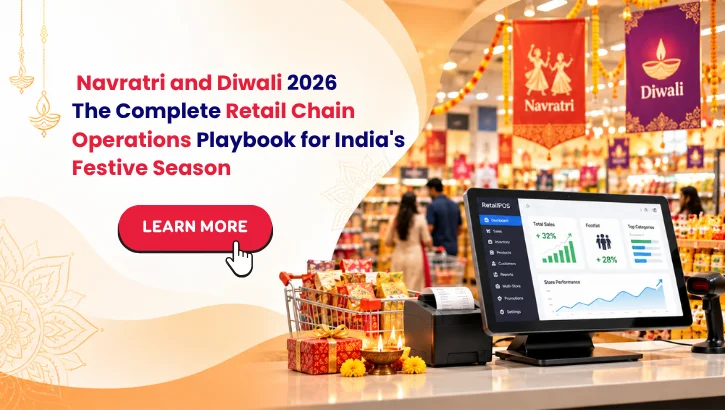
Navratri and Diwali 2026: The Complete Retail Chain Operations Playbook for India's Festive Season
A complete operations guide for retail chain owners managing the six weeks from Navratri to post-Diwali in India’s most important trading period of the year
Today Is Day One
Navratri begins today. October 1, 2026.
For Indian retail chains across every category from apparel and jewellery to supermarkets and electronics, today marks the beginning of the six weeks that will define the financial year. The festive season from Navratri through Dussehra through Diwali through the post-Diwali gifting period generates 25 to 40 percent of most Indian retail chains’ annual revenue in a window of approximately 40 trading days.
Every preparation decision that needed to be made before this moment has already been made. The stock is bought or it is not. The promotions are configured or they are not. The staff are trained or they are not.
What matters now is execution. How well your chain manages the operational realities of the next six weeks will determine how much of the festive season revenue opportunity your business actually captures.
This guide is an operations playbook for the next six weeks specifically. Not strategy. Not preparation advice. Specific, actionable guidance for managing your retail chain through India’s busiest trading period with the operational clarity and speed that the festive season demands.
Section 1: Week One — Navratri Opening Days: What to Watch and What to Act On Immediately
The first three days of any festive season reveal what the next six weeks will look like if you know what to look for. The data your billing system generates in the first three trading days of Navratri is the most valuable operational intelligence available for the rest of the season.
What to monitor in the first three days:
Which products are selling faster than expected. If a specific ethnic wear style, a particular gift item, or a category of festive food is selling at double the rate you planned, you have approximately three days before that stock begins to run critically low. The action is immediate: check your stock position across every outlet, identify any outlets with surplus of the same product, initiate inter-outlet transfers before the first stockout occurs, and place an emergency reorder with your supplier if total chain stock across all outlets is below two weeks of current demand.
Which outlets are outperforming and which are underperforming. By day three of the festive season, clear performance patterns emerge across the chain. An outlet that is running 35% above its weekday average on day one is likely to continue running hot. An outlet that is running only 5% above its weekday average on the same day may have a staff, stock, or promotion issue that needs investigation. The Cockpit dashboard showing all outlets’ live sales simultaneously makes this comparison immediate rather than requiring end-of-day calls to individual managers.
Whether your promotions are active and correctly configured at every outlet. The Navratri promotion should have activated at every outlet simultaneously this morning. Verify within the first hour of trading that the correct promotional price or discount is appearing at every counter at every outlet. A promotion that is live at four outlets and missing at one outlet creates a customer experience inconsistency that the affected outlet’s customers will notice and comment on.
Whether your staff are executing at peak service standards. The first Saturday of Navratri is typically one of the highest footfall days of the entire six-week period. If there are checkout queues that are longer than acceptable, if specific counters are slower than others, or if customer complaints are arriving within the first day, address them before day four when weekend trading is expected to be even stronger.
Section 2: Managing Stock Across Multiple Outlets in Real Time During Peak Demand
Festive season stock management is fundamentally different from normal trading period stock management in one critical way: the velocity of demand is 2 to 5 times higher than normal, which means the same stock management processes that are adequate during regular trading are too slow during the festive peak.
A product that sells through its minimum stock level in a normal week might sell through that same minimum in a single day during Navratri week. A stock position that seems adequate at 9 AM on a Saturday morning may be dangerously low by 4 PM of the same day.
The festive season stock management protocols that work:
Morning stock checks at every outlet, every day. Every outlet manager or shift supervisor should open the stock dashboard at the start of every trading day during the festive season and identify any product that has fallen below 30% of its opening season stock level. At 30% remaining stock on a fast-selling festive item, a reorder or inter-outlet transfer is urgent, not pending.
Daily inter-outlet stock rebalancing. During the festive season, inter-outlet transfers should happen every day rather than only when a stockout is imminent. A transfer that moves 20 units of a fast-selling variant from an outlet with 65 units to an outlet with 15 units maintains availability across the chain without waiting for a stockout alert. The outlet with 65 units still has more than adequate depth and the outlet with 15 units now has breathing room for another day of strong trading.
Emergency supplier contact protocol. Before the festive season began, you should have identified which of your suppliers can fulfil emergency orders within 24 to 48 hours and at what cost. If a bestselling product is going to stock out across the chain before the end of Navratri week, the decision to place an emergency order needs to happen on day three or four, not day seven when the stockout has already cost three days of peak revenue.
The stock categories that need different management during the festive season:
Category | Normal Management | Festive Season Management |
Core bestsellers | Weekly reorder based on velocity | Daily monitoring, reorder trigger at 30% remaining |
Festive collection items | Standard minimum stock alert | Three-day forward demand assessment, proactive transfer |
Perishables and food | Daily rotation, near-expiry alert | Twice-daily rotation check, more frequent smaller orders |
Gift items and packaging | Moderate safety stock | Deep safety stock, emergency supplier list maintained |
Clearance and last-season stock | As-available management | Active markdown to free cash for core bestsellers |
Section 3: Promotion Management During the Festive Season: What Goes Wrong and How to Prevent It
Promotional management during the festive season is where the most revenue is generated and where the most operational errors occur. Understanding the specific ways promotion management fails during peak trading helps retail chain managers prevent the most common and most costly errors.
Error 1: Promotions that did not activate at all outlets simultaneously.
If your Navratri promotion activated this morning, verify right now that it is live at every counter at every outlet. Call or message each outlet manager and ask them to process one transaction with a qualifying product and confirm the promotional price is appearing. This verification takes 10 minutes and prevents a situation where customers at one outlet are receiving the correct promotional price while customers at another outlet are paying full price without any staff awareness of the problem.
Error 2: Expired promotions that continue running.
A Navratri-specific promotion that should expire at the end of Navratri on October 11 must be set to expire automatically rather than requiring a manual deactivation at each outlet. If the promotion requires manual deactivation and your outlet managers are occupied with festive trading volume, expired promotions will continue running for days after their intended end date, giving away margin that is not planned or budgeted.
Error 3: Promotional mechanics that billing staff cannot explain.
When a customer asks “how does this offer work?”, every billing counter staff member at every outlet should be able to explain it accurately and confidently in one sentence. If the promotional mechanics are complex enough that staff cannot explain them, configure a simplified version that achieves the same revenue objective with a mechanism that every staff member can communicate clearly.
Error 4: Promotions that do not apply automatically.
Any promotion that requires the billing operator to manually select it, remember to apply it, or calculate it increases the error rate proportionally to the speed of the service. During peak festive trading when a billing counter is processing a new transaction every two minutes, manual promotion application is a source of errors and customer disputes. Every promotion should apply automatically when the qualifying product or basket value is reached.
The promotion calendar for the remainder of the festive season:
Period | Dates | Promotion Type | Configuration Status to Verify |
Navratri | October 1 to 11 | Ethnic wear and festive collection discount | Live and verified today |
Dussehra | October 12 | Single-day peak offer | Pre-configured and ready to activate |
Pre-Diwali | October 13 to 19 | Volume purchase incentive | Pre-configured for auto-activation |
Dhanteras | October 20 | Gold and electronics specific offers | Pre-configured and verified |
Diwali | October 21 | Peak festive discount | Highest promotional intensity |
Post-Diwali | October 22 to 31 | Gifting season continuation | Moderate promotion continuation |
November clearance | November 1 onwards | Progressive markdown on festive stock | Ready to configure based on remaining stock |
Section 4: Staff Management During Peak Trading: The Protocols That Matter Most
The festive season is the period when staff performance variability has the highest financial impact. A highly effective billing counter team during Navratri week processes more customers per hour, upsells more effectively, and makes fewer errors than the same counter would under the management of a less effective team. During the six weeks of the festive season, this performance difference translates into tens of lakhs of rupees of revenue difference across a chain.
The staff protocols that have the highest impact during festive trading:
Peak hour counter staffing levels. Every outlet manager should have a staffing schedule for the festive season that deploys maximum counter staff during the specific hours when footfall peaks. Saturday afternoons and evenings during Navratri week are historically the highest footfall periods of the entire season. These periods should have every available billing counter staffed and every trained staff member who can operate a counter doing so.
Clear escalation protocol for any system issue. During peak trading, any POS system issue that stops a counter from billing has immediate and compounding consequences. Every outlet must have a designated contact at head office or with the POS vendor who can be reached immediately if any technical issue arises. The escalation path should be known to every outlet manager before today’s trading begins, not discovered at 4 PM on the first Saturday of Navratri when a counter goes down.
Pre-briefing before every shift during peak weeks. A five-minute briefing before every shift during the festive season keeps all staff aligned on the current promotional mechanics, any stock alerts for that outlet, any customer service standards reminders, and any specific targets for the shift. Five minutes of briefing time per shift prevents hours of confusion and inconsistency during the actual trading period.
Recognition during the season, not only after it. Staff members who perform exceptionally during the festive season should receive acknowledgment during the season, not only in a year-end review. A manager who notices that a specific billing counter staff member has processed 40 more customers than their colleagues in a four-hour peak shift and acknowledges this specifically and promptly is building the performance culture that sustains excellence through six weeks of demanding trading.
Section 5: Customer Loyalty Activation During the Festive Season
The festive season is the highest-impact period for customer loyalty activation in Indian retail because customers are in an active buying mindset, are making significant purchasing decisions, and are responsive to recognition and reward from stores they have a relationship with.
The loyalty actions that generate the most festive season revenue:
WhatsApp communication to loyalty members before every major festive peak.
Your top 1,000 loyalty customers by spend should receive a personal WhatsApp message before each major festive event. Before Navratri, this message should be about the festive collection and a specific early-access benefit. Before Dhanteras, it should reference jewellery and electronics-specific offers for loyalty members. Before Diwali, it should be a personalised recognition of their loyalty with a specific Diwali benefit. These messages should feel personal, not like mass communications. They should reference the customer’s loyalty tier or their relationship history with the store where possible.
Double points activation during specific high-value periods.
A double-points period during the first three days of Navratri incentivises loyalty members to prioritise your store for their festive shopping early in the season rather than distributing their spending across multiple retailers. This is most effective as a time-limited benefit with a specific expiry because the limitation creates urgency.
Advance notification of high-demand items going to loyalty members.
If you have a specific festive collection item that is likely to sell out quickly, loyalty members who received advance notification before general customers feel valued and are more likely to visit specifically for that item. This converts the stock scarcity situation from a customer disappointment into a loyalty programme benefit.
Section 6: Real-Time Performance Management Across the Chain
The festive season is when the Cockpit dashboard earns its keep for any multi-outlet retail chain. Managing a five or ten-outlet chain through six weeks of peak trading by calling individual managers is not a management system. It is a coordination system that consistently provides information that is hours behind reality.
What real-time chain management looks like during the festive season:
Morning dashboard review before stores open. Every morning of the festive season, the chain owner or operations manager reviews the Cockpit dashboard showing yesterday’s performance across every outlet. Which outlets outperformed their targets? Which underperformed? What are the current stock alert positions across the chain? Which promotions are active and confirmed at every outlet? This morning review, taking 10 to 15 minutes, sets the operational agenda for the day before the first customer walks in.
Intraday alerts for any stockout or system issue. The Cockpit dashboard must be configured to send immediate alerts for any product falling below its minimum threshold at any outlet, any promotion configuration error at any outlet, and any counter performance significantly below the outlet’s hourly average. These intraday alerts convert the dashboard from a passive reporting tool into an active operational management system.
Evening performance review against daily targets. Each evening of the festive season, a brief review of the day’s performance against each outlet’s daily target identifies the patterns that need management attention the following day. An outlet that has achieved 75% of its daily target by 6 PM will need additional promotional activity or footfall generation the following day. An outlet that has exceeded its daily target by 3 PM has an opportunity to pull forward additional stock from another outlet to ensure it can sustain peak demand through the evening.
Section 7: The Mid-Season Stock Assessment: What to Do in Week Three
By week three of the festive season, the trading data provides a clear picture of which products have performed above expectations, which have performed below, and what the likely end-of-season stock position will be for every product at every outlet if current velocity continues.
The mid-season stock assessment framework:
Products running ahead of plan. Calculate the number of days of remaining stock at current sales velocity. Products with less than 10 days of remaining stock at current velocity that have 20 or more days of active selling window remaining need an immediate emergency reorder. Delay by even two days may mean stockout during the Diwali week peak.
Products running behind plan. Calculate what the likely remaining stock will be at the end of the festive season if current velocity continues. Products that will have more than 30% of their festive buying quantity remaining at season end are dead stock risks. The options are inter-outlet transfer to the outlets where they are selling faster, additional promotional push through in-store placement or targeted loyalty communication, price reduction to stimulate demand before full season-end markdown is required, or accepting the markdown position and beginning it earlier to maximise recovery.
Inter-outlet rebalancing at mid-season. Week three is the optimal moment for a comprehensive inter-outlet stock rebalancing. The trading data from the first two weeks reveals which outlets are selling which products fastest. A systematic transfer of excess stock from underperforming outlets to high-performing outlets, planned and executed in one coordinated operation, maximises the available stock’s revenue potential for the remaining three to four weeks of the season.
Section 8: Diwali Week: The Peak Within the Peak
Dhanteras on October 20 and Diwali on October 21 represent the highest consumer spending intensity of the entire six-week season. Jewellery, gold, electronics, and home décor buying concentrate in the 48 hours of Dhanteras and Diwali in a way that has no parallel in any other retail period of the year.
What makes Diwali week operationally different from the rest of the festive season:
Transaction value is higher. A customer who spent Rs 3,500 on apparel during Navratri may spend Rs 25,000 on jewellery on Dhanteras. High-value transactions require more attention from billing staff, more careful GST application, and more careful payment processing. Any error on a high-value transaction creates a larger customer service issue than the same error on a lower-value transaction.
Footfall is more compressed. Most Diwali shopping happens in a two to four hour window on specific days. An outlet that processes 150 transactions per day during Navratri week may process 200 transactions in a four-hour window on Dhanteras evening. Counter staffing, counter speed, and queue management must all be calibrated for this compressed peak rather than for a distributed daily average.
Promotions are at maximum intensity. The promotions running during Diwali week are typically the most aggressive of the entire season. Every promotional offer must be correctly configured and verified before Diwali trading begins. A promotional error during the highest-intensity trading day of the year costs more revenue than the same error on any other day.
The specific preparation for Diwali week that must happen this week:
Starting today, October 1, every outlet manager should verify that the Dhanteras and Diwali promotional configurations in the POS system are correctly set up and will activate automatically at the correct time. These promotions should be tested with a sample transaction in the system to confirm they apply correctly. The test takes five minutes and prevents a promotional failure on October 20 that cannot be fixed quickly because the trading volume is too high for any configuration work to happen during the day.
Section 9: Post-Diwali: Clearance Management and Season Close
The post-Diwali period from October 22 through November presents two simultaneous challenges: continuing the gifting season revenue that follows Diwali and beginning the systematic clearance of any unsold festive season stock before it becomes year-end dead stock.
The clearance management approach that maximises recovery:
Identify and categorise remaining festive stock by October 25. By October 25, four days after Diwali, the festive selling window for most categories is effectively closed. A physical count of remaining festive stock across every outlet, compared against the original buying quantity and the current system stock, reveals the total clearance task. This count should be done immediately and not deferred to November because every day of delay reduces the clearance selling window.
Begin progressive markdown from week one of November. The most effective clearance strategy for Indian retail chains is a progressive markdown that starts at 30 to 40% off in the first week of November, deepens to 50 to 60% off in the second week, and reaches maximum clearance discount in the third week. Starting the markdown earlier rather than later captures the customers who will buy festive items at a moderate discount immediately after the season rather than waiting for maximum discount.
Use inter-outlet transfer to concentrate clearance stock. Rather than running clearance operations at every outlet simultaneously, consider concentrating the unsold festive stock from lower-footfall outlets into one or two higher-footfall outlets that can generate better clearance sell-through from the same stock.
Section 10: How RetailPOS Manages Every Stage of the Festive Season for Indian Retail Chains
RetailPOS by Unipro Tech Solutions provides the specific operational infrastructure for every challenge described in this playbook.
Real-time stock management across all outlets.
Every sale at every outlet updates the centralised inventory count instantly. Low-stock alerts fire automatically when any product falls below its configured minimum at any outlet. The Cockpit dashboard shows every outlet’s current stock position simultaneously. Inter-outlet transfers are initiated, tracked, and completed entirely within the system with automatic inventory updates at both outlets.
Automated promotion deployment and verification.
Every festive promotion is configured once at head office and activates automatically at all outlets at the exact configured time. The Cockpit dashboard shows promotion compliance across every outlet in real time, flagging any configuration discrepancy before it affects customer transactions. Promotions expire automatically at their configured end time without any manual deactivation required at any outlet.
Live Cockpit dashboard for chain management.
The Cockpit dashboard shows every outlet’s live sales performance, inventory position, promotion status, and staff performance simultaneously from one screen on any device. Morning reviews, intraday alerts, and evening performance assessments are all possible from the same interface without any manual data compilation.
Customer loyalty and communication tools.
Every loyalty customer’s purchase history is accessible from any outlet. WhatsApp communications to specific loyalty segments can be sent directly from within the management interface. Double-points periods and festive-specific loyalty benefits are configured and activated centrally.
GST compliance through peak volume.
Every transaction at every outlet generates a fully compliant GST invoice automatically regardless of trading volume. GSTR-1 and GSTR-3B for the entire chain for the festive season months are generated from consolidated transaction data in minutes. No manual compilation regardless of how many transactions the festive season generates.
Full offline billing capability.
During the high-footfall periods of Navratri and Diwali when network congestion in commercial areas can affect internet connectivity, every RetailPOS counter operates at full billing speed without internet. Zero transactions are lost. Zero counters stop. The festive season peak never stops at a RetailPOS outlet because of connectivity.
Conclusion: Six Weeks That Define the Year. Make Every Day Count.
Today is October 1, 2026. Navratri begins right now across India. Every retail chain in the country opened its doors this morning to what may be the most important trading day of the year.
The businesses that will look back on the festive season of 2026 as a defining period of growth are the ones that execute with operational precision through every one of the next forty trading days. Not perfectly. There will be stockouts that nobody anticipated, promotions that need adjustment, staff challenges that require management attention, and weather or news events that change footfall patterns in ways that no plan could have anticipated.
But the businesses that have the real-time visibility to see these situations as they develop, the operational infrastructure to respond quickly, and the customer loyalty foundation to retain the customers they serve through the season will consistently outperform those that are flying blind through the most important six weeks of their retail year.
Every day of the festive season is an opportunity that cannot be recovered once it has passed. An empty shelf on a Saturday of Navratri week is revenue that will never come back. A customer who was disappointed on Dhanteras and went to a competitor is a customer who may not return in January.
Execute every day.
Frequently Asked Questions
The single most important operational priority on the first day of Navratri is verifying that every active promotion is correctly configured and live at every counter at every outlet simultaneously. A promotion that is live at four outlets but missing at one outlet creates customer experience inconsistency and potentially significant under-recovery of revenue at the affected outlet on the highest-traffic day of the year to that point. This verification takes approximately 10 minutes and should be the first action of every outlet manager when their store opens today.
During the festive season, performance data should be reviewed three times daily for chains with five or more outlets. A morning review before stores open establishes the day's priorities and identifies any overnight stock or system alerts. An intraday review around 3 PM during peak trading days identifies which outlets are having exceptional or below-expected performance while there is still time to intervene. An evening review after trading closes assesses the day's achievement against targets and sets priorities for the following morning. A real-time dashboard like RetailPOS Cockpit makes all three reviews possible in 10 to 15 minutes each rather than requiring manual data compilation from individual outlet managers.
An inter-outlet transfer should be initiated immediately within the inventory management system. The transfer should be approved and dispatched within the same trading day if the receiving outlet is in the same city, or within 24 hours if the outlets are in different cities. The receiving outlet's system should show the in-transit stock as soon as the dispatch is confirmed so that the outlet team knows stock is coming and can communicate accurate availability to customers. In RetailPOS, this entire transfer workflow from request through dispatch to receipt is managed within the system with automatic inventory updates at both outlets at each stage.
The post-Diwali period should be managed as two simultaneous operational tracks. The gifting season continuation track maintains full-price selling on gift-appropriate items through November. The clearance track runs progressive markdown on purely festive items that have no gifting season relevance beginning in the first week of November. These two tracks should be clearly distinguished in the promotion configuration so that gifting items do not get swept into festive clearance markdown and festive items that are not relevant to the gifting season are cleared efficiently. RetailPOS allows category-specific promotional configurations that manage these two tracks simultaneously without confusion at the billing counter.
The festive season typically generates the highest GST billing volume of the year, which means any configuration errors in GST rate mapping have their highest financial impact during this period. Two specific checks are recommended at the start of the festive season. First, verify that all new festive collection products have the correct HSN code and GST rate configured in the product master before the first transaction is processed. Second, for apparel chains, verify that the 5% to 12% GST rate switching at the Rs 1,000 price threshold is correctly functioning for all festive collection products by processing a test transaction above and below the threshold. Both of these checks take under 30 minutes and prevent compliance errors across thousands of festive season transactions.
About RetailPOS
RetailPOS is an enterprise retail POS and ERP solution by Unipro Tech Solutions Pvt Ltd, headquartered in Chennai, Tamil Nadu. With over 20 years of experience and 10,000 plus businesses served across India and globally, RetailPOS provides purpose-built retail technology for apparel chains, supermarkets, electronics retailers, pharmacy chains, jewellery retailers, and multi-format retail groups managing India’s festive season operations. Products include RetailPOS Enterprise, Cockpit multi-outlet dashboard, TapZap, WeighSense AI, Analytics, and consumer loyalty integration.
Website: retailpos.co.in | Phone: 044-421 421 40 / 95660 44300 | Email: salesenquiry@uniprotech.co.in