
Powered by Unipro Tech
POS Software for Electronics and Appliance Stores in India: The Complete 2026 Guide
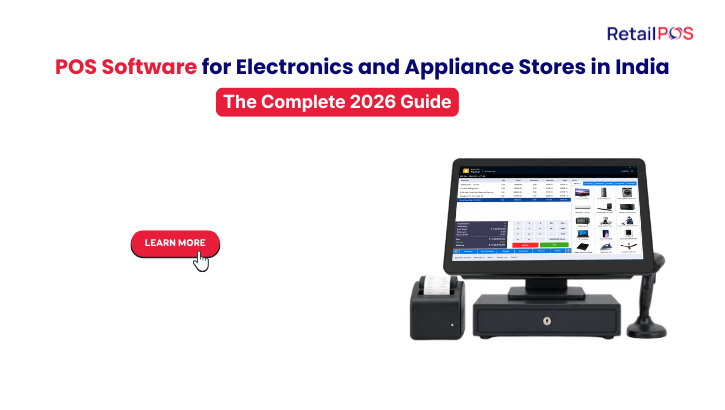
RetailPOS has powered billing, inventory, and warranty tracking for electronics and appliance retailers across India for over 20 years, serving showrooms from single-counter mobile stores to multi-branch appliance chains. This guide is based on patterns we see repeatedly across our installed base, combined with current market data cited below.
Quick summary
Electronics and appliance retail carries higher stakes than most retail categories: high ticket sizes, mandatory serial number tracking, warranty obligations, and EMI-heavy transactions. Generic billing software was not built for this. This guide explains what breaks when retailers use the wrong system, what a purpose-built POS should include, and how to evaluate options for your showroom
Why Generic POS Software Fails Electronics and Appliance Retailers
Most billing software on the market is designed for fast-moving consumer goods: groceries, apparel, or restaurant orders. Electronics retail works differently, and the gap shows up at the counter within the first week of using the wrong tool.
Every unit has its own identity. A packet of rice is interchangeable with the next one on the shelf. A refrigerator, television, or mobile phone is not. Each unit carries a unique serial or IMEI number, and that number has to be linked to the sale, the customer, and the warranty period from day one, not added later as an afterthought.
Warranty and service tracking cannot be manual. Customers return to the same store months or years later expecting an instant answer on whether their product is still covered. If that information lives in a paper register or a disconnected spreadsheet, staff waste time hunting for it and customers lose confidence in the store.
Financing and EMI are part of the sale, not an add-on. A large share of electronics and appliance purchases in India happen through EMI or financing partners, particularly during festive periods. Billing software that cannot cleanly handle part-payments, down payments, and scheme-based pricing slows checkout and creates reconciliation problems in accounting later.
High ticket size means high exposure. A single television or refrigerator can be worth more than an entire cart of groceries. Stock discrepancies, billing mistakes, or shrinkage at this price point hit margins far harder than in low-ticket categories.
What the Data Shows About India’s Electronics Retail Market
This is not a shrinking category. Industry estimates place India’s consumer electronics and appliances market at roughly USD 75 to 80 billion as of 2023-24, with most forecasts projecting continued annual growth in the range of 6 to 8 percent through 2030 and beyond. Offline retail, meaning physical showrooms, still holds the larger share of overall sales, with OEM stores, specialty retailers, and general retail outlets together accounting for the largest portion of the market even as online channels grow faster in percentage terms.
Two trends matter directly for how a showroom should be run day to day.
First, consumer financing is now a mainstream part of how electronics get sold, not a niche option. Industry research points to easy access to consumer finance and EMI schemes as a key factor making high-value electronics more accessible to a broader range of shoppers. A POS system that cannot handle EMI and scheme-based billing cleanly is working against how the category actually sells.
Second, price sensitivity remains high even as the market grows. Research from 2023 suggested that only around a quarter of Indian consumers were willing to spend on premium, high-end devices, with the majority favoring budget and mid-range products. That means margins on electronics retail are often thinner than the ticket size suggests, which makes shrinkage, warranty fraud, and billing errors proportionally more damaging to profitability.
What to Look for in POS Software for Electronics and Appliance Stores
1. Serial Number and IMEI Tracking
Every unit sold should be tagged with its serial number or IMEI at the point of billing, and that number should stay linked to the transaction permanently. This makes it possible to instantly pull up purchase history, confirm authenticity, and process warranty claims without digging through paper files.
2. Automated Warranty Management
The software should calculate warranty start and end dates automatically based on the sale date and product category, then surface that information the moment a staff member searches for the item. No calling the customer to ask for a bill copy just to check coverage.
3. EMI, Financing, and Scheme-Based Billing
Look for a system that supports multiple payment modes in a single transaction, including EMI splits, financing partner integrations, cash, card, and UPI. This matters even more during festive seasons when schemes and exchange offers drive a large share of sales.
4. High-Value Inventory Control
Because electronics inventory sits on high capital, real-time stock visibility matters more here than in almost any other retail category. A good system should show exactly how many units of each model, variant, and configuration are available across every branch, so staff never oversell a product that is already out of stock elsewhere.
5. Multi-Branch and Showroom Management
Electronics chains often operate a mix of flagship stores and smaller outlets. Centralized control lets you standardize pricing, run region-specific offers, and transfer stock between branches when one location runs low on a fast-moving model.
6. Exchange and Buyback Handling
Exchange offers are common in mobile phones, appliances, and electronics categories. Billing software should let staff record the exchanged item, adjust the final price, and update inventory in one motion instead of managing it as a separate manual process.
7. GST-Compliant Invoicing
With electronics carrying some of the highest transaction values in retail, accurate GST invoicing, CGST and SGST splits, and one-click return filing are not optional. A single billing error on a high-value item can create real compliance exposure.
8. Service and Repair Tracking
Many electronics and appliance stores also run in-house or partner service centers. Linking service tickets to the original sale record, tracking parts used, and updating customers on repair status keeps after-sales organized instead of chaotic.
The Real Cost of Not Having the Right System
Electronics retailers who continue relying on generic billing tools or manual registers tend to run into the same set of problems repeatedly.
Warranty disputes eat up staff time and damage customer trust, since there is no fast way to verify a claim. Stock mismatches between branches lead to lost sales when a model is actually available two kilometers away but nobody knows it. Billing slows down during festive rushes, exactly when EMI and exchange transactions spike and queues matter most. And without serial number tracking, spotting patterns in defective batches or fraudulent returns becomes nearly impossible.
None of these are minor operational quirks. They are direct revenue leaks, and they compound as a business grows from one showroom to a multi-branch chain.
How RetailPOS Supports Electronics and Appliance Retailers
RetailPOS is built for the challenges described above, with tools designed specifically for electronics and appliance retail:
- Serial number and warranty tracking linked directly to every billed unit
- Multi-payment billing that supports EMI, financing schemes, and exchange offers in one transaction
- Real-time inventory visibility across every branch through the Analytics dashboard, so staff always know what is in stock and where
- Centralized multi-store control via Enterprise for chains running flagship and satellite outlets
- Full GST compliance with automated CGST, SGST, and IGST calculations
- 350+ live analytics reports so owners can track category performance, scheme effectiveness, and outlet-wise margins from one dashboard
- Offline billing support, so sales never stop even during an internet outage
RetailPOS is trusted by 10,000+ businesses across India with more than 20 years of retail-specific experience, spanning supermarkets, apparel, electronics, and restaurant chains.
Whether you run a single mobile store or a multi-branch appliance showroom chain, the goal is the same: faster billing, fewer disputes, and complete visibility into high-value stock.
Frequently Asked Questions
Electronics and appliances involve serial number tracking, warranty periods, EMI billing, and high per-unit value, none of which generic billing software is built to handle well. Purpose-built POS software links every sale to a specific unit and its warranty, which a standard system cannot do reliably.
Yes. RetailPOS calculates warranty start and end dates automatically at the time of billing based on the product category and sale date, so staff can pull up coverage status instantly instead of relying on paper bills.
Yes. The system supports multiple payment modes in a single transaction, including EMI splits and financing partner integrations, which is essential for electronics and appliance retail where a large share of purchases happen on credit or scheme-based financing.
Yes. RetailPOS gives you real-time visibility into stock across every branch, so you can transfer inventory between outlets, avoid overselling, and standardize pricing and offers centrally.
Yes. RetailPOS scales from a single mobile or electronics counter to a multi-branch appliance showroom chain, with the same centralized control, GST compliance, and serial number tracking at every scale.
Most single-store setups go live within a few days. Multi-outlet rollouts typically take one to three weeks depending on the number of stores, data migration needs, and hardware integration such as barcode scanners and receipt printers.
Ready to Stop Losing Money on Warranty Disputes and Stock Mismatches?
If your electronics or appliance business is still relying on paper registers or disconnected spreadsheets to track serial numbers and warranties, it is costing you more than you realize in staff time, customer trust, and lost sales.
Book a free personalized demo and see how RetailPOS handles billing, warranty tracking, and multi-branch inventory for electronics and appliance retailers across India. No credit card required.

Book a free demo and see how RetailPOS gives you complete financial visibility across your operations..
Or WhatsApp our team directly – we respond within minutes.
Or call us at 95662 44611