
Powered by Unipro Tech
Real-Time Stock Visibility Across 15 Outlets: What It Looks Like and Why It Matters
Picture this. A customer calls your flagship store asking if a specific size and color is in stock. Your staff checks the shelf, says yes, and asks the customer to come by. She arrives an hour later and the item is gone, sold to someone else in the meantime, or worse, it was never actually there because the last stock count was done three weeks ago.
Now multiply that scenario across 15 outlets, each running its own local stock count, each syncing to head office once a day if you’re lucky, and each making buying and transfer decisions based on numbers that were already outdated by the time anyone looked at them.
This is the single most common operational gap in growing Indian retail chains. Sales, marketing, and store expansion get all the attention, while the systems tracking what is actually sitting on the shelf quietly fall behind. This article breaks down what real-time stock visibility across multiple outlets actually looks like in practice, why it becomes non-negotiable somewhere between 5 and 15 stores, what it costs a business when it’s missing, and how to tell if your current system is already holding you back.
What “Real-Time” Actually Means for Multi Outlet Retail
The word “real-time” gets used loosely in retail software marketing, so it’s worth being precise about what it should actually mean for a chain running multiple outlets.
Real-time stock visibility means that the moment a sale happens at outlet 7, that stock reduction is reflected in the central system within seconds, not at the end of the day, not after a batch sync at midnight, and not only when someone manually pulls a report. It means a purchase manager sitting at head office can see the exact stock count at every single outlet, for every single SKU, at any moment during business hours, without calling a single store manager to ask.
It’s worth separating this from a few things it is often confused with. A “cloud” system is not automatically a real-time system, cloud only means the data lives on a server rather than a local machine, it says nothing about how quickly that data updates or how visible it is across locations. Likewise, an “online” billing app is not automatically connected to every branch in a meaningful way. True real-time visibility requires three things working together: instant sync of every transaction, a single centralized view of that data, and the ability for the right people to see it without extra steps.
Why This Becomes Critical Between 5 and 15 Outlets
A single store owner can walk the floor and get a rough sense of stock levels. Even two or three outlets can be managed with a bit of manual coordination between store managers and a shared spreadsheet.
Somewhere between 5 and 15 outlets, that informal coordination breaks down completely. Here is what typically happens as chains scale without centralized, real-time visibility:
- Stock decisions get made blind. Purchase orders get placed based on gut feel or outdated reports, leading to overstocking in some outlets and stockouts in others, often at the same time, for the same product.
- Inter-branch transfers become guesswork. Without knowing exactly what every outlet holds right now, transferring surplus stock from a slow-moving branch to a high-demand one becomes reactive instead of planned.
- Stock discrepancies go undetected for weeks. Shrinkage, billing errors, and unrecorded returns pile up silently until a physical stock count finally reveals the gap, by which point the financial damage is already done.
- Customer experience suffers. Staff cannot confidently tell a customer whether another branch has an item in stock, leading to lost sales and, worse, customers who stop trusting what your staff tells them.
- Head office loses control of the business. Leadership ends up managing 15 separate stores instead of one connected retail chain, with each outlet effectively operating as its own silo.
- Growth itself becomes harder. Every new outlet added to a fragmented system adds another disconnected node to reconcile manually, so the operational burden grows faster than the business does.
This is why the businesses that struggle most with scaling are rarely short on customer demand. They are usually short on the internal visibility needed to serve that demand consistently, at every location, at the same time.
The Hidden Cost of Stock Blindness
It helps to put an actual number, even a rough one, behind what fragmented stock visibility costs a growing retail chain. Consider three separate cost streams that show up when outlets are not connected in real time.
Lost sales from false stockouts and false availability. When staff cannot confirm stock at another branch, chains lose sales two ways: customers walk away when a product looks unavailable that was actually sitting at another outlet, and customers get promised a product that has actually already sold out elsewhere, damaging trust when the order can’t be fulfilled.
Working capital tied up in the wrong place. Without a combined view of stock across all outlets, purchasing teams tend to over-buy for the chain as a whole to avoid stockouts at any single branch. That means capital sits in slow-moving stock at one outlet while a fast-moving outlet runs short of the same product, a problem that real-time visibility and planned transfers solve directly.
Shrinkage that compounds silently. Small discrepancies, a missed billing entry here, an unrecorded return there, are easy to catch when stock data updates in real time and gets reviewed regularly. Left to accumulate over weeks or months across 15 outlets, the same small errors become a significant, hard-to-trace loss by the time a physical stock count finally reveals it.
None of these costs show up as a single dramatic event. They accumulate quietly, outlet by outlet, month by month, which is exactly why so many growing chains underestimate how much fragmented visibility is actually costing them.
What Real Time Stock Visibility Looks Like in Practice
It’s easier to understand the value of this capability by looking at what it actually enables on a day-to-day basis across a retail chain.
1. A Single Dashboard for Every Outlet
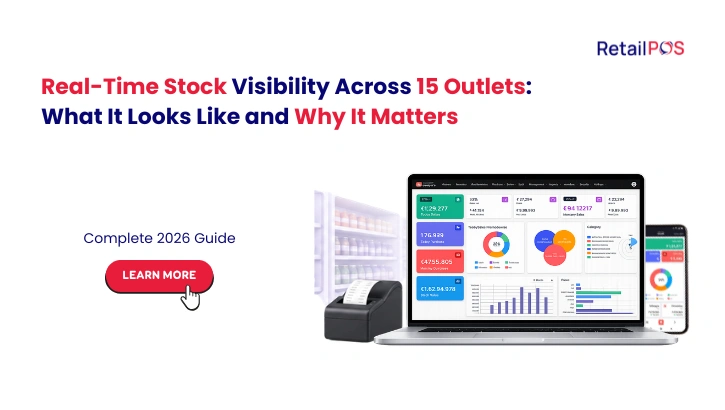
Instead of 15 separate spreadsheets or 15 separate local system logins, a purchase manager or business owner opens one dashboard and sees stock levels for every SKU across every outlet, updated live as sales, purchases, and transfers happen throughout the day.
2. Instant Cross-Branch Stock Checks
When a customer asks whether a product is available elsewhere, staff can check instantly instead of calling another branch or asking the customer to come back later. This alone recovers sales that would otherwise walk out the door.
3. Smarter, Faster Stock Transfers
With live visibility into what every branch is holding, transferring stock from a slow-moving outlet to a high-demand one becomes a planned, data-backed decision rather than a reactive scramble after a stockout has already happened.
4. Purchase Decisions Based on the Full Picture
Buying teams can see combined demand and stock levels across all outlets before placing a purchase order, avoiding the common trap of over-ordering for the chain as a whole because one or two outlets looked low while others were actually overstocked.
5. Faster Detection of Shrinkage and Errors
When stock numbers update in real time, discrepancies between expected and actual stock show up quickly rather than accumulating silently for weeks or months, making it far easier to trace the cause while it’s still fresh.
6. Branch Performance Comparison
With every outlet’s stock movement visible centrally, leadership can compare how fast the same product sells across different branches, informing decisions about assortment planning, pricing, and even which locations deserve more retail space or footfall investment.
How Real-Time Visibility Changes Day to Day Decision Making
It’s worth walking through how the same set of decisions plays out differently with and without real-time visibility, because the difference is rarely visible in a single transaction, it shows up in how consistently good decisions get made across hundreds of them.
Morning purchase planning. Without centralized visibility, a purchase manager reviews stock reports that may be a day or more old, and decides what to order largely on instinct and past experience. With real-time visibility, the same manager opens one dashboard, sees exactly what every outlet holds right now, and places orders based on the chain’s actual current position, not yesterday’s snapshot.
Mid-day customer requests. Without real-time visibility, a staff member fielding a stock query either guesses, calls around, or simply says the product is unavailable to avoid the risk of overpromising. With real-time visibility, the same query is answered in seconds with an accurate, chain-wide answer, and if another branch has it, a transfer or reservation can be arranged on the spot.
Weekly stock transfer reviews. Without real-time visibility, transfers between branches tend to happen only after a stockout has already occurred at one outlet, meaning lost sales have already happened by the time the transfer is even considered. With real-time visibility, transfers can be planned proactively based on current sell-through rates, moving stock before a shortage happens rather than after.
Month-end reconciliation. Without real-time visibility, month-end stock counts frequently turn up discrepancies that are difficult to trace back to a specific cause, because too much time has passed. With real-time visibility, discrepancies are far smaller and far easier to investigate, because the data trail is current and continuous rather than reconstructed after the fact.
The pattern across all four examples is the same. Real-time visibility does not just make reporting more accurate, it changes the timing of decisions from reactive to proactive, which is where the real financial impact comes from.
Common Signs Your Current System Is Not Actually Real-Time
Many retail chains believe they already have centralized visibility because they have some form of “cloud” or “online” system. The gap usually shows up in the details. Watch for these warning signs:
- Store managers rely on WhatsApp or phone calls to check stock at other branches
- Stock reports are pulled once a day rather than viewed live
- There is a noticeable lag between a sale happening and it reflecting centrally
- Physical stock counts regularly reveal large, unexplained discrepancies
- Purchase decisions are still made largely on instinct rather than current data
- Different outlets are effectively running different, disconnected systems
- Stock transfers between branches are informal, undocumented, or tracked outside the core system
- New outlets take significant time and manual effort to bring onto the same reporting standard as existing ones
If two or more of these sound familiar, your chain is likely operating with the appearance of centralization without the substance of it.
What to Look for in a True Multi-Outlet Retail System
Capability | Why it matters |
Live, second-by-second sync across all outlets | Decisions are based on current reality, not yesterday’s numbers |
Single centralized dashboard | No need to log into or call each store individually |
Built-in stock transfer workflow | Transfers are planned and tracked, not informal and undocumented |
Branch-wise and SKU-wise reporting | Enables real comparison and smarter purchasing decisions |
Offline resilience with automatic sync | Billing continues even if internet drops, and syncs the moment it’s back |
Role-based access for store and head office staff | Store teams see what they need, leadership sees everything |
GST-compliant billing at every outlet | Every branch stays compliant without separate manual handling |
Scalable onboarding for new outlets | Adding outlet 16 should not require rebuilding the reporting structure |
How to Move From Fragmented Stock Data to Real-Time Visibility
For chains currently operating with disconnected outlets, the shift to real-time visibility does not have to happen all at once. A practical path usually looks like this.
Start with an honest audit. List every outlet and how its stock data currently reaches head office, whether that’s a shared spreadsheet, a phone call, a nightly export, or a proper live sync. This alone often reveals how fragmented the current setup actually is.
Centralize billing on one system first. Real-time visibility is only possible if every outlet is billing on the same underlying platform. Mixed systems across branches, even good ones individually, cannot be reconciled into one live, accurate view.
Set up branch-wise reporting before scaling further. Before adding outlet 12, 13, or 14, make sure the reporting structure for the existing outlets is clean and centralized. Adding more locations to a fragmented base only multiplies the existing problem.
Build a transfer workflow into daily operations. Once visibility is centralized, make stock transfers a proactive, planned exercise, reviewed regularly using live sell-through data, rather than a reaction to a stockout that has already cost a sale.
Review discrepancies weekly, not just at stock count time. With real-time data, small issues can be caught and corrected weekly instead of accumulating until the next full physical count, which keeps shrinkage and error rates far lower over time.
How RetailPOS Delivers Real Time Visibility Across Outlets
RetailPOS is built for Indian retail chains that need one connected view of their business, not 15 disconnected ones. Every sale, purchase, and stock transfer at any outlet reflects centrally in real time, giving business owners and purchase teams a live, accurate picture of stock across the entire chain, whether that’s 3 outlets or 30.
With centralized dashboards, built-in inter-branch transfer workflows, branch-wise reporting, offline billing with automatic sync, and GST-compliant billing at every counter, RetailPOS is trusted by 10,000+ businesses across India, backed by more than 20 years of retail-specific experience.
Growing from a handful of stores to 15 or more outlets should feel like scaling one strong business, not managing 15 separate, disconnected ones. Real-time stock visibility is what makes that difference possible, and it’s often the single change that unlocks the next stage of growth for a chain that has already proven its retail concept works.
Frequently Asked Questions
It means every sale, purchase, and stock transfer at any outlet is reflected centrally within seconds, giving head office an accurate, live view of stock across every branch at all times, rather than relying on delayed or manually compiled reports.
Beyond a handful of stores, informal coordination between store managers breaks down. Without centralized live visibility, purchase decisions, stock transfers, and shrinkage detection all become reactive and error-prone rather than planned and accurate.
Yes. When purchase and transfer decisions are based on the full picture across all outlets rather than one branch in isolation, chains can move surplus stock to where demand actually is, reducing both stockouts and excess inventory simultaneously.
It shows up as lost sales from false stockouts, working capital tied up in the wrong outlets, and shrinkage that goes undetected until a physical stock count reveals it, all of which are largely preventable with live, centralized visibility.
Yes. RetailPOS gives businesses a single, live dashboard across all outlets, with built-in stock transfer workflows and branch-wise reporting, whether a chain has 3 stores or 30. Book a free demo to see it for your business.
A properly built system continues billing offline at that outlet and automatically syncs stock and sales data centrally the moment connectivity is restored, so no visibility is permanently lost.
It does not need to be. Starting with an honest audit of current stock data flow, centralizing billing on one platform, and building reporting and transfer workflows on top of that gives most chains a clear, manageable path without disrupting daily operations.
Ready to see all your outlets from one screen, in real time? Book your free RetailPOS demo today →

Book a free demo and see how RetailPOS gives you complete financial visibility across your operations..
Or WhatsApp our team directly – we respond within minutes.
Or call us at 95662 44611