
Powered by Unipro Tech
Your Restaurant Has Loyal Customers But No Data About Any of Them: Here Is What That Is Costing You
A complete guide for Indian restaurant owners who want to turn their loyal customer base into a measurable, manageable revenue asset
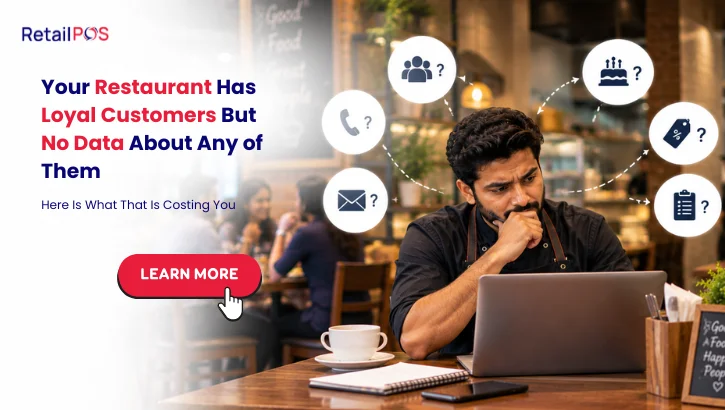
The Restaurant That Knows Everyone and Nobody
A Chennai restaurant owner has been running his South Indian cuisine restaurant in Nungambakkam for eleven years. On any given Friday evening he can walk his dining room and greet half the tables by name. He knows that the family at Table 7 orders the same filter coffee and ghee roast every week. He knows that the IT professional at the corner table always orders extra sambar. He knows which corporate groups book the private dining room every month-end.
He knows all of this. His restaurant software knows none of it.
When that IT professional who visits every Tuesday does not come for three weeks, nobody notices. There is no alert. No follow-up. No reach-out. He simply stops appearing, and the restaurant loses a weekly customer without ever knowing he was gone until much later when the owner vaguely recalls not having seen him recently.
When the Friday family celebrates a birthday, they do it at a competitor whose app sent them a birthday discount. Not because they prefer that restaurant. Because that restaurant knew their birthday and this one did not.
When a new competing restaurant opens 200 metres away and targets the corporate lunch crowd with an aggressive first-month promotion, the Chennai restaurant has no way to reach its own corporate customers directly to retain them. It has no phone numbers linked to order history. It has no data showing which customers are at risk of switching.
This is the customer data problem in Indian restaurants. It is not a technology problem, exactly. Most restaurants have a POS system that could collect customer data if configured to do so. It is a strategic problem. The data that would make every customer relationship manageable and every retention action targeted simply does not exist in a form the restaurant can use.
This guide explains what customer data a restaurant should be collecting, what it reveals when collected systematically, and what specific revenue actions become possible when that data exists.
Section 1: What Customer Data Your Restaurant Is Already Generating But Not Capturing
Every restaurant transaction generates data. A customer who orders butter chicken, garlic naan, and a lassi on a Tuesday evening at 7:45 PM has provided the following information through that single transaction.
Their visit time: Tuesday evening, suggesting a weekday diner who may be a working professional.
Their food preference: North Indian cuisine, non-vegetarian, prefers dairy-based beverages.
Their average spend: the basket value of that order.
Their visit pattern: if they have been before, the gap between this visit and the last one.
Their channel preference: whether they ordered through Zomato, through a QR code at the table, or through the billing counter.
None of this data is private or invasive. It is the natural output of a transaction that happened. The question is whether your restaurant is capturing it systematically against a customer identity, a phone number or loyalty ID that links every visit to the same person, or whether each transaction is simply a transaction with no connection to who made it.
Most Indian restaurants are in the second category. Transactions happen. Revenue accumulates. But no customer profile builds over time. Each visit is as anonymous as the first, even for customers who have been coming for years.
The moment a restaurant starts linking transactions to customer identities, two things happen simultaneously. The restaurant begins to understand who its customers actually are. And the restaurant begins to accumulate the data that makes targeted, effective customer communication possible for the first time.
Section 2: The Revenue That Disappears When You Have No Customer Data
The revenue impact of having no customer data falls into three specific categories, each of which is invisible until you have the data to see it.
The lapsed customer revenue gap.
Every restaurant has customers who visited regularly and then stopped. The regulars who come every week eventually become the regulars who came every week. Without customer data, this transition is invisible. Nobody knows when a regular customer’s last visit was. Nobody knows how many weekly regulars have become monthly regulars or quarterly visitors or former customers in the last six months.
When restaurants implement customer data tracking and run their first lapsed customer analysis, they consistently find a larger pool of formerly loyal customers than they expected. In most cases, 20 to 30% of the customers who were regular visitors a year ago have either significantly reduced their frequency or stopped visiting entirely.
The revenue implication depends on how many of these customers can be re-engaged. A restaurant with 500 active weekly customers that has lost 120 of them over the past year and can re-engage 40% of the lapsed group through a targeted communication has recovered 48 customers returning to weekly visits. At an average order value of Rs 450 per visit, that is Rs 21,600 in additional weekly revenue from re-engagement alone.
The birthday and occasion revenue gap.
Birthdays are the highest-intent dining occasion in Indian restaurant culture. A family celebrating a birthday at a restaurant will almost always spend significantly above the average transaction value, order special items, book in advance, and choose a restaurant specifically rather than casually. A restaurant that knows its customers’ birthdays can reach out two weeks before with a specific birthday dining offer. A restaurant with no customer data cannot.
The new competitor response gap.
When a competing restaurant opens nearby or launches an aggressive promotional campaign, a restaurant with a customer database can reach directly to its most loyal customers with a counter-communication. A restaurant with no customer data has no direct channel to its own customers and can only respond through generic marketing that reaches its loyal customers alongside everyone else.
Section 3: The Five Things Customer Data Enables That Instinct Cannot
Thing 1: Knowing exactly when a regular customer has not visited.
Instinct tells the owner that a specific customer has not been in recently. Data tells the owner that 47 customers who visited at least three times in the previous 60 days have not visited in the last 21 days. These are two different kinds of knowing. The second enables action at scale.
Thing 2: Identifying your most valuable customers objectively.
Every restaurant owner has a mental list of their best customers. This list is shaped by who is most visible, most personable, and most frequently present during peak hours when the owner is also present. The actual most valuable customers by lifetime spend and visit frequency may be different from this mental list. Customer data reveals the objective ranking.
Thing 3: Understanding what your customers actually order versus what you think they order.
A restaurant owner’s perception of their bestselling dish is shaped by what they hear the most orders for, what they see coming out of the kitchen most, and what gets the most comments. Customer data shows what specific customers actually order on repeat, which dishes drive the highest visit frequency, and which dishes are single-trial items that are not generating return visits from the customers who ordered them.
Thing 4: Predicting demand patterns from customer behaviour.
When customer data shows that 60% of Tuesday evening customers order the same combination of dishes, Tuesday prep quantities can be planned against this pattern rather than against last Tuesday’s total. When data shows that the corporate customer segment visits significantly less frequently in the last week of the month, promotions targeting that segment should avoid that window.
Thing 5: Communicating with specific customers about specific things.
Generic WhatsApp broadcast messages to all customers are the equivalent of shouting in a crowded street. Targeted messages to specific customer segments about things that are specifically relevant to them are the equivalent of a personal conversation. The conversion rate difference between these two approaches is not incremental. It is transformational.
Section 4: What a Restaurant CRM Must Capture and Why
A restaurant customer relationship management system must capture specific data points that together create a complete and actionable customer profile. Not all of these are collected at once. They build over multiple visits as the customer’s relationship with the restaurant develops.
Data Point | How It Is Captured | What It Enables |
Phone number | At first billing counter interaction or loyalty enrolment | Primary identifier linking all future visits to this customer |
Name | At enrolment | Personalised communication that feels human not automated |
Visit date and time | Automatically from every transaction | Visit frequency tracking and time-of-day preference identification |
Dishes ordered | Automatically from every transaction | Preference identification and personalised recommendation |
Channel used | Automatically from transaction source | Understanding whether customer is primarily dine-in, delivery, or both |
Average spend per visit | Automatically calculated | Customer value segmentation |
Last visit date | Automatically updated | Lapsed customer identification |
Total lifetime spend | Automatically accumulated | Long-term customer value calculation |
Birthday | Collected at enrolment or offered | Occasion-based targeted communication |
Loyalty points balance | Automatically updated | Redemption motivation and visit frequency incentive |
The critical design principle is that most of this data must be captured automatically from transaction records rather than requiring the customer to fill out forms or the staff to manually enter information. A customer data system that depends on manual data entry will have gaps, errors, and inconsistency that undermine the quality of every analysis built on top of it.
Section 5: Customer Segmentation for Indian Restaurants: The Four Groups That Matter
Customer segmentation is the practice of dividing your customer database into groups based on behaviour patterns and engaging each group differently. For Indian restaurants, four segments consistently emerge from customer data and each requires a different engagement approach.
Segment 1: Weekly Regulars.
These are customers who visit at least once a week consistently. They are the backbone of a restaurant’s revenue, the customers whose visits are most predictable, and the customers whose departure would be most damaging. The engagement strategy for Weekly Regulars is recognition and deepening: make them feel genuinely valued as the important customers they are, give them access to things that other customers do not get such as reserved seating priority or advance notice of menu changes, and ensure that nothing in their regular experience ever disappoints.
Segment 2: Monthly Loyalists.
These are customers who visit once or twice a month with reasonable consistency. They are loyal but not habitual. The engagement strategy for Monthly Loyalists is frequency increase: give them a specific, recurring reason to visit more often. A double-points Tuesday. A monthly loyalty member special. A reservation incentive for booking before a certain day each month.
Segment 3: At-Risk Customers.
These are customers who were regular visitors but whose visit frequency has declined measurably. They have not left. But they are going somewhere else some of the time. The engagement strategy is re-engagement with urgency: a personalised communication that acknowledges their presence as a valued customer and offers a specific benefit for their return visit within a defined window.
Segment 4: Occasion Visitors.
These are customers who visit specifically for celebrations, family occasions, or group dining events. They may visit only 3 to 5 times a year but spend significantly above average on each visit. The engagement strategy is occasion capture: ensure your restaurant is in their consideration for every relevant occasion by communicating specifically around the occasions when they are most likely to be making a dining decision.
Section 6: How to Use Customer Data to Drive Re-engagement and Repeat Visits
The most immediate revenue value in restaurant customer data is re-engagement of lapsed customers. This is because lapsed customers already know the restaurant, have demonstrated willingness to pay, and require only a reason to return rather than a reason to try for the first time.
The re-engagement communication structure that works for Indian restaurants:
A re-engagement message must do three things. It must feel personal rather than generic. It must offer a specific and compelling benefit for the return visit. And it must create urgency through a time-limited offer window.
A message that says “We have not seen you in a while! Here is 20% off your next visit, valid for the next 14 days” does all three things. The acknowledgment of absence feels personal. The discount is a specific benefit. The 14-day window creates urgency.
A message that says “Exciting new menu items now available at our restaurant! Visit us soon” does none of these things. It is not personal, it offers no specific benefit to this customer, and it creates no urgency.
The frequency incentive that moves Monthly Loyalists to Weekly Regulars:
The most effective mechanism for increasing visit frequency among Monthly Loyalists is a streak-based loyalty benefit. A customer who visits in week 1, week 2, and week 3 of the same month earns a bonus benefit in week 4. This creates a compounding incentive to maintain the streak, pulling visit frequency upward from monthly toward weekly over a period of 2 to 3 months.
The birthday communication that captures occasion visits:
A birthday communication sent 14 days before a customer’s birthday that offers a specific dining benefit for a visit in the birthday month has three advantages over a general promotion. It is timed to a moment when the customer is actively thinking about dining plans. It is personally relevant. And it offers a specific benefit that makes your restaurant the natural birthday dining choice over competitors.
Section 7: The Festival Season Customer Data Opportunity Right Now
Today is September 23, 2026. Navratri begins in less than two weeks. Diwali is six weeks away. This is the most important customer communication period of the year for Indian restaurants.
Every restaurant that has a customer database with contact information has the ability to reach its most loyal customers right now with a specific festival dining communication. Every restaurant without that database is entering the festive season with no direct channel to the customers who are most likely to celebrate with a restaurant dining experience.
The specific festival season customer data actions that generate revenue this week:
Action 1: Identify your top 100 customers by lifetime spend.
Pull a report showing your 100 highest-spending customers. These are the customers most likely to book a festive dining experience at your restaurant if approached personally. A direct WhatsApp message from the restaurant to these customers offering a preferred reservation for the Navratri or Diwali celebration period will convert at a significantly higher rate than any generic promotion.
Action 2: Create a festive advance booking incentive for loyalty members.
Customers who have accumulated loyalty points have already demonstrated their commitment to the restaurant. A communication offering bonus points or a special benefit for advance booking of the festive period gives these customers a specific reason to commit to your restaurant for their celebration rather than leaving the decision open until they are already at the moment of choosing.
Action 3: Run a pre-Navratri re-engagement for lapsed customers.
Customers who were regular visitors but have not come in the last 45 to 60 days represent a specific re-engagement opportunity before the festive season. A message that says “We want to celebrate Navratri with you. Here is a welcome-back offer for your first visit in the next 10 days” has a clear time-bound urgency that a generic re-engagement message does not.
Section 8: How RetailPOS Dineazy Builds Your Restaurant’s Customer Intelligence
RetailPOS Dineazy provides the customer data infrastructure that converts every transaction in your restaurant into a building block of customer intelligence.
Automatic customer recognition at every touchpoint.
Every billing counter transaction, QR table order, ConsumerApp direct order, and Zomato and Swiggy delivery order that includes a customer identifier is automatically linked to the customer’s profile in Dineazy. The customer’s visit history, order preferences, loyalty balance, and last visit date update automatically with every transaction without any manual data entry from staff.
Customer profile that builds over time.
From the first transaction where a customer provides their phone number, Dineazy begins building a profile that grows with every subsequent interaction. By the tenth visit, the customer’s profile shows visit frequency pattern, preferred day and time, most frequently ordered dishes, average spend, and cumulative lifetime value. This profile is the foundation of every personalised communication and every segmentation decision.
Automatic lapsed customer detection.
Dineazy monitors every customer’s visit recency and fires automatic alerts when any customer who previously visited with a minimum frequency has not visited within a configurable number of days. The restaurant management team receives a daily list of at-risk customers to prioritise for re-engagement without any manual analysis.
Customer segmentation from transaction data.
Dineazy’s analytics segment the customer database automatically by visit frequency, average spend, last visit date, preferred channel, and category preference. These segments update in real time as customer behaviour changes. A Monthly Loyalist who starts visiting weekly graduates automatically to the Weekly Regular segment and begins receiving the communication and recognition appropriate to that relationship level.
WhatsApp and SMS communication integration.
Targeted communications to any customer segment can be sent directly from within the Dineazy management interface. Birthday communications, re-engagement offers, festive season promotions, and loyalty milestone notifications are configurable as automated triggers that fire without any manual initiation once the rules are set.
Multi-outlet customer recognition.
For restaurant chains, every customer’s profile is shared across all outlets simultaneously. A customer who visits the Anna Nagar outlet is recognised immediately at the Velachery outlet with their complete history, preferences, and loyalty balance visible to the billing staff. The chain-wide customer relationship is more valuable than any individual outlet relationship because it follows the customer wherever they choose to visit.
Conclusion: Your Loyal Customers Are Your Most Valuable Asset. Start Knowing Them.
The Chennai restaurant owner from the opening of this guide has something genuinely rare in Indian dining: eleven years of customers who keep coming back. That loyalty represents an enormous asset. It also represents an enormous opportunity that is currently going unrealised because the loyalty exists in the owner’s memory rather than in a system that can work on it actively.
Every weekly regular who stops coming without the restaurant noticing is revenue lost. Every birthday celebration that goes to a competitor because that competitor knew the date is revenue lost. Every new opening that pulls customers away without the restaurant having any direct channel to retain them is revenue lost.
The data that prevents all of these losses already exists inside the restaurant’s transactions. Every customer who has ever visited has told the restaurant something about when they come, what they eat, and how much they spend. The question is whether that information is being captured, connected to a customer identity, and used to strengthen the relationship.
In the two weeks before Navratri, the answer to that question determines whether this festive season’s revenue comes from loyal customers you knew how to reach or from whoever happened to walk past.
Frequently Asked Questions
The minimum viable customer data set for effective restaurant loyalty management is phone number, name, and visit transaction history. The phone number serves as the unique customer identifier linking all visits. The name enables personalised communication. The visit transaction history, captured automatically from each billing interaction, provides the behaviour data for segmentation, frequency analysis, and preference identification. Additional data points like birthday and email address add further communication capability but are secondary to the core three. The most important principle is that this data must be captured automatically from transactions rather than relying on customers to fill out detailed forms.
Two visits create the baseline for visit frequency tracking and the ability to identify a lapsed customer. Three to five visits provide enough order history to identify food preferences with reasonable confidence. Ten or more visits provide the complete behavioural profile needed for sophisticated segmentation and predictive communication. The practical implication is that new customer enrolment should be prioritised from the very first visit, even if the initial data capture is only a phone number, because the profile builds automatically from that point forward with every subsequent transaction.
Customer data in Dineazy is stored on secure servers under Unipro Tech Solutions' data protection infrastructure. Customer phone numbers collected for loyalty programme enrolment are used only for programme communications. The system does not share customer data with third parties. Customers can request removal from the loyalty programme and their contact data at any time. For restaurant groups deploying customer data for WhatsApp communications, the restaurant is responsible for ensuring communications comply with applicable consent requirements under India's Personal Data Protection framework.
Yes. In RetailPOS Dineazy, customer data is stored in a centralised database shared across all outlets simultaneously. A customer who visits Outlet A is recognised at Outlet B with their complete visit history from both locations. If a customer previously visited without providing a loyalty identifier at one outlet and then enrols at another outlet, historical transactions can be linked retrospectively to the new profile where the system can match on transaction date and basket details. The unified cross-outlet profile is one of the most significant advantages of a centralised restaurant management system over individual outlet systems.
Indian restaurant operators who implement structured loyalty programmes with automated re-engagement communications typically see visit frequency improvements of 15 to 30% among enrolled loyalty members compared to non-enrolled customers over the first year of programme operation. The specific improvement depends heavily on the quality and consistency of the re-engagement communication strategy. Restaurants that configure automated lapsed customer alerts and send personalised re-engagement messages within 48 hours of the alert firing consistently outperform those that use the data reactively.
About RetailPOS
RetailPOS is an enterprise restaurant and retail POS solution by Unipro Tech Solutions Pvt Ltd, headquartered in Chennai, Tamil Nadu. With over 20 years of experience and 10,000 plus businesses served across India and globally, RetailPOS provides purpose-built restaurant management technology including Dineazy with integrated customer CRM and loyalty management, multi-outlet customer data unification, automated re-engagement communications, and the Cockpit multi-outlet dashboard for restaurant chains, QSR operators, and multi-outlet F&B groups across India.
Website: retailpos.co.in | Phone: 044-421 421 40 / 95660 44300 | Email: salesenquiry@uniprotech.co.in