
Powered by Unipro Tech
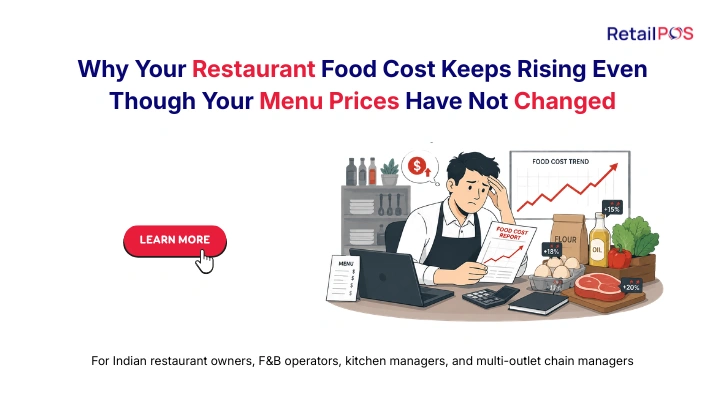
Why Your Restaurant Food Cost Keeps Rising Even Though Your Menu Prices Have Not Changed
For Indian restaurant owners, F&B operators, kitchen managers, and multi-outlet chain managers
Section 1: The Restaurant Owner’s Frustration: Same Menu, Shrinking Margins
You opened your menu to your regulars six months ago and the prices have not changed. The butter chicken is still Rs 280. The biryani is still Rs 220. The dal makhani is still Rs 160. Your customers are satisfied. Your tables are full on weekends. By every external measure, nothing has changed.
But something has changed. Your monthly accounts show it clearly. Food cost as a percentage of revenue is higher than it was six months ago. Your gross margin has shrunk. The money that should be reaching your bank account is disappearing somewhere between the kitchen and the accounts sheet, and you cannot identify exactly where.
This is one of the most common and most frustrating experiences in Indian restaurant ownership. The menu prices have not moved. The sales volume has not dropped. And yet the money is less.
The instinctive response is to blame suppliers. Prices have gone up, you think. Tomatoes are expensive this season. Paneer is costing more. And yes, ingredient prices do fluctuate in India, sometimes dramatically. But supplier price increases alone rarely explain the full picture of a restaurant whose food cost percentage is rising month after month. The real causes are usually operational, and they are sitting inside your kitchen right now, generating financial leakage every single service period.
This guide identifies the seven specific reasons Indian restaurant food costs keep rising even when menu prices stay fixed, shows you exactly what each one costs in rupees, and explains how to fix every single one permanently.
Section 2: Why Rising Food Cost Is Not Always a Supplier Problem
Before understanding the real causes, it is important to separate two distinct phenomena that both show up as a rising food cost percentage.
Rising ingredient prices from suppliers means the rupee cost of what you buy is going up. A kg of paneer that cost Rs 280 in January now costs Rs 320. A kg of chicken that cost Rs 200 now costs Rs 240. This is a real and legitimate cost pressure that affects every restaurant in India, particularly for proteins, dairy, and seasonal vegetables.
Rising food cost percentage from operational leakage means you are paying the same ingredient prices but losing a higher proportion of your food spend to waste, over-portioning, theft, over-ordering, and spoilage. Even if supplier prices are completely stable, your food cost percentage can climb steadily if these operational leaks are not managed.
The reason this distinction matters is that the response to each problem is completely different.
Problem Type | Cause | Solution |
Supplier price increases | Market forces, seasonal variations | Menu price review, portion adjustment, supplier negotiation |
Operational food cost leakage | Internal systems failures | Recipe standardisation, inventory management, waste tracking |
Both happening simultaneously | Market forces plus internal inefficiency | Combined approach addressing both simultaneously |
Most Indian restaurant owners focus entirely on supplier prices because those are the most visible costs. The operational leakage is invisible because it is never measured. This guide addresses the operational side because that is where the most significant and most controllable savings exist.
Section 3: The Seven Real Reasons Your Restaurant Food Cost Keeps Rising
3.1 Portion Size Creep: The Silent Margin Drain
Portion size creep is the most widespread and least discussed food cost problem in Indian restaurant kitchens. It happens gradually and invisibly. Your butter chicken recipe specifies 180g of chicken per portion. Six months ago your head chef was plating exactly that. Today the same chef, now more experienced and moving faster, plates 210g because that is what feels right at the speed the kitchen is running.
Nobody has told the chef this is wrong. Nobody has measured it. The customer receives a slightly more generous portion and is happy. But your food cost just increased by 17% on that dish without any supplier price change.
The rupee impact of 30g over-portioning on butter chicken:
- Chicken cost: Rs 240 per kg
- Extra chicken per portion: 30g
- Extra cost per portion: Rs 7.20
- 80 portions per day: Rs 576 additional daily cost
- Monthly impact: Rs 17,280
- Annual impact: Rs 2.07 lakh from one portioning habit on one dish
Now multiply this across 8 to 10 dishes on your menu where portioning has drifted, and the annual food cost variance from this single problem alone easily reaches Rs 15 to Rs 25 lakh for a busy restaurant.
The critical insight is that portion size creep is almost never intentional. Chefs are not trying to give away food. They are doing what feels natural at service speed without a standardised guide to hold them to the recipe. The system that prevents this is standardised recipe management, not shouting at chefs.
3.2 Untracked Ingredient Wastage
Ask a restaurant owner what their monthly wastage cost is and most will give a rough guess or say they genuinely do not know. This answer reveals the problem precisely. Wastage that is not measured cannot be managed, and wastage that is not managed grows steadily over time.
In Indian restaurant kitchens, wastage accumulates at three distinct stages:
Stage 1: Raw ingredient wastage. Perishables over-ordered and not used before spoiling. Coriander bought Monday that goes into the bin by Thursday. Paneer ordered for a weekend that ran lighter than expected, sitting in the fridge past its useful life. Tomatoes bought in bulk for a Monday promotion that did not drive the expected volume.
Stage 2: Preparation wastage. Mise en place prepped in excess of what the service actually needs. Curry base made for 60 portions when the service used 38. Rice cooked for the lunch buffet that was not fully consumed and cannot be reused at dinner standard. Marinated proteins prepared for an evening service that was slower than expected.
Stage 3: Service and plate wastage. Dishes sent back by customers. Kitchen errors that produce food that cannot be served to standard. Items prepared for orders that were subsequently cancelled before reaching the table.
Rupee cost of invisible wastage:
Restaurant Monthly Revenue | Wastage Rate | Monthly Wastage Cost |
Rs 8 lakh | 5% | Rs 40,000 |
Rs 8 lakh | 8% | Rs 64,000 |
Rs 12 lakh | 5% | Rs 60,000 |
Rs 12 lakh | 10% | Rs 1,20,000 |
Rs 20 lakh | 5% | Rs 1,00,000 |
Rs 20 lakh | 8% | Rs 1,60,000 |
A restaurant doing Rs 12 lakh monthly revenue with an 8% wastage rate is losing Rs 76,800 every month to food that was purchased, prepared in some cases, and then discarded without generating any revenue. Over a year that is Rs 9.2 lakh.
3.3 Over-Purchasing Based on Estimates Rather Than Data
Most Indian restaurant purchasing decisions are made by the head chef based on experience, memory, and a rough sense of what the upcoming week will require. This approach has a systematic upward bias: chefs prefer to over-order rather than risk running out during service. Running out of an ingredient during service is visible and immediately uncomfortable. The waste from over-ordering accumulates quietly and is never directly attributed to the purchasing decision that caused it.
The result is that most Indian restaurants carry 15 to 25% more raw material stock than their actual service requirements demand. This excess either spoils before use or sits in storage occupying working capital that could be deployed elsewhere.
The specific problem in India is that many ingredients are fresh and perishable with shelf lives measured in days. Leafy vegetables, fresh proteins, dairy, and certain spices need to be purchased and used within tight windows. A systematic over-purchasing pattern with these ingredients guarantees regular wastage regardless of how well the kitchen manages preparation.
3.4 Menu Items With Hidden High Food Costs
Every Indian restaurant menu contains dishes with dramatically different food cost percentages. A simple dal tadka might have a food cost of 18 to 22%. A prawn curry with premium proteins might have a food cost of 48 to 55%. Both dishes might appear on your menu at similar price points relative to their category, and both might sell consistently.
But if the prawn curry sells 40 portions per day and the dal tadka sells 40 portions per day, the prawn curry is generating significantly more revenue while also consuming significantly more food cost. When prawn prices increase seasonally, which they do dramatically in South India during certain months, the food cost percentage on that dish can spike to 60% or above.
Without dish-level food cost tracking, restaurant owners have no way to know which dishes are consuming disproportionate food cost relative to their contribution to revenue. They continue promoting and serving their “popular” dishes without realising that some of those popular dishes are the primary drivers of their rising food cost percentage.
3.5 Delivery Orders Creating Invisible Stock Consumption
The growth of Zomato and Swiggy delivery has created a food cost tracking problem that did not exist five years ago. Your dine-in service and your delivery orders consume the same physical ingredient stock. But in most Indian restaurants, the kitchen has no unified view of how much stock is being consumed across both channels simultaneously.
A restaurant that receives 40 Zomato orders for butter chicken during afternoon delivery hours before dinner service may enter the dinner service with significantly less chicken stock than the evening chef expects, having never been told about the delivery volume. The evening service runs short. An emergency purchase is made at a local market at retail price rather than supplier price. Food cost for that day spikes.
This happens because delivery orders are tracked separately from dine-in operations. The inventory consequence is never consolidated in real time. The result is both stockouts that require expensive emergency purchases and over-purchasing on days when delivery volume was lower than expected.
3.6 No Recipe Cost Updating When Supplier Prices Change
Your restaurant set its menu prices 12 months ago based on ingredient costs at that time. Since then, chicken has become 18% more expensive, cooking oil has increased by 22%, tomatoes have spiked seasonally to three times their usual price, and paneer has increased by 15%. Your menu prices have not changed.
Every one of these individual ingredient price increases has silently raised the food cost percentage of every dish that contains these ingredients. But because most Indian restaurants do not maintain live recipe costing that updates when supplier prices change, the owner has no visibility into how much their effective food cost percentage has risen on a dish-by-dish basis.
They see the total food cost percentage increase at the end of the month. But they cannot identify which dishes have been most affected by which supplier price changes. This makes it impossible to make informed decisions about which dishes need repricing, which need reformulation, and which are still performing within acceptable food cost ranges.
3.7 Theft and Unrecorded Consumption
This is the most sensitive subject in restaurant operations and also one that is universally acknowledged privately and rarely addressed systematically. Staff meals, management tastings, samples provided to guests, and in some cases deliberate pilferage all consume ingredient stock that is never formally recorded against a sale or a documented use.
The result is a growing gap between theoretical stock, calculated by adding purchases and subtracting sold portions, and actual physical stock. Every physical stocktake reveals this gap. Most restaurant owners attribute it vaguely to wastage and move on. In reality, a portion of it is unrecorded consumption that is neither wastage nor theft per se, but legitimate use that has simply never been documented.
When this gap reaches 8 to 12% of total food purchases, it represents a meaningful financial leakage that a proper inventory system, with staff meal logging and management consumption recording, can reduce to 2 to 3% by making every use of ingredients accountable.
Section 4: The Numbers Every Indian Restaurant Owner Must Track Every Week
The reason food cost keeps rising without being caught is that most Indian restaurant owners track it monthly at best. Monthly tracking means a problem that started in Week 1 is not discovered until the end of Week 4, by which time three weeks of leakage have already occurred.
Here are the five numbers that must be tracked weekly, not monthly:
Number | How to Calculate | Healthy Range | Action If Outside Range |
Food cost percentage | Total ingredient cost divided by total revenue multiplied by 100 | 28% to 35% | Immediately investigate portioning, wastage, and purchasing |
Dish-level food cost | Ingredient cost per dish divided by selling price multiplied by 100 | Varies by dish type | Reprice, reformulate, or remove dishes above 40% consistently |
Wastage value | Total recorded wastage for the week multiplied by ingredient cost | Below 3% of food purchases | Identify which stage and which ingredients generate most waste |
Purchase-to-sales ratio | Total purchases for the week divided by total sales for the week | Should align with food cost target | Rising ratio indicates over-purchasing or wastage |
Theoretical vs actual stock | Theoretical stock based on sales minus actual physical count | Gap below 3% | Gap above 5% indicates unrecorded consumption requiring investigation |
Section 5: The Problem vs Solution Breakdown
Food Cost Problem | Root Cause | Technology Solution | Estimated Monthly Saving |
Portion size creep | No standard recipe at station level | Recipe management module with gram-level portion guide | Rs 15,000 to Rs 40,000 |
Invisible wastage | No wastage logging or daily reporting | Daily wastage recording with reason codes and reports | Rs 25,000 to Rs 70,000 |
Over-purchasing on estimates | No consumption-based purchase recommendation | Demand-driven purchase suggestions from sales data | Rs 20,000 to Rs 50,000 |
Hidden high-cost dishes | No dish-level food cost tracking | Recipe-linked menu engineering reports | Rs 15,000 to Rs 35,000 |
Delivery stock blindspot | Channels not connected to same inventory | Unified POS deducting from shared stock across all channels | Rs 10,000 to Rs 25,000 |
No live recipe cost updates | Supplier prices not linked to recipe costs | Supplier price updates flowing into dish-level cost calculations | Rs 20,000 to Rs 45,000 |
Unrecorded consumption | No staff meal or management consumption logging | Internal consumption recording with reason codes | Rs 10,000 to Rs 20,000 |
Total monthly saving potential | Rs 1.15 lakh to Rs 2.85 lakh |
These are conservative estimates for a mid-size Indian restaurant doing Rs 10 to Rs 18 lakh in monthly revenue. The actual saving depends on current operational discipline, waste levels, and menu complexity.
Section 6: How Technology Solves the Food Cost Problem Permanently
Each of the seven food cost problems above has a specific technology solution. Here is how a properly configured restaurant management system addresses every one of them.
6.1 Recipe Management and Portion Standardisation
A recipe management module stores exact ingredient quantities per dish in grams or millilitres, accessible at every kitchen station. Every chef follows the same standard regardless of shift, experience level, or service speed.
- Every dish sold automatically deducts its exact ingredient quantities from live stock
- Food cost percentage per dish is calculated automatically and updated as supplier prices change
- Variance between theoretical and actual stock becomes measurable and reportable
- Chef training is anchored to specific gram quantities, not general descriptions
6.2 Real-Time Wastage Tracking
Kitchen staff log wastage directly in the system during or after each service with a specific reason code: over-preparation, spoilage, plate return, kitchen error, staff meal.
- Daily wastage report reviewed by the manager every morning
- Wastage by ingredient and by reason code identifies patterns that can be addressed specifically
- Staff meal and management consumption recorded separately from production wastage
- Theoretical vs actual stock gap shrinks to under 2% within 60 days of consistent logging
6.3 Consumption-Based Purchase Recommendations
The system analyses historical sales data by day, shift, and season to generate purchase recommendations that are grounded in actual consumption rates rather than chef estimates.
- Recommendations account for current stock on hand before suggesting purchase quantities
- Seasonal demand patterns and festival spikes built into forecasting from historical data
- Over-purchasing bias eliminated because the system has no emotional preference for buffer stock
- Most restaurants see fresh ingredient over-purchasing reduce by 20 to 30% within the first month
6.4 Menu Engineering Reports
Dish-level food cost data linked to sales volume data generates a menu engineering report every month, showing every dish by its contribution to revenue and its food cost percentage.
- Stars: High volume and low food cost. Feature and protect.
- Workhorses: High volume but high food cost. Reprice or reformulate.
- Puzzles: Low volume but low food cost. Reposition or bundle.
- Dogs: Low volume and high food cost. Remove or radically redesign.
This report transforms menu management from creative intuition to financial evidence, identifying which dishes need attention before the end of month accounts reveal the damage.
6.5 Unified Inventory Across Dine-In and Delivery
Every order from every channel, whether dine-in table, Zomato, Swiggy, takeaway, or telephone, deducts its ingredient quantities from the same centralised live inventory.
- Kitchen always has an accurate view of available stock regardless of which channel has been ordering
- Emergency purchases triggered by delivery blindspot eliminated
- When stock reaches a critical level for any ingredient, the system alerts the kitchen before the service period rather than during it
- Delivery dishes can be automatically paused on aggregator platforms when ingredient stock reaches zero
Section 7: How RetailPOS Dineazy Gives You Control Over Your Food Cost
RetailPOS Dineazy is a full-service restaurant POS and management system built specifically for Indian F&B businesses. Here is how each module directly addresses the food cost problem.
Recipe management module: Every dish is mapped to exact ingredient quantities. Sub-recipes for bases, sauces, and marinades are supported with automatic deduction cascading to individual raw ingredients. Recipe costs update automatically when supplier prices are changed in the system. The chef at every station has access to the standard recipe with exact portion weights.
Real-time inventory deduction: Every order from every channel deducts the exact recipe-defined ingredient quantities from live stock simultaneously. The kitchen manager can see current stock position for every ingredient at any point during service.
Wastage recording: Kitchen staff log waste directly in Dineazy with reason codes. Daily wastage reports show total value wasted, broken down by ingredient, stage, and reason. Management consumption is logged separately from production waste for clean reporting.
Purchase recommendation engine: Based on historical sales patterns and current stock levels, Dineazy generates ingredient purchase recommendations before each ordering cycle. The owner or purchase manager sees exactly what is needed and in what quantity based on data, not estimates.
Delivery platform integration: Dineazy connects Zomato, Swiggy, and dine-in orders to the same inventory database. Every channel draws from the same live stock count. Dishes can be auto-paused on delivery apps when ingredient stock reaches the configured minimum threshold.
Menu engineering reports: Monthly reports classify every dish by sales volume and food cost percentage. The owner can see which dishes are performing well, which need repricing, and which should be removed. These reports update automatically from actual transaction and cost data.
Cockpit for multi-outlet chains: For restaurant groups with multiple outlets, the Cockpit dashboard shows food cost percentage, wastage value, and purchase efficiency metrics across all locations simultaneously. A chain owner in Hyderabad can see that the Banjara Hills outlet is running at 38% food cost this week while the Madhapur outlet is at 31%, and investigate the specific cause before the monthly accounts reveal a chain-wide problem.
Section 8: What Your Restaurant Should Look Like 90 Days After Fixing This
When a restaurant implements proper food cost management through the right system and uses it consistently, here is the progression:
Week 1 to 2:
- Recipe standards established for all dishes and accessible at every station
- Wastage logging begins and the first daily wastage reports are reviewed
- First purchase recommendations generated from historical sales data
Week 3 to 4:
- First low-stock alerts fire before mid-service shortages
- Chef portioning becomes consistent as recipe guides are used regularly
- Over-purchasing begins to reduce as purchase quantities are based on system recommendations
Month 2:
- Food cost percentage visible and actively managed on a weekly basis
- Wastage value beginning to decline as the daily reporting creates accountability
- First menu engineering report generated from 30 days of dish-level data
Month 3:
- Food cost percentage measurably lower than before implementation
- Wastage gap between theoretical and actual stock below 4% and declining
- Two to three high-food-cost dishes identified and either repriced or removed
- Owner can answer the food cost question in real time, not at month end
Conclusion: Your Food Cost Is Rising Because It Is Not Being Measured. The Fix Is Measurement.
The food cost problem is not mysterious and it is not uncontrollable. It is the predictable result of running a kitchen without the visibility to know what is happening to your ingredients between purchase and plate.
When portioning is not standardised, chefs plate by feel and costs drift upward. When wastage is not recorded, spoilage and over-preparation accumulate invisibly. When purchasing is based on estimates, over-ordering compounds the wastage problem. When delivery orders are not connected to the same inventory, emergency purchases happen at retail prices. When recipe costs do not update with supplier prices, you cannot see which dishes have become unprofitable.
Every one of these problems is solved by the same underlying capability: real-time data about what is happening in your kitchen. Not monthly accounts data. Not weekly summaries. Real-time visibility into stock, consumption, waste, and cost that updates with every transaction on every channel.
The restaurants in India that are maintaining healthy margins in 2026 despite ingredient price pressures are not doing it by charging more. They are doing it by measuring more. When you know your food cost this week rather than last month, you can intervene before the damage compounds. When every ingredient use is recorded, waste cannot hide. When recipe standards are enforced by the system rather than by shouting, portioning is consistent across every shift and every chef.
Your food cost is rising because it is not being measured in real time. The fix is real-time measurement and the right system to make it automatic.
Frequently Asked Questions
For Indian restaurants, a food cost percentage of 28 to 35% is generally considered healthy depending on the format. Quick service restaurants typically run at 28 to 32% due to simpler recipes and faster preparation. Casual dining restaurants typically run at 30 to 35%. Fine dining and premium restaurants may run at 32 to 38% given higher quality ingredient requirements. Food cost above 40% consistently indicates operational problems that need specific investigation, either in portioning, wastage, purchasing, or menu pricing.
Daily tracking of key indicators and weekly calculation of total food cost percentage is the standard for well-managed Indian restaurants. Monthly tracking means problems run for 3 to 4 weeks before they are caught. Weekly tracking means the maximum lag between a problem starting and being detected is one week. Daily wastage recording and stock level checks further tighten this window. RetailPOS Dineazy calculates food cost percentage automatically from recipe-level deductions and displays it in real time without any manual calculation.
Yes, and in fact this is precisely the scenario where recipe management delivers the most value. When the recipe is defined in gram-level quantities stored in the system and accessible at every station, the standard is consistent regardless of which chef is on duty. The system does not prevent chefs from expressing skill and quality in preparation technique. It standardises only the quantity of each ingredient per portion, which is a financial standard rather than a culinary one.
Implementing standardised recipe portion weights and monitoring wastage daily are the two highest-impact changes available to most Indian restaurants. Both can show measurable food cost improvement within 2 to 4 weeks of consistent implementation. Consumption-based purchasing shows impact within the first purchasing cycle after implementation, typically within one week. Menu engineering improvements take 30 to 45 days to gather enough data for the first meaningful report.
Yes. RetailPOS Dineazy supports central kitchen operations with production planning based on consolidated outlet-level demand across the chain. Production quantities are driven by actual sales data from each outlet rather than estimates. Ingredient transfers from central kitchen to outlets are tracked with full documentation. The Cockpit dashboard shows central kitchen efficiency metrics alongside individual outlet performance for complete chain-wide visibility.

 Book your demo
 Talk to our POS experts
- 📧 Email: salesenquiry@uniprotech.co.in
Book a free demo and see how RetailPOS Dineazy gives you complete financial visibility across your restaurant operations..
Or WhatsApp our team directly – we respond within minutes.
Or call us at 95662 44611
About RetailPOS
RetailPOS is an enterprise restaurant and retail POS solution by Unipro Tech Solutions Pvt Ltd, headquartered in Chennai, Tamil Nadu. With over 20 years of experience and 10,000 plus businesses served across India and globally, RetailPOS provides purpose-built technology for restaurant, retail, and distribution businesses. Restaurant products include Dineazy, KDS, Kitchenserve, Kioskserve, QSR+, QR+, and the Cockpit multi-outlet dashboard.