
Powered by Unipro Tech
Your Restaurant Opens a New Branch and Everything That Worked at the First One Stops Working
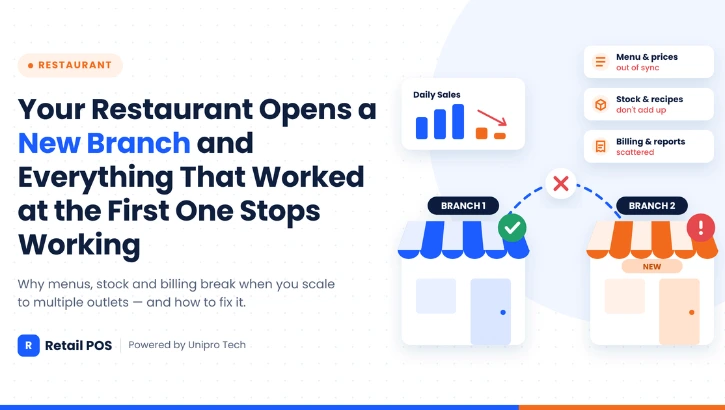
A complete guide for Indian restaurant owners who are planning to open a second location or who have already opened one and are experiencing exactly the problems described here.
The Most Dangerous Moment in Indian Restaurant Growth
A restaurant owner in Pune ran the most successful restaurant in her neighbourhood for four years. The food was consistently excellent. The service was warm and personal. The kitchen ran smoothly because she was there every evening. The accounts were clean. The food cost was managed because she personally reviewed every supplier invoice.
In January of this year she opened a second branch in a new commercial area six kilometres away.
By April, the Zomato rating at the new branch was a full star lower than the original. Food cost at the new branch was running at 44% compared to 32% at the original. Three kitchen staff had quit at the new branch in three months. A customer at the new branch complained that the butter chicken tasted different from the original. The owner was spending so much time at the new branch that the original was beginning to show the first signs of drift.
By June she was seriously considering closing the new branch.
She had not made bad decisions. She had made exactly the same decisions that worked at the first restaurant. The food was the same. The menu was the same. The team structure was the same. The supplier relationships were the same.
What was different was that the operating system that made the original restaurant work was the owner herself. Her physical presence was the quality control system, the food cost management process, the staff management framework, and the customer experience standard simultaneously. When she divided her presence between two locations, all four of these functions degraded at both locations because none of them had been systematically documented, measured, and made independent of her personal supervision.
This is the second outlet problem. And it is not unique to this owner in Pune. It is the most common growth story in Indian restaurant history.
Why the Second Outlet Is Where Most Indian Restaurant Growth Stories End
The restaurant industry in India has one of the highest failure rates of any business category and the second outlet is where a disproportionate number of those failures occur. Not the first outlet, which benefits from the owner’s complete attention and full energy. The second outlet, which divides that attention and often reveals that the first outlet’s success was more dependent on the owner’s personal presence than on any transferable system.
The statistics on this are consistent across Indian restaurant markets. A restaurant group that successfully manages one outlet for three or more years and then opens a second location faces a specific risk window of 12 to 18 months after the second outlet opens. During this window, the original outlet is at risk of declining because the owner’s attention is divided. The new outlet is at risk of never reaching the operational standard of the original because the systems that would allow it to do so were never documented.
Understanding exactly what breaks during this window — and why — is the starting point for managing it differently.
The Seven Specific Things That Break When You Open a Second Outlet
1. Food Quality Consistency
The most immediate and most visible failure at most second restaurant outlets is inconsistent food quality. The dishes that customers loved at the original outlet do not taste the same at the new one.
This happens for a specific and identifiable reason. At the original outlet, recipe standards exist in the head chef’s memory and in the informal knowledge of a kitchen team that has worked together for years. When a new kitchen team at the new outlet is trained, they are trained by the original team’s description of the recipe rather than by a documented standard with specific gram quantities and preparation protocols. The description is never as precise as the standard would be.
The new kitchen team produces dishes that match the description. But the description was imprecise, so the output differs from the original. The customer who visits both outlets notices the difference. The difference accumulates with every recipe that was transmitted informally rather than documented precisely.
2. Food Cost Control
Food cost at the second outlet is almost always higher than at the original. The gap is typically between 4 and 10 percentage points and is not explained by supplier price differences alone.
The specific causes of higher food cost at a second outlet include portion sizes that drift because there is no standardised recipe documentation to enforce, wastage that accumulates because the owner is not present daily to review it, procurement decisions made by a junior team member without the owner’s supplier relationship knowledge, and receiving shortfalls from suppliers that go undetected because the checking process is less rigorous without senior supervision.
At the original outlet, all of these potential cost drivers are controlled by the owner’s daily presence. At the second outlet, they are controlled only to the extent that formal systems have been put in place to replace that presence.
3. Staff Performance and Retention
Staff turnover at second outlets is typically higher than at original outlets for the first 12 months of operation. The specific reasons include a new team that has not yet developed the cohesion of the original, a management presence that is less consistent because the owner divides their time, performance standards that are less clearly communicated because the owner is not there to model them daily, and a team culture that is weaker because it has not had years to develop.
At the original outlet, the owner’s daily presence created accountability, model behaviour, and a team culture almost unconsciously. At the second outlet, these things need to be created deliberately through systems, documentation, and structured management rather than through the owner’s personal presence.
4. Order Accuracy and Kitchen Coordination
Delivery platform integration, kitchen display management, and order sequencing at the second outlet typically produce higher error rates than at the original for the first several months. The specific cause is that the operational choreography of the original kitchen — how orders are sequenced, how stations communicate, how delivery orders are managed alongside dine-in — was developed over years of the team working together and was never formally documented.
The new kitchen team at the second outlet must develop this choreography from scratch, which takes time and produces errors in the meantime.
5. Inventory Management and Stockouts
The second outlet will experience more stockouts and more over-purchasing than the original during the first year of operation. The purchasing process at the original outlet was based on the owner’s or head chef’s experienced judgement about demand patterns. This judgement was accurate because it was developed over years of observation. The new outlet does not have this accumulated experience and must build it, typically through the costly process of alternating between over-ordering and running short.
6. GST Compliance Complexity
Two outlets means two GST records, twice the reconciliation work, and the possibility of compliance gaps at one outlet not being caught because the owner’s attention is divided. For restaurant groups that span two states, the GST complexity multiplies again with separate state registrations and the specific compliance requirements that apply to each.
7. Management Visibility and Response Speed
At the original outlet, the owner knew what was happening because they were there. At the second outlet, information about what is happening arrives through manager reports, phone calls, and end-of-day summaries. These information sources are slower, less complete, and less reliable than direct observation.
The response time to problems at the second outlet is therefore longer than at the original. A food quality issue that the owner would have caught and corrected within an hour at the original outlet may persist for days at the second outlet before it surfaces through customer feedback or a manager’s report.
Why Everything You Did at the First Outlet Will Not Transfer Automatically
The core insight that most restaurant owners discover too late is this: the operating system of a successful single-outlet restaurant is usually the owner. The quality control, the training process, the food cost management, the customer experience standard — all of these functions exist primarily in the owner’s personal knowledge, behaviour, and daily presence rather than in documented systems that can operate independently.
When the owner is physically present, these functions work excellently. When the owner’s presence is divided, these functions degrade proportionally to the reduction in their presence.
This is not a criticism of the owner. It is a description of how most successful single-outlet restaurants actually work. The owner’s personal involvement is one of the genuine advantages of an independent restaurant over a chain. The personal touch, the flexibility, the responsiveness — these are real qualities that customers value and that the owner’s presence enables.
The challenge is that these qualities cannot be divided between two locations by dividing the owner’s time between them. They need to be converted into systems that can operate with consistency at each location regardless of whether the owner is physically present.
The specific conversions that must happen before the second outlet opens:
Currently in the Owner’s Head | Must Become |
Recipe standards remembered intuitively | Documented gram-level recipe specifications for every dish |
Food cost managed through supplier knowledge | Systematic purchasing with cost tracking per dish per day |
Quality maintained through daily personal review | Written quality standards with checklists per station per shift |
Staff managed through daily personal interaction | Structured performance tracking with measurable metrics per individual |
Customer experience created through personal presence | Service standards documented and trained explicitly |
Kitchen coordination learned informally over years | Formal kitchen communication systems with KDS and documented protocols |
None of these conversions happen automatically. Each requires deliberate effort before the second outlet opens. The restaurants that open a second outlet successfully are the ones that do this conversion work before the opening. The ones that fail are the ones that assume the second outlet will develop these qualities the same way the first one did — through time and the owner’s presence.
The Systems That Must Exist Before You Open a Second Outlet
System 1: Documented Recipe Standards for Every Dish
Every dish on the menu must have a written recipe specifying every ingredient with its exact quantity in grams or millilitres. Not “chicken as needed.” Not “a ladle of gravy.” Exact quantities that a new kitchen team member at the second outlet can follow independently without needing to consult the original kitchen team. These documented recipes are the foundation of food quality consistency across locations.
System 2: Recipe-Linked Inventory Management
The recipe documentation must be connected to an inventory management system that deducts the specified ingredient quantities from kitchen stock with every order. This creates two capabilities simultaneously: real-time food cost tracking per dish and reliable low-stock alerts before ingredients run out mid-service. Both capabilities must work independently of the owner’s presence.
System 3: Performance Metrics per Staff Member
Every staff member’s performance must be measurable through the POS system: covers per shift, average transaction value, error rate on orders and payments. These metrics create accountability that does not depend on the owner’s observation. A kitchen team member at the second outlet whose preparation times are consistently above the station average is identifiable through the KDS data without the owner needing to be present to observe it.
System 4: A Live Management Dashboard Showing Both Outlets Simultaneously
The owner must be able to see what is happening at both outlets in real time from any device. Not through phone calls to managers. Not through end-of-day reports. Real-time data showing sales, food cost, inventory alerts, and kitchen status at both outlets on one screen. This is the technology that compensates for the physical presence that can no longer be at both locations simultaneously.
System 5: Standardised Training Documentation
The onboarding process for new staff at the second outlet must be deliverable without the original team’s informal coaching. Written training materials, video demonstrations of preparation standards, and structured checklists for each role that a new team member can progress through independently.
Food Cost Management Across Two Outlets: Why It Doubles in Complexity
Managing food cost across two outlets is not twice as complex as managing it at one. It is significantly more complex because the variables multiply in ways that compound.
At one outlet, food cost management involves tracking ingredient purchases against revenue and monitoring the gap. The owner’s daily presence catches most of the variance drivers: the oversized portion, the wastage from over-preparation, the supplier short delivery.
At two outlets, the same monitoring requires separate tracking at each location, with the additional challenge that the causes of variance at one location may be invisible to the management at the other. A food cost problem at the second outlet that begins in week one may not be visible in the consolidated accounts until week four or five.
The specific food cost management requirements for a two-outlet restaurant group:
Per-outlet food cost percentage tracked daily. Not monthly. Not weekly. Daily. A food cost drift that begins on Monday at the second outlet and is discovered on the following Friday has five days of accumulated excess cost that could have been identified and corrected on Monday evening if the data had been visible.
Recipe compliance monitoring. The gap between the food cost that the recipe specifies and the food cost that is actually occurring at each outlet is the measurement of recipe compliance. A system that deducts recipe-specified quantities from inventory with every order and then compares actual consumption to theoretical consumption reveals over-portioning, substitution, and preparation waste at each outlet separately.
Per-outlet wastage recording. Wastage at the second outlet cannot be captured in a shared daily total. It must be recorded separately at each outlet with reason codes that allow the management team to identify whether the second outlet’s kitchen has a specific wastage pattern that the original does not.
Supplier price tracking per outlet. If the second outlet is purchasing some ingredients from different suppliers than the original due to logistics, the food cost calculations must reflect the actual prices paid at each outlet rather than a shared average.
Staff Management When You Cannot Be in Two Places at Once
The owner’s physical presence is the most powerful staff management tool in any single-outlet restaurant. Its effect on performance, accountability, and team culture is disproportionate to any management system that can substitute for it. When the owner divides their time between two outlets, this effect is halved at each location.
The specific challenge is building the management infrastructure that maintains accountability and performance standards at each outlet independently of the owner’s presence.
The management infrastructure that works across multiple restaurant outlets:
Objective performance data per individual. When staff performance at the second outlet is measurable through the POS system — covers served per shift, order accuracy rate, average transaction value — the management conversation moves from the owner’s observation to the data. A shift supervisor at the second outlet can conduct a meaningful performance review using the system’s data even if the owner was not present during that shift.
Clear escalation protocol with defined response times. Every staff member at the second outlet must know exactly what to do when something is beyond their authority. Not general guidance. Specific escalation contacts, specific situations, and specific expected response times. A billing system error at 7 PM on a Friday requires a different escalation path than a supplier delivery dispute on a Tuesday morning.
Daily operational checklists. Opening checklists, pre-service checklists, and closing checklists that cover every routine operational responsibility create consistency that does not depend on individual staff members remembering their responsibilities. These checklists are particularly valuable at new outlets where the routine has not yet become habitual.
Customer Experience Consistency: The Standard That Makes or Breaks the Brand
The customer who visits both outlets of a two-location restaurant group forms a single brand perception from the combined experience. An excellent experience at the original and a mediocre experience at the new outlet does not average out to a good brand. It creates a confused perception and a damaged trust.
The customer who visits the new outlet first and has a mediocre experience will not visit the original outlet to discover that the standard is higher there. They will conclude that the brand’s standard is mediocre and move on.
The customer experience elements that must be explicitly standardised before the second outlet opens:
The greeting standard. How customers are greeted from the moment they enter. What is said. What tone is used. This feels like a small detail until a customer who was warmly welcomed at the original outlet visits the new outlet and is ignored for three minutes after entering.
The order recommendation standard. Which dishes staff recommend and how they communicate the recommendation. At the original outlet, this recommendation culture developed naturally through years of the owner’s example and customer interaction. At the new outlet, it must be explicitly trained.
The complaint handling standard. Every customer complaint must be handled according to a defined protocol that every staff member at every outlet knows. An inconsistent response to the same type of complaint at two outlets creates a perception of brand unreliability.
The table time standard for dine-in. How long after ordering should starters arrive? How long between courses? How quickly should the table be cleared after the main course? These timing standards define the dining experience quality as much as the food does.
The Technology Infrastructure That Makes Multi-Outlet Restaurant Management Work
A restaurant group with two or more outlets needs technology infrastructure that extends management visibility beyond physical presence. This infrastructure does not replace good management. It enables good management to operate at scale.
The specific technology requirements for multi-outlet restaurant management:
One centralised database for all outlets. Every transaction at every outlet must feed one shared database. This shared database is the foundation of every other multi-outlet management capability: unified food cost reporting, cross-outlet customer loyalty, consolidated GST, and the live management dashboard.
Live management dashboard showing all outlets simultaneously. The owner, operations manager, or chain director must be able to see every outlet’s current sales against target, current kitchen order queue length, current food cost percentage, any inventory alerts, and delivery platform status from one screen on any device at any moment. This real-time visibility is what makes it possible to manage two or more outlets from one location without blind spots.
Recipe-linked ingredient deduction across all outlets. Every order at every outlet must deduct the recipe-specified ingredient quantities from that outlet’s kitchen inventory automatically. Food cost percentage per dish must be visible per outlet, enabling immediate identification of which outlet has a food cost problem and which does not.
Centralised menu management with per-outlet deployment. The menu at both outlets must be the same document, managed from one place, deployed to both outlets simultaneously. A recipe change, a price update, or a seasonal menu addition configured once must appear at every outlet automatically. Manual menu updates per outlet are a source of inconsistency that compounds over time.
Delivery platform integration at every outlet. Both outlets’ Zomato and Swiggy integrations must route into their respective kitchen queues automatically. Management must be able to see both outlets’ delivery performance, ratings, and per-channel revenue from one consolidated view.
How RetailPOS Dineazy Powers Multi-Outlet Restaurant Operations
RetailPOS Dineazy is built specifically for Indian restaurant chains. Every capability described in this guide is a core function of the platform, not a module or an add-on.
Centralised Database for All Outlets
Every outlet connects to one shared Dineazy database. Every transaction updates the shared data immediately. There is no manual consolidation, no end-of-day sync, and no outlet where the management dashboard is delayed.
Live Cockpit Dashboard
The Cockpit dashboard shows every outlet’s real-time sales, food cost percentage, kitchen order queue, inventory alerts, and delivery performance simultaneously from one screen on any device. The Pune restaurant owner from the opening of this guide would have seen the food cost drift at her new branch beginning in week one rather than discovering it in month four.
Recipe-Level Food Cost Tracking per Outlet
Every dish at every outlet is linked to its exact ingredient quantities. Every order deducts those quantities from the outlet’s kitchen inventory automatically. Food cost percentage per dish per outlet is updated in real time. The dashboard shows the food cost comparison between outlets, making any variance immediately visible for investigation.
Unified Kitchen Display System per Outlet
Each outlet’s KDS receives all orders from all channels — dine-in, Zomato, Swiggy, QR table ordering, and direct app orders — in one unified queue. Every outlet’s kitchen team works from one clear display regardless of how many ordering channels are active. The owner can see each outlet’s kitchen queue status on the Cockpit dashboard in real time.
Centralised Menu Management
Menu changes, recipe updates, and pricing modifications configured at head office deploy to all outlets simultaneously. A recipe standardisation change made after identifying a food quality inconsistency between outlets reaches every outlet’s billing system and kitchen display immediately.
Genuine Delivery Platform Integration at Every Outlet
Zomato and Swiggy orders at every outlet auto-import into the Dineazy system and enter the outlet’s kitchen queue without any manual entry. Delivery performance metrics for all outlets appear on the Cockpit dashboard side by side. The owner can compare both outlets’ Zomato ratings, delivery acceptance rates, and delivery channel food cost from one view.
Per-Outlet Staff Performance Data
Every billing transaction, every KOT, and every table is attributed to the specific staff member who handled it. Performance metrics per staff member per outlet are available for any period. The management team at a second outlet can conduct meaningful performance conversations using system data even when the owner is not physically present.
Multi-Outlet Customer Loyalty
A customer who visits the original outlet and earns loyalty points is recognised at the second outlet immediately with their complete history and full balance. The unified customer database across all outlets builds the chain-level customer relationship that makes the brand more valuable than the sum of individual outlet relationships.
Conclusion: The Second Outlet Is Either a Multiplier or a Divider. The Difference Is Systems.
The Pune restaurant owner’s experience is not unusual. Most Indian restaurant chains go through a version of the same story. The second outlet opens. The owner’s attention divides. Problems appear at both locations. The second outlet never reaches the original’s standard.
The restaurants that break this pattern do not do it by working harder or by being in two places at once. They do it by converting the systems that lived in the owner’s presence into documented processes, measurable metrics, and technology infrastructure that can maintain standards independently.
Every element of the original restaurant’s success — the recipe consistency, the food cost control, the staff accountability, the customer experience standard — can be systematised. The recipe is documented gram by gram. The food cost is tracked per dish per outlet per day in real time. The staff performance is measured through the POS and KDS data. The customer experience standard is defined and trained explicitly.
And the owner watches all of it from one dashboard on their phone, from either location, in real time.
Today is Dussehra, October 20, 2026. India’s most celebrated shopping day. Restaurants across the country are serving record covers and record orders. If you are a restaurant owner thinking about expanding while your first outlet is at its best, this is the right moment to think about what systems you are building to make the second outlet as good as the first.
Book a free demo and see how RetailPOS Dineazy manages multi-outlet restaurant operations. Visit retailpos.co.in/register-demo | Call 044-421 421 40 / 95660 44300 | Email salesenquiry@uniprotech.co.in
Frequently Asked Questions
The right time to open a second restaurant outlet is when three conditions are simultaneously true. First, the first outlet has been consistently profitable for at least 18 months with documented systems rather than owner-dependent informal processes. Second, the recipe standards, training protocols, and operational procedures are documented precisely enough to be implemented at a new location without the original team’s presence. Third, the management technology is in place — specifically a POS system that gives the owner real-time visibility into both outlets from one dashboard — before the second outlet opens, not after it opens and problems have already developed. Opening on revenue momentum alone, without these three conditions, is the most common cause of second outlet failure.
Food cost at a second outlet is typically higher because the cost management practices of the original outlet depended on the owner’s daily presence rather than on formal systems. The owner at the original outlet catches oversized portions, reviews supplier deliveries personally, manages kitchen wastage through daily observation, and maintains purchasing discipline through personal supplier relationships. At the second outlet, none of these practices can operate through the owner’s presence because they are not there daily. Food cost management must therefore be systematised: gram-level recipe documentation enforced through kitchen training, daily food cost reporting per outlet through the POS system, formal receiving procedures at the loading dock, and systematic daily wastage recording. Restaurants that build these systems before opening the second outlet typically hold food cost within 2 to 3 percentage points of the original. Those that rely on the same informal processes see gaps of 8 to 12 percentage points.
Quality consistency across multiple restaurant outlets is maintained through three interconnected mechanisms. Recipe documentation at gram-level precision ensures that the same dish is produced the same way at every outlet regardless of which team member prepares it. Performance data per staff member through the POS and KDS systems provides objective measurement that identifies quality issues at the individual level rather than requiring direct observation. And real-time management visibility through a live dashboard showing both outlets’ performance simultaneously allows the owner to identify emerging problems — a food cost drift, a rising order error rate, a declining cover count — before they have been accumulating for weeks.
Three technology capabilities are essential before opening a second restaurant outlet. First, a restaurant POS system that connects both outlets to one centralised database, providing a live management dashboard showing both outlets simultaneously from any device. Second, recipe-linked kitchen inventory management that tracks ingredient consumption and food cost per dish per outlet in real time, making any food cost variance visible immediately rather than at month end. Third, genuine delivery platform integration at both outlets routing Zomato and Swiggy orders directly into each outlet’s kitchen queue without any manual entry. Without these three capabilities in place before the second outlet opens, the owner is managing two outlets with the information tools of one outlet.
With proper systems in place before opening, a second restaurant outlet typically reaches the original’s operational standard within 3 to 5 months. Without documented recipe standards, real-time food cost tracking, and genuine technology infrastructure, this timeline extends to 12 to 18 months or never. The 3 to 5 month timeline assumes that recipe documentation is complete before the second outlet opens, that the KDS and POS systems are live from day one, that staff training at the second outlet used the documented standards rather than informal coaching, and that management reviews performance data for both outlets daily during the first 90 days.
Ready to make your second outlet as strong as your first? Book your free RetailPOS Dineazy demo today →