
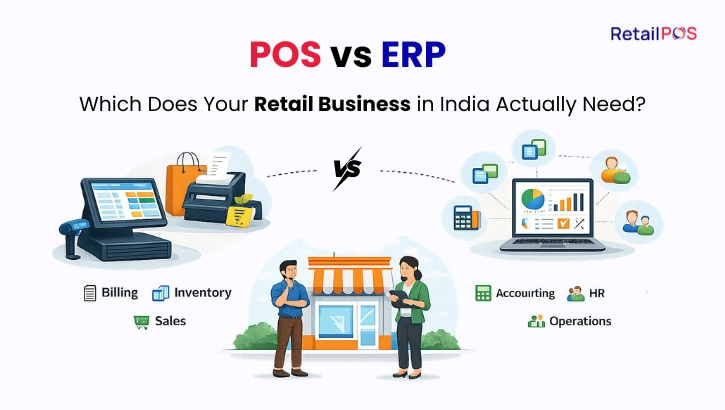
There is a conversation that happens in almost every growing retail business in India at some point. The owner or operations head sits across from their accounts team and asks a straightforward question: why does running this business keep getting harder even though we have software?
The billing counter is fast. The invoices go out. GST numbers look right on the surface. But inventory keeps going out of sync. The second outlet is impossible to track from head office. The monthly MIS report still takes three days to compile. And nobody can explain why the system shows 400 units of a product that clearly does not exist on the shelf.
The answer to that question is almost always the same. The business has outgrown its point of sale system and needs an enterprise resource planning platform. Or, in some cases, a business has invested in a heavyweight ERP that its team cannot operate and needs a leaner, faster system at the counter. Either way, the confusion between POS and ERP is costing Indian retailers time, money, and growth.
This guide exists to end that confusion. By the time you finish reading, you will know exactly what each system does, where one ends and the other begins, what stage of business each suits, and how to make the right decision for your specific retail operation.
What a POS System Actually Is
A point of sale system is the technology that sits at the front end of your retail operation. Its primary job is to process transactions accurately and quickly. When a customer brings items to your counter, the POS system scans or searches for the products, applies the correct prices and GST rates, accepts payment through cash, card, or UPI, prints or sends the invoice, and updates the sales record.
A well-built retail POS system in India handles several layers beyond basic billing:
- Fast billing at the counter with barcode scanning and multi-payment support
- Product catalogue management with pricing and discount configuration
- GST-compliant invoice generation with HSN code mapping and tax computation
- Basic inventory tracking that reduces stock counts after each sale
- End-of-day cash reconciliation and shift management
- Daily and weekly sales reports by product and category
- Offline billing capability during internet outages
The defining characteristic of a POS system is that it is transaction-centric. Everything it does revolves around what happens at the billing counter. It is excellent at that job. The limitation appears the moment your business needs systems that operate beyond the counter.
Think of a POS system as a very capable cash register that has grown up. It handles the front of your store beautifully. But it does not know what is happening in your warehouse, what your purchase team ordered last week, how your profitability compares across two outlets, or what your CRM says about a customer who walks in for the fourth time this month.
What an ERP System Actually Is
An enterprise resource planning system is a fundamentally different category of software. Where a POS handles the transaction at the counter, an ERP connects every function of the business into a single, unified platform.
A retail ERP integrates all of the following functions under one common database:
- Billing and point of sale across all outlets
- Real-time multi-outlet inventory management with inter-branch transfers
- Purchase and procurement with vendor management and automated reordering
- Accounts payable, accounts receivable, and general ledger
- GST filing support including GSTR-1, GSTR-3B, and e-invoicing with IRN generation
- Customer relationship management and loyalty programme management
- Staff management with role-based access, shift scheduling, and productivity tracking
- Business analytics with outlet-wise, category-wise, and vendor-wise reporting
The critical word in ERP is integration. In a business without ERP, each function operates in its own silo. The billing team has their records. The purchase team has their spreadsheets. The accounts team has their Tally entries. The warehouse has its own stock count. The head office gets a PDF report compiled manually from all of these sources, usually days after the period has ended.
In a business with a retail ERP, all of these functions write to and read from the same data source in real time. When a sale happens at the counter, inventory reduces instantly. When a purchase order is raised and goods are received, stock updates immediately. When a customer uses loyalty points, the CRM reflects it across all outlets. When the month closes, your GSTR-1 data is already prepared because every transaction has been recorded correctly from the moment it occurred.
POS vs ERP: Side-by-Side Comparison
The table below captures the core differences between a standalone POS system and a full retail ERP platform across the functions that matter most to Indian retailers.
Function | POS System | Retail ERP |
Billing and invoicing | Fast, full-featured | Fast, full-featured |
GST invoice generation | Yes, with HSN mapping | Yes, with full automation |
E-invoicing and IRN | Limited or add-on | Built-in with IRP integration |
GSTR-1 and GSTR-3B preparation | Manual export required | Automated from billing data |
Inventory tracking | Basic, sale-side only | Full cycle: purchase to sale to audit |
Inter-branch stock transfer | Not available | Managed with document trail |
Purchase order and procurement | Not available | Integrated with vendor management |
Multi-outlet reporting | Manual consolidation | Real-time centralised dashboard |
Customer loyalty and CRM | Basic or not available | Full CRM with campaign automation |
Staff and shift management | Basic cashier management | Full role-based access and scheduling |
Business analytics | Sales reports only | Margin, profitability, and vendor analysis |
Accounts and accounting | Not integrated | Full integration or native accounting |
Scalability for chains | Up to 2 to 3 outlets efficiently | Designed for 1 to 200+ outlets |
Implementation complexity | Low, fast to deploy | Moderate, requires setup and training |
Cost | Lower entry cost | Higher but covers multiple systems |
This comparison immediately reveals the fundamental truth: a POS system and an ERP are not competing products. They serve different operational scopes. The question is not which one is better. The question is which one matches where your business is right now and where it is going.
When a POS System is Exactly What You Need
Not every retail business in India needs an ERP. A well-built POS system is the right choice for a significant portion of the retail market, and choosing an ERP before your business is ready creates its own set of problems including unnecessary cost, implementation complexity, and features your team will never use.
A POS system is the right fit when:
- You operate a single store and your primary challenge is fast, accurate billing with GST compliance
- Your inventory is manageable and your team is small with straightforward reporting needs
- You are in an early growth phase and your processes are still being refined and standardised
- You sell in a single category with relatively simple inventory such as a standalone bakery, a neighbourhood pharmacy, or a single-location boutique
- Your operational problems are at the counter: slow billing, GST invoice errors, long queues, or end-of-day reconciliation taking too long
The key signal that a POS system is right for you is that your problems live at the billing counter. These are POS problems and a good POS system solves them completely without the overhead of an ERP.
Signs Your Retail Business Has Outgrown a POS System
These signs appear gradually and are often misread as team problems or communication failures. They are almost always system limitations masquerading as people problems.
- Inventory inaccuracy your team cannot explain
The POS shows 250 units of a product. The shelf has 180. Nobody knows where the gap came from. Without a system that tracks every inward movement through a purchase receipt, every outward movement through billing, every adjustment through stock audit, and every inter-branch transfer through a proper document trail, inventory inaccuracy becomes inevitable and grows over time.
- Opening a second outlet creates disproportionate complexity
You now need to track two sets of stock, two sets of sales, two sets of staff shifts, and somehow produce reports that combine both into a coherent picture of business performance. If this requires phone calls between stores, manual data exports, or spreadsheets compiled every evening, your system is not scaling with your ambition.
- GST filing is still a manual process every month
Your accounts team exports billing data, opens spreadsheets, categorises transactions by GSTIN type, computes ITC manually, builds GSTR-1 tables row by row, and then uploads to the portal. Every month, for every return. This is a compliance risk and a time cost that compounds with every additional transaction your business processes.
- You cannot answer basic business questions in real time
Questions like: which outlet is most profitable this week, which supplier is delivering below contracted price, which product category has the highest shrinkage rate, which customer segments drive the highest repeat purchase volume. If answering any of these requires a manual data pull, your system is giving your management team incomplete visibility to make fast decisions.
- Your purchase function is disconnected from your sales function
Your purchase team buys based on intuition or a stock count someone did last week. Your billing system has real-time data showing exactly which products are moving fast and which are sitting. But these two systems do not communicate. As a result, you overstock slow-moving products and regularly run out of fast-moving ones.
- Staff accountability is hard to enforce
When your system cannot clearly attribute every transaction to a specific cashier, every stock movement to a specific staff action, and every discount to an authorised approval, managing accountability across your team becomes a persistent problem rather than an occasional one.
The Hidden Cost of Using the Wrong System
Most retailers evaluate software on visible costs: licence fees, hardware, and implementation charges. The real cost of using the wrong system sits in places that do not appear on any report.
Hidden Cost | How It Shows Up | Typical Impact |
Inventory shrinkage | Stock count never matches system | 1% to 3% of inventory value annually |
Manual reconciliation labour | Accounts team time on return preparation | 20 to 40 staff hours per month |
Missed stock-out sales | Products run out before reorder is raised | 2% to 5% of potential revenue lost |
GST error corrections | Amendment filings and interest on shortfalls | Penalties plus 18% interest per annum |
Delayed management decisions | Reports arrive days after period ends | Strategic opportunities missed |
Multi-outlet coordination overhead | Phone calls and manual data sharing | 5 to 10 hours of management time weekly |
When you add these costs across a full year for a multi-outlet retail business, the investment in an appropriate ERP system often pays for itself within the first year through shrinkage reduction and labour savings alone. The decision is not whether you can afford an ERP. It is whether you can afford to continue without one.
The Indian Retail Context: Why This Decision is Different Here
The POS versus ERP decision for Indian retailers carries dimensions that do not apply to retailers in other markets. Three factors make the Indian context fundamentally distinctive.
GST Complexity
No other major economy runs a retail tax system with as many rates, as many return types, and as much digital infrastructure as India’s GST framework. Every retail transaction must carry the correct HSN code, tax rate, and mandatory invoice fields. B2B transactions now require e-invoicing with IRN generation through the IRP. Monthly and quarterly return filing requires accurate categorisation of every transaction into the right table. Annual returns require full year reconciliation. This level of compliance complexity demands a system that integrates billing and accounting at a fundamental level.
The Rapid Formalisation of Indian Retail
Indian retail is moving from unorganised to organised at a pace that is faster than most business owners anticipated. A single-store retailer who planned gradual growth over ten years may find themselves managing four outlets within three years because of favourable market conditions, franchise opportunities, or simply good execution. The technology decision made at two outlets determines how painful the transition to five, ten, or twenty outlets will be. Getting the infrastructure right before the growth happens is significantly cheaper than migrating systems in the middle of expansion.
The Availability of Affordable Retail ERP in India
The historical argument that ERP is only for large enterprises with large budgets no longer holds for Indian retailers. Purpose-built retail ERP systems are now available at pricing and implementation timelines that make them viable for businesses with as few as two or three outlets. The decision is no longer purely about affordability. It is about operational readiness and growth ambition.
POS vs ERP by Business Type: Quick Reference
The table below matches common retail business types in India to the system that typically serves them best at their current stage.
Business Type | Recommended System | Key Reason |
Single neighbourhood grocery store | POS | Volume and complexity are counter-level |
Single-location apparel boutique | POS | SKU and compliance needs are manageable |
Standalone pharmacy with 500 to 1000 SKUs | POS with pharma features | Expiry tracking and basic compliance |
Supermarket with 5000 plus SKUs | ERP | Inventory depth and purchasing complexity |
Apparel chain with 3 or more outlets | ERP | Variant tracking and centralised pricing |
Pharma chain across multiple states | ERP | Multi-GSTIN compliance and batch management |
Quick service restaurant chain | ERP | Kitchen integration and multi-outlet P&L |
Electronics retailer with serial tracking | ERP | Serial number and warranty management |
FMCG distribution business | ERP | Distributor billing and route management |
Multi-format retail group | ERP | Consolidated reporting and category analytics |
This is a general guide, not an absolute rule. The correct answer for your business depends on your specific operational complexity, your team’s capability, and your growth timeline. If you are between two rows in this table, the tiebreaker is almost always your expansion plan for the next 24 months.
How to Make the Right Decision for Your Business
Map your five most painful operational problems. List the things that cost your business the most time, money, or missed opportunity every month. Then use this framework to identify where those problems live.
Step 1: Count your outlets and your planned outlets in 24 months
One outlet with no expansion plan: POS. Two or more outlets or concrete expansion plans: begin evaluating ERP now.
Step 2: Assess your inventory complexity
Fewer than 1000 SKUs in a single category: POS manages well. More than 1000 SKUs, multiple categories, variants, batches, or expiry tracking: ERP-level inventory control is necessary.
Step 3: Evaluate your GST filing burden
Primarily B2C, single GSTIN, basic return filing: POS handles compliance adequately. Significant B2B volume, multiple GSTINs, or above the e-invoicing threshold: ERP-level compliance support is essential.
Step 4: Assess your reporting needs
Daily sales summaries are sufficient: POS provides what you need. You need margin analysis, outlet-wise profitability, vendor performance, and customer behaviour data: only an ERP generates this from your operational transactions.
Step 5: Consider your team’s capacity for system complexity
A lean team with limited technology exposure may get more value from a well-implemented POS than from an ERP they cannot operate fully. The best system is the one your team actually uses effectively, not the most powerful one available.
When You Need Both: The Integrated POS and ERP Approach
The most sophisticated retail operations in India do not choose between POS and ERP. They use both, tightly integrated so that the speed and simplicity of a purpose-built POS counter experience is combined with the depth and control of a full ERP backend.
In this architecture, the billing counter runs a fast, intuitive POS interface optimised for speed and ease of use by counter staff. Every transaction processed at the POS feeds instantly into the ERP backend, which updates inventory, records accounting entries, logs loyalty points, and prepares data for GST filing. Counter staff never need to think about ERP complexity. The management team and accounts function get full ERP data depth without slowing down the front end at all.
The benefits of this integrated approach include:
- Counter speed is not sacrificed for backend depth
- Data flows from transaction to compliance to analytics without manual transfer
- A single system of record eliminates reconciliation across multiple platforms
- Management visibility is real-time rather than end-of-period
- Scaling from one to many outlets requires configuration, not system replacement
- Staff train on a single platform rather than two or more disconnected tools
This is the architecture that scales from a single outlet to a national chain without requiring a technology change at each growth milestone. RetailPOS is built on exactly this principle, with a purpose-built billing terminal delivering the counter experience and an ERP backend handling inventory, procurement, GST, CRM, and analytics from one centralised platform.
What RetailPOS Delivers Across Both Dimensions
For retailers at the POS stage, RetailPOS delivers:
- Fast billing on tablet, mobile, and desktop hardware with barcode scanning support
- Full GST-compliant invoice generation with automatic HSN mapping and tax computation
- Offline billing that continues accurately without internet connectivity
- Basic inventory tracking with low-stock alerts at the SKU level
- End-of-day settlement reports and cashier shift management
- UPI, card, cash, and wallet payment acceptance at the counter
For retailers ready for ERP-level management, the same platform extends to:
- Real-time multi-outlet inventory with inter-branch transfer management and audit trails
- Centralised purchase management with automated reorder alerts and vendor price comparison
- Full GST return support including GSTR-1, GSTR-3B, and e-invoicing with direct IRP integration
- Customer loyalty and CRM with WhatsApp and SMS campaign automation
- Staff management with role-based access controls and shift scheduling
- Business analytics with outlet-wise, category-wise, and vendor-wise profitability reporting
- Centralised pricing and promotion management pushed to all outlets from head office
The transition from POS to ERP within RetailPOS happens on the same platform. No data migration, no staff retraining on a different system, no disruption to counter operations while backend capability expands. Retailers who have experienced a system migration mid-growth understand the value of this continuity far more than it sounds on paper.
Conclusion
The POS versus ERP debate in Indian retail is not really a debate. It is a sequencing question. Every retail business starts where a POS system is the right fit. As it grows in outlets, SKU complexity, transaction volume, GST obligations, and management information needs, the right fit changes.
The businesses that get this sequencing right grow faster, waste less, and build operational infrastructure that supports rather than constrains their ambition. The most expensive mistake in retail technology is not choosing the wrong system. It is staying on the wrong system too long after the right one has become obvious.
If the signs in this guide sound familiar and you are unsure whether your business has crossed the line from POS to ERP territory, the RetailPOS team is ready to walk you through a personalized demonstration built around your actual outlet structure, product categories, and compliance requirements. Not a generic demo. A real conversation about your specific business.
Frequently Asked Question
A POS system manages transactions at the billing counter, covering billing, payment processing, GST invoice generation, and basic inventory tracking. A retail ERP connects every function of the business including billing, inventory, purchasing, vendor management, accounting, GST return filing, CRM, and multi-outlet analytics into one unified platform. The fundamental difference is scope: a POS controls what happens at the counter, while an ERP controls the entire business operation from procurement to compliance to customer engagement.
The clearest signals are inventory inaccuracy that your team cannot explain, a second outlet that creates disproportionate operational complexity, GST filing that still requires manual spreadsheet preparation every month, management reports that take days to compile after the period ends, and a purchase function that is disconnected from real-time sales data. If three or more of these describe your current situation, your business has likely outgrown standalone POS and needs ERP-level management infrastructure.
Yes. Purpose-built retail ERP systems designed for the Indian market are now available at pricing and implementation timelines that make them viable for businesses with as few as two or three outlets. The more relevant question is the total cost of not having an ERP, which includes inventory shrinkage from untracked stock movements, labour cost of manual GST reconciliation, missed reorder decisions, and delayed management reporting. For most multi-outlet retailers, the ERP investment pays for itself within the first year through operational savings alone.
Yes, and the most effective retail operations in India use both in an integrated architecture. The billing counter runs a fast, purpose-built POS interface optimised for counter staff speed and simplicity. Every transaction feeds instantly into the ERP backend, which updates inventory, records accounting entries, logs loyalty points, and prepares GST return data. RetailPOS is designed on exactly this principle, delivering counter speed at the front end and full ERP depth at the backend from a single unified platform.
The best retail ERP for Indian multi-outlet retailers is one built specifically for the Indian market with native GST compliance, multi-GSTIN support, inter-branch inventory management, centralised pricing and promotion control, and real-time consolidated reporting. Generic accounting ERPs or globally built platforms often lack the retail-specific workflows and India-specific compliance features that growing chains need. RetailPOS has served over 10,000 retail businesses across India with a platform purpose-built for multi-outlet management across supermarkets, apparel chains, pharma, electronics, and food and beverage businesses.
Implementation timelines vary based on outlet count, data migration complexity, and the degree of customisation required. For a retail chain with three to five outlets, a typical implementation runs four to six weeks from contract to full go-live. This includes product master setup, HSN and GST configuration, staff training at all outlets, hardware setup if required, and a parallel run period where both old and new systems operate simultaneously to validate data accuracy before full cutover. A phased implementation approach, starting with billing and inventory before activating advanced modules, reduces risk and allows your team to build confidence on the platform before full deployment.

 Book your demo
 Talk to our POS experts
- 📧 Email: salesenquiry@uniprotech.co.in
Run your store with confidence. Let technology handle the complexity.
Or WhatsApp our team directly – we respond within minutes.
Or call us at 95662 44611