
Key Takeaways
- Stockouts and overstock are two sides of the same inventory control problem and together they silently drain retail profit margins every single day.
- A stockout is not just a missed sale. It is a customer who walks out, finds a competitor, and may never return to your store.
- Overstock locks up working capital, wastes shelf space, and almost always ends in forced markdowns that damage your profit margins.
- Retailers who implement real-time inventory management software, automated reorder alerts, and centralized purchasing reduce both problems fast, often within one season.
- RetailPOS gives Indian retail chains the tools to eliminate stockouts and overstock with live inventory tracking, smart alerts, and complete multi-outlet control.
You ordered too much of one product. You completely ran out of another. Sound familiar?
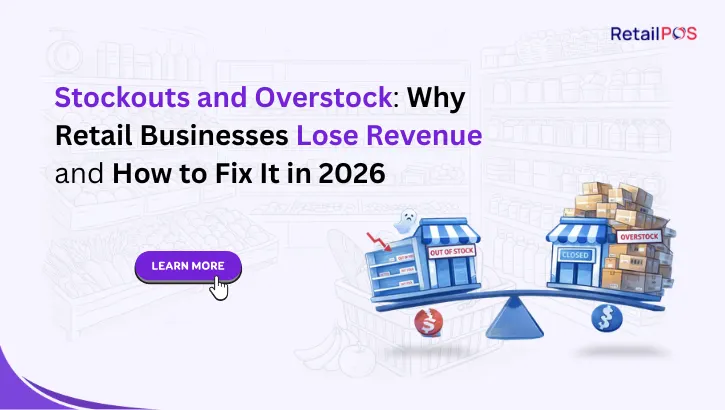
Stockouts and overstock are the two most expensive inventory problems in retail today. The frustrating reality is that they almost always happen at the same time. One shelf sits empty while another piles up with products no customer wants to buy.
For retail chain owners across India, this is not a minor operational inconvenience. It is a direct, daily hit to revenue, customer loyalty, and cash flow.
This complete guide breaks down exactly why stockouts and overstock happen, what they are costing your retail business right now, and the proven strategies to fix them permanently.
Contents
2. Why Do Stockouts and Overstock Happen?
3. The True Financial Cost of Stockouts and Overstock
4. 8 Proven Strategies to Eliminate Stockouts and Overstock
5. How to Diagnose Which Inventory Problem You Have
6. Key Retail Inventory Metrics Every Store Owner Must Track
7. How the Right Retail POS Software Solves Both Problems
8. How RetailPOS Helps Indian Retailers Eliminate Stockouts and Overstock
9. Real Results From RetailPOS Customers
10. Frequently Asked Questions
1. What Are Stockouts and Overstock in Retail?
Stockout occurs when a product a customer wants to purchase is unavailable in your store. The shelf is empty. The variant is out of stock. The customer walks away, often directly to a competitor.
Overstock occurs when you hold far more inventory than your customers are buying. The stock sits on shelves or in your warehouse, tying up working capital, consuming storage space, and steadily losing value.
Both problems share the same root cause: retailers lack accurate, real-time inventory visibility into what they have, what is selling, and what is not.
Stockout Example
A supermarket in Chennai runs out of a popular basmati rice brand every weekend because reordering is triggered manually. By the time someone notices the empty shelf, customers who came specifically for that product leave without buying anything else.
Overstock Example
A garments store in Coimbatore ordered 200 pieces of a kurta style based on the previous year’s trend. This season it barely moved. By December, 140 pieces are still sitting on the rack and the only way to clear them is a 50% markdown that completely wipes out the profit margin.
2. Why Do Stockouts and Overstock Happen?
Understanding the root cause is the critical first step to solving the problem permanently. Here are the most common reasons retail businesses face these inventory challenges:
No Real-Time Inventory Visibility When your team does not know the exact stock level of every product at every outlet in real time, all purchasing and replenishment decisions are made without accurate data. By the time someone manually checks, it is already too late to act.
Purchasing Decisions Based on Intuition Instead of Data Many retail buyers rely on experience and instinct when placing purchase orders. Without sales velocity data showing how fast each SKU sells, overstocking slow items and understocking fast-selling ones becomes almost inevitable.
No Automated Reorder Alerts or Minimum Stock Thresholds Without a retail inventory management system that automatically flags when a product drops below a safe stock level, stockouts happen silently. They are only discovered when a customer asks for something that is no longer available.
Inventory Blind Spots Across Multi-Outlet Chains In a chain with five or more outlets, products selling fast at one store may be sitting completely unsold at another. Without centralized inventory visibility, you are placing fresh supplier orders when a simple inter-store stock transfer would solve the problem.
Seasonal Demand Misjudgement Apparel, electronics, and FMCG categories are heavily influenced by seasons, festivals, and market trends. Retailers who do not use historical sales data to plan seasonal buying consistently end up with either empty shelves or excess inventory every cycle.
Unpredictable Supplier Lead Times If a supplier’s delivery time varies between 7 and 21 days and your reordering is based on a 7-day assumption, stockouts become a regular occurrence. Effective buffer stock planning must account for realistic and variable supplier timelines.
3. The True Financial Cost of Stockouts and Overstock
Most retail business owners significantly underestimate how much these two inventory problems are actually costing them. Here is a clearer picture of the financial impact:
The Real Cost of a Stockout
Lost Revenue: The immediate sale you did not make.
Lost Customer: Research shows that 30 to 40 percent of customers who experience a stockout purchase the product from a competitor. A significant share of those customers never return to your store.
Lost Entire Basket: A customer who came for one item would typically have purchased three or four additional products. When they leave because of a stockout, your store loses the entire purchase value, not just one item.
Reputation Damage: In the age of Google reviews and social media, customers who cannot find what they need at your store will share that experience publicly.
Real Example: A retail chain in Tamil Nadu calculated that recurring stockouts on 12 high-demand medicines were costing approximately Rs. 1.8 lakh per month in direct lost sales, not including customers who permanently shifted to a nearby competitor.
The Real Cost of Overstock
Locked Working Capital: Cash tied up in unsold inventory cannot be used to purchase new stock, pay suppliers on time, or invest in business growth.
Wasted Storage Space: Overstock occupies valuable shelf space and warehouse space that could be generating revenue with faster-moving, high-margin products.
Forced Markdowns: When overstock remains unsold too long, the only solution is a deep discount that eliminates margin or forces selling at a loss.
Inventory Write-Offs: In perishable categories like food, pharma, and cosmetics, overstock that reaches expiry becomes a direct financial write-off with zero recovery.
Real Example: A supermarket chain with six outlets in South India was carrying approximately Rs. 12 lakh in slow-moving inventory at any given time. Most of this stock eventually went to clearance at a 40 percent markdown, recovering less than half its original cost.
4. Eight Proven Strategies to Eliminate Stockouts and Overstock
1. Implement Real-Time Inventory Management Software
The single highest-impact investment a retail business can make is moving from manual stock counts and spreadsheets to a real-time retail inventory management system. Every purchase receipt, every sale, every inter-store transfer, and every customer return should update inventory automatically and instantly.
What this changes immediately:
- You always know the exact stock level of every product at every outlet
- Stockouts are identified and prevented before they reach the shop floor
- Overstock becomes visible early, before it turns into a write-off problem
Best suited for: All retail formats including grocery chains, apparel stores, supermarkets, electronics showrooms, and multi-outlet retail chains.
2. Set Minimum Stock Levels and Automated Reorder Points
For every product in your store, particularly your top-performing SKUs, define a minimum stock threshold. When inventory drops to that level, your retail POS system automatically generates a reorder alert or purchase recommendation.
Key Benefits:
- Eliminates reactive, last-minute emergency ordering from suppliers
- Reduces stockouts on your highest-revenue products
- Gives your purchasing team data-driven triggers instead of guesswork
Important Considerations:
- Accurate minimum thresholds require clean historical sales velocity data
- Reorder points need regular review as customer demand shifts seasonally
Real Example: A home appliances store in Madurai set automated reorder points for their top 150 SKUs. Stockout incidents on those products dropped by 55 percent in the following quarter, directly increasing customer satisfaction and repeat purchases.
3. Use Sales Velocity Data to Drive Smarter Purchasing Decisions
Sales velocity data tells you precisely how fast each product sells per day, per week, or per month. Use this data, not last year’s purchase invoice, to drive every buying decision for the upcoming cycle.
Questions to answer before placing any purchase order:
- How many units of this SKU sold in the last 30 days?
- Is demand trending upward or downward compared to the same period last year?
- How many days of remaining stock do I have based on the current daily sales rate?
- What is my supplier’s realistic minimum and maximum lead time?
Real Example: A grocery chain in Trichy used six months of sales velocity data to plan their Pongal stock requirements. They reduced overstock on slow-moving festive items by 34 percent compared to the previous year while achieving zero stockouts on all high-demand products throughout the festival period.
4. Apply ABC Inventory Analysis to Prioritize Stock Control
ABC analysis is one of the most powerful retail inventory management techniques available. It classifies your entire inventory by sales contribution:
A-Category Products: The top 20 percent of SKUs that generate approximately 80 percent of total revenue. These require the tightest inventory control, fastest reorder cycles, and closest monitoring.
B-Category Products: Mid-tier products with consistent but moderate sales performance. These should be monitored on a weekly basis.
C-Category Products: Slow-moving or highly seasonal items. Keep lean stock levels and review regularly for emerging overstock risk.
Concentrating purchasing and replenishment effort on A-category products prevents the most revenue-damaging stockouts. Keeping C-category items lean eliminates the most common source of overstock buildup.
5. Transfer Stock Between Outlets Before Reordering From Suppliers
In a multi-outlet retail chain, one store’s overstock problem is frequently another store’s stockout problem. Before raising a fresh purchase order with a supplier, check whether a sister branch holds surplus stock that can be transferred immediately.
Key Benefits:
- Reduces unnecessary supplier purchasing costs
- Moves slow-selling stock from low-footfall outlets to high-demand locations
- Improves overall chain-level sell-through rate across every branch
Real Example: A fashion retail chain with seven outlets across Tamil Nadu discovered they were reordering products from suppliers that were sitting in surplus at two other branches. After implementing systematic inter-store stock transfers, they reduced fresh purchase orders by 18 percent in one quarter, freeing up significant working capital.
6. Calculate and Maintain Buffer Stock Based on Supplier Lead Times
If your supplier takes 14 days to deliver, never wait until you have only 3 days of inventory remaining before reordering. Maintain a buffer stock level that accounts for realistic lead times including occasional supplier delays and unexpected demand spikes.
Buffer Stock Formula: Buffer Stock equals Maximum Daily Sales minus Average Daily Sales, multiplied by Maximum Supplier Lead Time in Days.
This calculation ensures your store never runs out of critical stock even when suppliers face delays or customer demand increases unexpectedly.
7. Set Overstock Alerts and Act Early on Slow-Moving Inventory
Just as you configure minimum stock alerts to prevent stockouts, configure maximum stock thresholds to flag overstock situations early. If a product has had zero sales for 45 consecutive days, it needs immediate action: a targeted promotional offer, a strategic price reduction, or a transfer to a higher-footfall outlet.
The earlier you act on a slow-moving product, the better the price you will recover.
A 15 percent markdown at week 6 is dramatically more profitable than a 60 percent clearance sale at month 5.
8. Centralize All Purchasing Decisions Across Your Entire Retail Chain
In a multi-outlet retail business, individual store managers should not be placing independent purchase orders with suppliers. Centralizing all purchasing through a head office system delivers immediate benefits:
- Eliminates duplicate ordering of the same products across different branches
- Generates better negotiating leverage with suppliers through larger consolidated order volumes
- Provides a single, unified view of all outstanding orders, in-transit shipments, and received inventory
- Ensures consistent stock levels and product availability across the entire retail chain
5. How to Diagnose Which Inventory Problem Your Retail Store Has
Not certain which problem is costing your business the most revenue? Use this diagnostic framework:
Symptom You Are Experiencing | Most Likely Problem |
Customers frequently ask for products not currently on the shelf | Stockouts |
High volume of end-of-season clearance sales every year | Overstock |
Working capital feels consistently tight despite good sales | Overstock |
Store staff regularly report lost sales to customers | Stockouts |
Warehouse or backroom storage space always overcrowded | Overstock |
Frequent emergency reorders placed directly with suppliers | Stockouts |
Products sitting on shelves for more than 60 days without selling | Overstock |
Customers mentioning they found the product elsewhere | Stockouts |
Most retail businesses will identify symptoms of both problems simultaneously. The solution to both is identical: better real-time inventory data and smarter, data-driven purchasing decisions.
6. Key Retail Inventory Metrics Every Store Owner Must Track
Metric | What It Measures | Target Range |
Stockout Rate | Percentage of time a product is unavailable when a customer requests it | Below 2% |
Inventory Turnover Rate | How many times total stock is sold and replenished per year | 6 to 12x for FMCG, 4 to 6x for apparel |
Days of Inventory Outstanding | How many days of current stock you hold at present sales rates | 30 to 45 days for FMCG, 45 to 60 for apparel |
Overstock Percentage | Share of total inventory unsold beyond 60 days | Below 10% |
Sell-Through Rate | Units sold as a percentage of total units received in a season | 75 to 85% per season |
Dead Stock Value | Total value of inventory unsold beyond 90 days | Target zero |
Order Fill Rate | Percentage of customer purchase requests fulfilled completely | Above 95% |
7. How the Right Retail POS Software Solves Both Problems
A modern retail POS and ERP system eliminates the guesswork and manual processes that create stockouts and overstock. Here is what best-in-class retail management software delivers:
Live Inventory Dashboard Every sale, purchase receipt, customer return, and stock transfer updates inventory in real time across all outlets. You always know exactly what you have without waiting for manual stocktakes.
Automated Reorder Alerts When any product drops below its configured minimum threshold, the system immediately alerts your purchasing team. Silent stockouts become a problem of the past.
Centralized Purchase Order Management Raise, track, approve, and receive all purchase orders from a single central system. See exactly what has been ordered, what is in transit, and what has been received at each outlet.
Slow Mover and Dead Stock Reports The system automatically identifies and flags products that have not sold within a defined period, giving you time to act decisively before overstock becomes a write-off.
Inter-Store Transfer Management Check real-time stock availability across all outlets and raise digital transfer requests instantly, reducing costly fresh supplier orders.
Demand Forecasting and Sales Trend Analysis Historical sales data and trend reports enable your purchasing team to plan the next buying cycle accurately, consistently reducing both under-ordering and over-ordering.
8. How RetailPOS Helps Indian Retailers Eliminate Stockouts and Overstock
RetailPOS by Uniprotech is purpose-built for Indian multi-outlet retailers managing high SKU volumes across multiple branches. Here is exactly how it solves the stockout and overstock challenge:
Real-Time Inventory Visibility Across All Outlets Every sale and purchase receipt updates stock levels instantly across your entire retail chain. Your team always knows the precise inventory position at every branch with zero manual intervention.
Automated Low Stock and Reorder Alerts Configure minimum stock thresholds for any product in your catalog. RetailPOS sends automatic alerts the moment stock approaches that level, giving your purchasing team time to act before a stockout impacts your customers.
Centralized Purchase Order and GRN Management All purchase orders are raised from head office. Supplier deliveries are verified through the GRN process at the outlet level. A complete audit trail is maintained automatically within the system.
Dead Stock and Slow Mover Intelligence Reports RetailPOS automatically identifies every product that has not sold within your defined timeframe. Take early action with targeted markdown campaigns, bundle promotions, or inter-store transfers before inventory loses its value.
Smart Inter-Store Stock Transfer Identify surplus stock at one outlet and transfer it directly to a branch facing a shortage, with just a few clicks from any device. Reduce supplier reorder costs and optimize stock distribution intelligently across your entire chain.
CockPit Live Business Dashboard Your management team sees a real-time view of stock levels, sales performance, purchase order status, and complete inventory health across every outlet from any device, anywhere in India.
Fully Offline On-Premise Operation RetailPOS operates completely offline in on-premise mode. Billing, stock updates, and inventory management continue uninterrupted even during internet outages. Data syncs automatically when connectivity is restored.
9. Real Results From RetailPOS Customers
Kovai Pazhamudhir Cholai A trusted multi-outlet retail chain that has used RetailPOS since 2012. Their team highlighted how the inventory management system made stock tracking accurate and reliable across all branches, and how even non-technical store staff could operate the billing POS without making errors.
“Software is very technically strong. Even unskilled staff are able to use the billing POS without any error. That’s the biggest plus with them.” Founder, Kovai Pazhamudhir Cholai
Paarr Ever Supermarket, Chennai A 13-outlet supermarket chain using RetailPOS to manage centralized inventory, multi-store billing, and complete GST compliance across all branches, processing multiple customer bills simultaneously without any errors.
“Being able to process multiple bills simultaneously has saved us so much time. Customers are really happy about it.” Owner, Paarr Ever Supermarket
10. Frequently Asked Question
A stockout means you have run out of a product that customers actively want to purchase, resulting in lost sales and lost customers. Overstock means you are holding significantly more inventory than your customers are buying, locking up cash and shelf space. Both problems are caused by insufficient inventory visibility and inaccurate demand forecasting.
Industry research consistently shows that stockouts cost retailers between 4 and 8 percent of total annual sales. For a retail store generating Rs. 1 crore in annual revenue, that represents Rs. 4 to 8 lakh in preventable lost sales every single year.
If more than 10 percent of your total inventory value has not generated any sales in the past 60 days, your business has a significant dead stock problem. A retail inventory management system like RetailPOS generates this report automatically, identifying specific products and the exact number of days they have remained unsold.
Yes. Modern retail POS systems like RetailPOS are available at accessible price points suitable for stores of all sizes. In virtually every case, the monthly cost of the software is significantly lower than the combined monthly revenue loss from stockouts and overstock.
Most retailers experience a measurable and significant reduction in stockout frequency within 60 to 90 days of implementing a retail inventory management system, once automated reorder points are configured and the purchasing team begins making decisions based on live inventory data.
Yes. RetailPOS is designed to support a wide range of retail formats including supermarkets, grocery chains, apparel and fashion stores, electronics and appliance retailers, pharma and healthcare stores, and all types of multi-outlet retail chains across India.
RetailPOS operates completely offline in on-premise deployment mode. All business operations including customer billing, inventory updates, stock receipts, and returns continue without interruption during internet outages. All data syncs automatically and securely when connectivity is restored.
Visit retailpos.co.in/register-demo to book a free, personalized online demo. The RetailPOS team will configure the demonstration specifically for your retail format, number of outlets, and inventory management requirements. No credit card or commitment required.
Conclusion
Stockouts and overstock are not unavoidable problems of running a retail business. They are entirely predictable outcomes of making inventory decisions without accurate, real-time data.
Every time a customer leaves your store because the product they wanted was out of stock, that is preventable revenue loss. Every time you are forced to mark down a product by 50 percent just to free up shelf space, that is avoidable margin destruction.
The solution requires three things: complete inventory visibility across every outlet, automated alerts that trigger action before problems become costly, and data-driven purchasing decisions that replace guesswork with precision.
RetailPOS gives Indian retail chains all three. Always have the right products, in the right quantities, at the right outlets. Stop losing money to empty shelves and overflowing warehouses.
Ready to see how RetailPOS eliminates stockouts and overstock in your retail business?
Book a free personalized demo today. No credit card required. No commitment needed.

 Book your demo
 Talk to our POS experts
- 📧 Email: salesenquiry@uniprotech.co.in
Run your store with confidence. Let technology handle the complexity.